
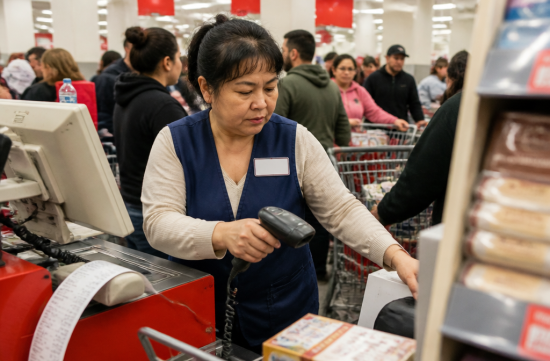
Thanksgiving is just over ten days away. This year, Thanksgiving falls on Thursday, November 26, and Black Friday is the very next day, Friday, November 27.
These days, when I meet people working in retail or restaurants, this topic always comes up. "If I work that day, I get time and a half, right?" they ask.
Recently, a friend of mine mentioned while drinking coffee that the manager posted a sign-up sheet for Black Friday shifts, and everyone raised their hands thinking they would get 1.5 times pay.
So I cautiously asked, "Is that written in the company handbook, or is it just something everyone thinks?" My friend's expression froze for a moment.
To get straight to the point, just because you work on Black Friday does not legally entitle you to 1.5 times pay.
The Fair Labor Standards Act (FLSA) does not require private companies to provide holiday pay premiums. The Department of Labor (DOL) also states that additional pay for holiday work is a matter of agreement between the employer and employee.
Even federal holidays like Thanksgiving Day or Christmas are the same. There is no obligation under federal law for private companies to give employees the day off or to pay more for working that day.
What about Texas? The state labor laws also do not have provisions requiring private employers to pay holiday pay. Essentially, it follows the federal standard.
Interestingly, the Texas Government Code lists the Friday after Thanksgiving as a state holiday. However, this applies only to state employees, so it does not affect those working in stores or malls.
So the thought that "Black Friday is a Texas holiday, so I should get paid extra" is only half correct. It is a holiday, but there may be no change in the paycheck for private sector employees.
So when do you get 1.5 times pay? The law guarantees only overtime pay.
If a non-exempt employee working hourly exceeds 40 hours in a week, the hours over 40 must be paid at 1.5 times the regular hourly rate. This is calculated on a weekly basis, regardless of the day.
During Thanksgiving week, shifts are often packed in stores. If you exceed 40 hours that week, whether from Black Friday or Wednesday, the extra hours will be paid at 1.5 times.
Conversely, even if you work 10 hours on Black Friday, if your total for the week is below 40 hours, there will be no overtime. Many people get confused here.
One more thing to keep in mind: the money a company pays for a paid holiday does not count as "worked hours."
For example, if you receive 8 hours of paid time off on Thanksgiving and then work 36 hours on other days, your paycheck may show 44 hours, but the overtime calculation will be based on 36 hours. Federal regulation 29 CFR 778.219 states that this paid holiday time cannot be counted as overtime.
That said, holiday pay is not entirely irrelevant. If a company promises holiday premiums in the handbook, offer letter, or union contract, that becomes a binding promise.
So I always say: look at the documents, not just the rumors.
First, check the employee handbook for sections on holiday pay or premium pay. Also, verify whether Black Friday is included in the company's designated holiday list.
Second, if the documents are unclear, email HR or your manager to ask. What you heard verbally, "They'll probably pay it," has no power later on.
Third, after your shift, keep a separate record of your clock-in and clock-out times. A note on your phone is sufficient. Getting into the habit of comparing your hours and pay rate when the paycheck comes out can be surprisingly helpful.
If you exceeded 40 hours but did not receive overtime, first request a correction from the company. If that doesn't resolve the issue, you can contact the federal Department of Labor's Wage and Hour Division.
If you are an exempt employee receiving a salary, the situation is different. There is no obligation for additional pay for working on holidays, but the company cannot reduce your weekly salary due to a holiday closure.
Honestly, I feel a bit upset about this point. People who postpone family dinners to work on the busiest day of the year deserve compensation, and it seems unfair that it relies solely on the goodwill of the company.
Some states have separate regulations regarding holiday work, and I hope there will be more discussions about this in Texas. I believe it is unfair to leave worker protection solely to employer discretion.
Still, reality is reality, so you need to do what you can now. Before raising your hand for a Black Friday shift, take a moment to open the handbook.
If you expect 1.5 times pay and then see your regular hourly rate on your paycheck, that disappointment can linger for quite a while. Knowing in advance allows you to make a choice without disappointment.
To everyone working on Black Friday this year, thank you for your hard work. Make sure to wear comfortable shoes, and enjoy a warm bowl of soup afterward.
 FastCurious
 iforever







 neroyo |

 American Food Information & Calories |

 Bald Eagle Brothers |

 sunny side |

 kodak |

 lorixa |
 orvian89 |

 US 210 Kim Sangsa |

 nexaro |

 Gupabal MissKorea |
 donggul donggul |
 korvix |
 Noodle Zin |
 Forever Tiger Teacher |
 strongman |
 U.S. Military Recruitment Information |
 |
 cherry cherry |
 Star Way |
 Pleasant K |
 Spaghetti Flying Religion |
 Texas Migration Story |
 Forever Coco is Bangga |
 nougat |
 coloradoman |
 Village Man |
 endone |
 Live and that's it |
 what gives |
 willow woo |