
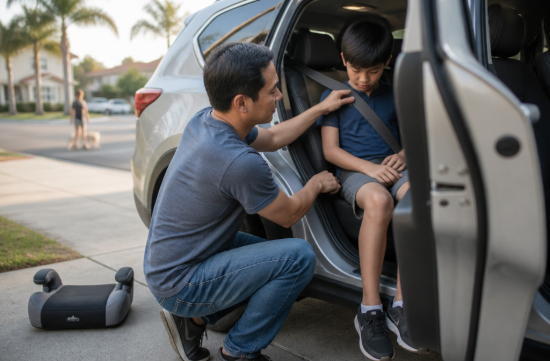
Starting January 1 of next year, California's seat belt standards will change. There are only about six weeks left, but surprisingly few people around me know about this.
Let me get straight to the point. Children aged 8 to under 16 must pass what is called the 5-step test to ride with just a seat belt.
The bill is named AB 435. Governor Gavin Newsom signed it in October 2025, and it will take effect on January 1, 2027. The bill's sponsor is Assemblymember Lori Wilson.
When this bill was first introduced, the reaction was quite loud. It included provisions like mandatory booster seats for children under 10 and a ban on front seat riding for those under 13. It's no surprise that there was significant backlash from parents.
Ultimately, those provisions were removed. The ban on small teenagers riding in the front seat also disappeared from the final version.
So, the rumor that "middle schoolers must use booster seats" is not true. The existing booster seat criteria remain unchanged. However, the criteria for transitioning to a seat belt have become much more specific.
To review the current standards: children must use a booster or car seat until they turn 8 or reach a height of 4 feet 9 inches.
The change comes in the next step. A child who graduates from a booster seat cannot simply wear a seat belt; it must fit their body properly.
The 5-step test is straightforward. The driver must answer "yes" to all five questions.
First, does the child's bottom and back rest completely against the seat back? If there is a gap between the back and the seat, they fail right there.
Second, do the knees bend naturally at the edge of the seat? If the legs are stretched out or the child has to scoot forward to bend their knees, they will not pass.
Third, does the shoulder belt cross over the collarbone and not the neck or arm? It's surprisingly common for kids to pull the belt under their arm because it scratches their neck.
Fourth, does the lap belt sit low on the thighs and not on the stomach? If the belt rides up over the stomach, the force in a crash will be directed toward the abdomen.
Fifth, can the child maintain this position throughout the ride? Honestly, I think this is the hardest requirement. On long drives, kids quickly twist their bodies and slide down.
If they answer "no" to any question, they are considered improperly secured. According to a report by CalMatters, in this case, the driver could receive a ticket and face a $490 fine.
$490 is not a small amount. It's quite a hefty price for a moment of forgetfulness. With that money, you could buy several booster seats.
One of my complaints is that the criteria are somewhat ambiguous for police officers to judge. How can they consistently determine if the knees are bending "naturally" from the road? It's practically impossible to check the lap belt position from outside a moving car.
If enforcement is inconsistent, it could lead to certain neighborhoods or specific drivers being pulled over more frequently. We've seen many instances where safety laws are enforced contrary to their intent.
Still, I believe the direction of the law is correct. Assessing whether the seat belt fits the body rather than the age is much closer to actual safety.
Adult seat belts are designed for adult body sizes. For smaller children, the lap belt can ride up over the stomach, and in an accident, the impact will directly hit that area.
So, rather than worrying about the fine, it's better to check in advance for your child's safety. Here's how I would approach it.
First, have your child sit in their usual spot in the parking lot. Go through the five questions one by one out loud, and it will take just five minutes. Taking a photo with your phone from the side will help show the belt position much better.
If you have multiple cars, check each one separately. Depending on whether it's a sedan or an SUV, and whether it's in the front row or third row, the results can vary. The depth of the seat and the height of the belt can differ, so a child might pass in one car but not in another.
Children aged 16 and older already fall under the general seat belt regulations. This law targets those in between, specifically children who have graduated from boosters but are still not fully grown.
If they fail any item, it's appropriate to bring the booster seat back out. Backless boosters are not too expensive.
If your car has an adjustable shoulder belt height, start by adjusting that. Sometimes, that alone can resolve the third requirement.
When you take your child for regular check-ups at the pediatrician, you can refer to their height records. Even if they exceed the height requirement, the results of the test can vary based on their seated height and leg length.
If you carpool, I recommend discussing this with other parents in advance. It can be awkward if you get a ticket while transporting someone else's child.
Finally, explain the reasons to your child. At this age, they might wonder why they are the only one using a booster seat when all their friends are just wearing seat belts.
I hope this law serves as a reminder for parents to check rather than just a tool for enforcement. Invest just five minutes on a weekend before January.
 GingerKart
 Squid Q








 Noodle Noodle |
 figtop |

 Toaster Pizza Magic Show |
 DO Main TODAY |

 Caribbean |

 San Gabriel Mountains |

 CA Real Estate |

 US Embassy |

 Lifestyle Information Search USA |
 donggul donggul |
 korvix |
 Noodle Zin |
 Forever Tiger Teacher |
 strongman |
 U.S. Military Recruitment Information |
 |
 cherry cherry |
 Star Way |
 Pleasant K |
 Spaghetti Flying Religion |
 Texas Migration Story |
 Forever Coco is Bangga |
 nougat |
 coloradoman |
 Village Man |
 endone |
 Live and that's it |
 what gives |
 willow woo |