
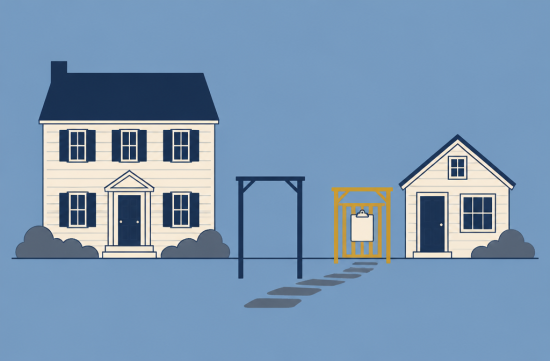
These days, I often hear a common question during consultations: "So, Massachusetts can build ADUs without permits now?" It's half true and half false.
To get straight to the point, the special permit process from the town has been eliminated. However, you still need to obtain a building permit.
The basis for this is the Affordable Homes Act passed by the state legislature in 2024, specifically Chapter 150 of the 2024 laws. This law changed the state zoning laws and took effect on February 2, 2025.
The detailed rules are found in the state regulation 760 CMR 71.00. It was first released at the end of January 2025, and as of November 2026, this regulation remains the basic framework.
The key point is that if you are in a zone where single-family homes are allowed, you can build one ADU by-right on a single lot. The state regulation refers to this as a Protected Use ADU.
There is also a size limit. The maximum size is either 900 square feet or half the size of the main dwelling, whichever is smaller.
For example, if the main dwelling is 1,600 square feet, then half of that, which is 800, is the limit. If the main dwelling is 2,400 square feet, it stops at 900. If it's an older Cape-style house, the limit might be smaller than expected.
The town can allow larger sizes, but it cannot restrict it to less than 900.
There are also several things the town can no longer impose. For instance, they cannot require that the homeowner live in either the main dwelling or the ADU.
The parking requirements have also been reduced. At most, only one space can be required, and if any part of the lot is within a half-mile radius of public transportation, off-street parking cannot be required.
These two changes are quite significant. Previously, many towns had residency requirements, making it difficult to add an ADU to investment properties.
So, what remains? Surprisingly, quite a bit.
First, there are building codes and fire codes. It is clearly stated in 760 CMR 71.00 that it does not replace state building codes (780 CMR) or other health and safety regulations. Therefore, you still need to go through the building department permit process.
Second, there is site plan review. This remains an item that towns can reasonably require.
Third, if the house uses a septic system, there is Title 5. It must meet Title 5 standards for single-family homes, and the state Department of Environmental Protection (MassDEP) issued guidance for ADUs in April 2025 and updated it once in September.
If the number of bedrooms increases, the septic capacity calculations may change. It's best to check with the Board of Health first.
Fourth, there are short-term rentals. The state has left this to the discretion of the towns. If you plan to rent the ADU on Airbnb, you need to check the town ordinances first.
What about Burlington? The town is working on aligning its regulations with state rules by presenting an amendment to the ADU ordinance at the town meeting warrant in January 2025.
A comparison document shows evidence of removing existing language that conflicts with state regulations. For the final wording, it's best to check directly with the Planning Department or town clerk records.
Here, two options emerge. You can either build a new accessory structure in the yard or renovate the basement or garage inside the house.
The accessory structure option offers better independence. When renting, both the tenant and the homeowner have less overlap. However, the costs for foundation work and utility connections can be significant.
The basement or garage renovation option uses the existing structure, so the scope of work is smaller. However, there can be issues with ceiling height, emergency exits, and fire safety standards.
Costs can vary widely depending on the house structure and contractor, making it hard to provide a single number. It's advisable to get estimates from at least two or three places under the same conditions for comparison.
There are also two purposes for the ADU. One is for family members, such as parents or adult children, to live in, and the other is for generating income through long-term rentals.
If it's for family living, the flow and privacy are more important than profit calculations. If it's for rental, the focus is on how quickly you can recoup the construction costs.
And one more thing: adding an ADU can increase property value, so property tax assessments may change. Be sure to include this in your return calculations.
If I were a homeowner, I would approach it this way. First, I would check the size of the main dwelling to determine if the limit is 900 or smaller.
Next, I would confirm whether it's a sewer or septic system, and if it's septic, I would contact the Board of Health first. Then, I would meet with a designer and finally submit the building permit.
If you take the phrase "without permits" at face value and start construction immediately, you could run into trouble. Unpermitted expansions will show up during inspections when you sell the house later. Fixing it then will be much more costly in terms of both time and money.
In summary, the threshold has indeed been lowered. However, remember that the only thing that has been eliminated is the special permit, while codes and permits remain in place.
 BlueOcean
 GoldenCore74





 B.I.G. Victor |

 Amber H |
 uplifted |

 Dr. Kelso |

 silents |

 walnutbo |

 almondo |

 nougat |


 donggul donggul |
 korvix |
 Noodle Zin |
 Forever Tiger Teacher |
 strongman |
 U.S. Military Recruitment Information |
 |
 cherry cherry |
 Star Way |
 Pleasant K |
 Spaghetti Flying Religion |
 Texas Migration Story |
 Forever Coco is Bangga |
 coloradoman |
 Village Man |
 endone |
 Live and that's it |
 what gives |
 willow woo |