
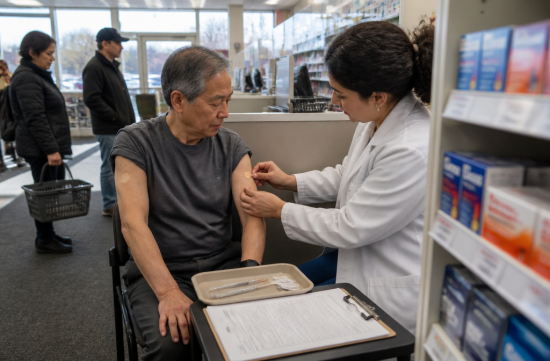
Last weekend, I happened to overhear a conversation between an elderly gentleman and a pharmacist while visiting a local pharmacy. He asked, "Is it okay to get the flu shot and the COVID vaccine on the same day, or should I wait about two weeks?"
The pharmacist smiled and replied that it is fine to get them on the same day, but suggested getting them in different arms. That brief exchange stuck with me longer than I expected.
In fact, until a few years ago, I held a similar belief. I thought you should only get one shot at a time, as the body needs time to rest.
Those who grew up in Korea seem to have even more caution about this. So today, I want to properly address this question.
To get straight to the point, the CDC does not require a minimum interval between the flu vaccine and the COVID vaccine. If you are eligible for both vaccines, it is possible to receive them together in one visit.
The guidelines from the American Academy of Family Physicians (AAFP) for the 2026-2027 season also support this. They state that the flu, COVID, and RSV vaccines can be administered together during the same appointment, with no minimum interval required.
So, is it really okay? A study published on June 30 in the medical journal Annals of Internal Medicine by the Department of Veterans Affairs (VA) provides quite a specific answer.
The researchers compared records of 705,124 individuals who received both vaccines on the same day with 1,813,205 individuals who only received the flu vaccine. They tracked over 46 adverse reactions for 90 days post-vaccination.
When categorized into serious or life-threatening reactions, clinically significant reactions, and mild reactions, none of the groups showed an increased risk. The results indicated almost no difference in numbers.
Honestly, I was a bit surprised by the scale of this study. Given that it involved hundreds of thousands of people, I believe it provides a much more reliable basis than vague concerns.
That said, it doesn't mean there are no side effects. According to CDC data, when receiving both vaccines together, mild reactions like fatigue, headaches, and muscle aches may occur slightly more often.
Most of these symptoms resolve within a day or two. Therefore, many pharmacists recommend getting vaccinated the evening before an important event or on the weekend.
It's also good to remember the injection sites. When receiving multiple vaccines at once, the principle is to administer them in different areas, typically one in each arm.
If you must receive both shots in the same arm, there is guidance to keep them at least one inch apart. Pharmacies usually handle this, but if one arm is uncomfortable, you can let them know in advance.
One thing to note is that the recommendations for the COVID vaccine have changed significantly since last year.
The Advisory Committee on Immunization Practices (ACIP) changed the COVID vaccine recommendations in September 2025 to allow for individual clinical judgment, meaning decisions should be made in consultation with healthcare providers. This is different from the previous blanket recommendations for everyone.
On the other hand, the flu vaccine is still recommended annually for everyone aged six months and older. The CDC suggests getting vaccinated by the end of October, but advises that it's acceptable to get vaccinated later while flu activity is ongoing.
For those aged 65 and older, high-dose, recombinant, or adjuvanted flu vaccines are prioritized. If you are taking your parents, be sure to check this with the pharmacist.
Ultimately, the decision to get vaccinated on the same day is more about convenience and personal condition than safety. Personally, I would prefer to avoid the hassle of two trips to the pharmacy and get it done in one visit.
However, those with underlying health conditions, a history of severe vaccine reactions, or multiple medications may have different considerations. In such cases, it's essential to consult with your doctor or pharmacist before making a decision.
It's also necessary to check insurance coverage. Since the COVID vaccine is now administered based on consultation, procedures may vary by pharmacy, so asking during the appointment scheduling can save time.
As I discuss this, I am reminded of the differences between Korea and the U.S. In Korea, it's common to see a doctor face-to-face at a health center or local clinic, while here, it's common to get vaccinated at a pharmacy inside a grocery store.
Initially, many felt uneasy about this casual approach. However, looking back, it can be an advantage that pharmacists serve as the closest point of consultation.
That day, the elderly gentleman at the pharmacy ended up getting one shot in each arm. As he left, he remarked, "That wasn't as bad as I thought," and he looked quite relaxed.
His simple question about his concerns helped alleviate his worries. I was reminded that information gains power when it is shared between people.
If you have family or neighbors who are still hesitant about getting vaccinated, why not casually discuss this topic today? Rather than pushing for answers, suggesting that you explore the information together might build a stronger bridge.
Are you considering getting both vaccines at once this winter, or do you plan to space them out? It might be worth reflecting on the reasons behind your choice.
 AscanMovie
 Pointy





 fruitflash |

 Anjollinya Blog |

 United States Army |

 premium |

 The Emperor Must Grow |

 refresh |

 ansdal |

 fantastic |


 werehere |
 donggul donggul |
 korvix |
 Noodle Zin |
 Forever Tiger Teacher |
 strongman |
 U.S. Military Recruitment Information |
 |
 cherry cherry |
 Star Way |
 Pleasant K |
 Spaghetti Flying Religion |
 Texas Migration Story |
 Forever Coco is Bangga |
 nougat |
 coloradoman |
 Village Man |
 endone |
 Live and that's it |
 what gives |
 willow woo |