

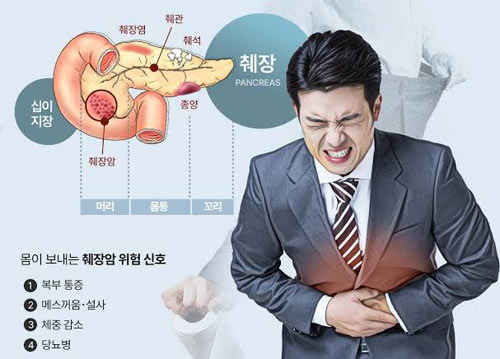
When it comes to cancer, people tend to be particularly fearful of pancreatic cancer. Many often say, "Isn't it too late once pancreatic cancer is detected?"
Of course, there are people who are diagnosed early and receive surgery and treatment. However, it is a clear fact that early detection is more difficult compared to other cancers.
The main reason is the location of the pancreas.
The pancreas is not located at the front of the abdomen; rather, it is situated behind the stomach, deep within the abdomen. It can be understood as being hidden among organs like the liver, stomach, and duodenum.
Therefore, even if a small tumor forms, it cannot be felt from the outside, and there are no clear symptoms from the early stages.
The second reason is that the early symptoms are either very mild or quite vague.
It may start with slight discomfort in the stomach, poor digestion, decreased appetite, or fatigue. These symptoms are something anyone might experience as they age.
"Why has my digestion been off lately?"
People might easily take digestive aids and move on.
The problem arises with the symptoms that appear as the tumor grows. If a tumor forms in the head of the pancreas and blocks the bile duct, jaundice may occur, causing the skin and eyes to turn yellow. The color of urine may darken, or the color of stool may lighten.
Some people may experience weight loss for no apparent reason or pain in the abdomen and back.
However, when these symptoms appear, it is often the case that the cancer has progressed to a certain extent.
Another reason is the metastatic nature of pancreatic cancer.
There are many important blood vessels and lymphatic vessels around the pancreas. If cancer cells invade surrounding tissues or blood vessels, or metastasize to other organs like the liver, peritoneum, or lungs, the range of possible surgical intervention is greatly reduced.
This is why surgery is crucial in the treatment of pancreatic cancer.
If the cancer is confined to the pancreas, has not severely invaded important blood vessels, and has not metastasized to other organs, surgery may be considered. However, there are many patients for whom surgery is difficult from the time of initial diagnosis.
So, one might think, why not just get a health check-up every year?
There are challenges here as well.
For colorectal cancer, there is a colonoscopy, and for breast cancer, there is a mammogram. However, there is currently no universally proven screening test that can be easily performed on asymptomatic individuals to reduce the mortality rate of pancreatic cancer.
It is also difficult to consistently detect small pancreatic cancers with just a standard abdominal ultrasound. This is because the pancreas is located deep within the abdomen and can be obscured by intestinal gas, among other factors.
That said, it doesn't mean that nothing can be done.
Individuals at high risk for pancreatic cancer due to family history or specific genetic risk factors may consider regular follow-up with a specialist using tests like MRI/MRCP or endoscopic ultrasound.
Additionally, if jaundice suddenly appears, or if there is unexplained weight loss, persistent upper abdominal or back pain, or ongoing gastrointestinal symptoms that are different from before, it is advisable not to dismiss these as just aging. If new diabetes develops or existing diabetes suddenly worsens, and other symptoms or risk factors are present, a doctor may consider further evaluation.
The real reason pancreatic cancer is frightening is not that it suddenly appears one day.
It can grow for a significant period without giving any clear signals deep within the body, and by the time we notice those signals, it is more likely to have progressed to surrounding areas compared to other cancers.
Therefore, in the case of pancreatic cancer, it is much more important to be aware of the risk factors and to seek medical attention promptly when there are persistent changes that differ from the norm, rather than being vaguely fearful.
 GoldenPath73
 popskytraveler1976
 HedgehogToot





 Tora Tora |
 neroyo |
 nivex85 |
 Old English |
 nixxon |
 yentra |
 Virginia Butterfly Mom |
 Kondae Garusong Blog |
 Atlanta Mama |
  Baguette Blog |
  US Embassy |
  Korean Mom |
  My NYC |
  moo moo |
  Mr Oh |
  forevergee |
  festival |
  manchester |
  constant |
  Leapfrog Move |
  vibranto |
  yellowbutter |
  Dolly |
  NYC saladbar |
  Finding Superfoods |
  lightyear |
  song bang |