

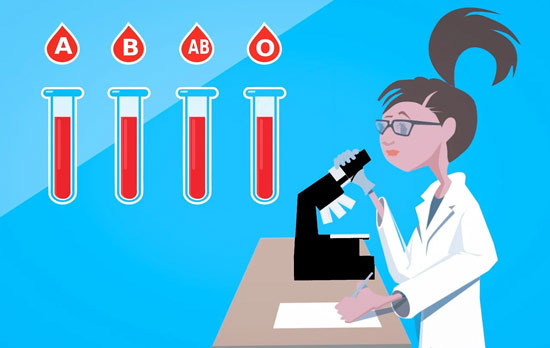
If you're Korean, you might remember being asked this question at least once: "What's your blood type?"
It was a question that came up as naturally as asking about hobbies when meeting someone for the first time.
And the follow-up comment was almost always the same: "Oh, you're type A. That makes sense."
Or, "You're type B, so you must be a free spirit." Something along those lines.
The blood types we commonly know actually originated from medical classifications.
A person's blood is categorized based on the antigens present on the surface of their red blood cells.
This blood type is crucial when receiving a transfusion at a hospital.
Transfusing incompatible blood can lead to serious complications.
The issue begins here. At some point, this medical classification of blood types started to be linked with personality traits.
Type A is meticulous, type B is self-centered, type O has leadership qualities, and type AB is unique, among other claims.
At one time, these ideas were almost common knowledge.
Especially in Korea and Japan, the belief in blood type personality theory was quite popular for a long time.
In Japan, there were even bestsellers explaining personality traits based on blood types.
TV programs would often feature segments analyzing celebrities' personalities according to their blood types.
In Korea, friends would casually joke, "You're type B, right?"
However, as time passed, many in the younger generation have come to doubt this blood type personality theory.
The reason is that it has been repeatedly shown to lack scientific basis.
Psychological studies have found no evidence of a meaningful correlation between blood type and personality.
Nowadays, when people in their 20s or early 30s hear about blood types, they often take it as a joke.
They might say, "Isn't that an old tale?" and not think much of it.
Instead, the more reliable MBTI personality tests have gained popularity, pushing the blood type personality theory to the background.
Interestingly, the blood type itself remains very important medical information.
Hospitals still accurately check ABO and Rh blood types during transfusions.
Blood type information is also basic data in organ transplants and emergency medical situations.
In other words, while blood types are medically significant, linking them to personality traits is generally seen as scientifically meaningless today.
Of course, that doesn't mean the blood type personality stories have completely disappeared.
They are still sometimes mentioned lightly as jokes.
They remain a topic of conversation among friends or on dates, but the belief in them has certainly diminished. It's more like discussing zodiac signs for fun.
Thinking about it, this phenomenon could be a reflection of changing times.
As access to the internet and information has increased, people are more likely to ask, "Is this really true?"







 hot chocolate |
 Chichiki Chicago Train |
 Noodle Noodle |
 Twist Kim |
 U.S. Weather Bureau News |
 parlon |
 SODA MAKER |

 yentra |
 Key spots |
  berrypup |
  Yo Lock Me Up |
  Oh my Julia |
  bibigoo |
  silents |
  Team Korea Psychoanalysis Research |
  North Dakota Ragdoll Cat Owner |
  El Dorado |
  Cap Com |
  Trot King News |
  Blondee |
  some fame |
  rapidfire |
  walnutbo |
  Shinbaram Dr. Blog |
  breaddough |
  Michigan Enthusiast |
  Only Dentalbay |
  postcard |