
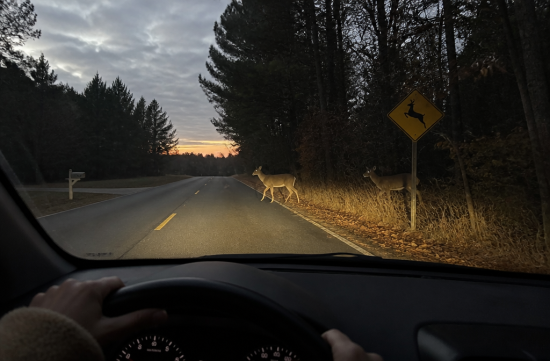
Last week, I turned onto a country road on my way home from work, and a deer suddenly jumped out from the grass on the shoulder. After hitting the brakes, my heart was racing for a while. But what really shocked me was what happened next.
As the first deer passed, two more followed right behind it. I shuddered at the thought of what could have happened if I had only seen the first one and pressed the gas. So this time, I made sure to look up the numbers.
According to the latest analysis from State Farm, from July 2025 to June 2026, the probability of a driver in the U.S. colliding with an animal is 1 in 145. During the same period, there were over 1.6 million animal collision insurance claims.
Deer are by far the most common type of animal involved. The months with the highest number of collisions are November, October, and December. This means we are right in the middle of the season.
Data from IIHS tells a similar story. HLDI analyzed claims from 2013 to 2022 and found that the rate of animal collision claims in November was more than double the annual average.
So why is it particularly in the fall? The answer is rut, which is deer mating season. Males are chasing females, causing them to move around much more and with less caution than usual.
On top of that, hunting season overlaps. As more people enter the woods, deer tend to scatter and often end up on the roads.
However, Alabama has a slightly different situation. According to state government data, the rut timing varies quite a bit by region. In the southwestern D and E zones, it occurs from mid-November to early December, while most of zone B runs from late January to early February.
As a result, actual accident numbers are concentrated in the winter. According to ALEA data, there were 1,652 wildlife collision incidents reported by state police in 2024.
Looking at it by month, January had the highest number at 328 incidents, followed by December with 288, and November with 177. Honestly, I was surprised by this. I thought it would be over after December based on national statistics.
The conclusion is simple. In Alabama, you can't let your guard down from October through January. You can check which zone your area is in on the ADCNR Rut Map.
Speaking of timing, daylight saving time ends on Sunday, November 1. Starting the following week, it will suddenly get dark earlier after work.
The times when deer are most active are at dusk and dawn. IIHS also notes that animal collision fatalities tend to occur on country roads, roads with speed limits over 55 miles per hour, and during darkness or at dusk and dawn.
So how should you drive? I'll summarize what ALEA and State Farm emphasize, combined with my own experience.
First, if you see one deer, assume there are more. Deer often travel in groups. If you, like me, only notice the first one and feel relieved, it could lead to a serious accident.
Second, if there are no cars in front of you, use your high beams actively. If you see eyes shining from a distance, you can slow down much earlier. If there's an oncoming car, dim your lights immediately, as a matter of course.
Third, this is the most important. If you feel you can't avoid a collision, don't swerve the steering wheel; instead, brake hard while keeping your lane.
Your instinct might be to turn the wheel. But if you swerve suddenly, you could hit an oncoming car or a tree, or even flip your vehicle. That is much more dangerous than hitting a deer.
Fourth, if you have room to avoid a collision, slow down while honking your horn and gently tapping the brakes to signal to the car behind you. If there's no one behind you, it's okay to brake hard.
Fifth, obey the speed limit and always wear your seatbelt. ALEA states that wearing a seatbelt is the most effective way to reduce injuries.
By the way, you know those deer whistles you attach to your car? State Farm says there's no scientific evidence for their effectiveness. If you let your guard down believing in that to save a few bucks, it could backfire.
If you do hit a deer, first pull your car to a safe place and call 911. Having a police accident report will make insurance claims easier.
Don't just drive off if your car seems fine. According to ALEA, if you drive without realizing oil is leaking after a collision, your engine could overheat or stall, leading to much higher repair costs.
Avoid getting too close to an injured deer. You can't predict how an injured animal will react.
Also, check your insurance now. Deer collisions are usually handled under comprehensive coverage, not collision. ALEA warned that if you don't have comprehensive coverage, you might not get reimbursed for repairs to your car.
It's also good to check how much your deductible is. The exact coverage varies by company and plan, so it's best to ask your agent directly.
This season, I've decided to completely avoid driving on country roads at dusk and to leave for work a little earlier. Leaving 10 minutes earlier is much cheaper than thousands of dollars in repair costs.
In sports, critical moments often occur in the fourth quarter when focus tends to drop. During the fourth quarter of the day, which is dusk, let's put down our phones and focus on the road. Everyone drive safely!
 BobIsBrown


 Baguette Blog |
 Khan Film Blog Production |
 dermoon |
 hoosierdaddy |
 sun walker |
 GOGO SING |
 Samsung My My |
 Montgomery Mom |
 Alabama Bang |
 Mrs. Duluth |
  jaxter |
  Atlanta Mama |
  US Embassy |
  Korean Mom |
  My NYC |
  moo moo |
  Mr Oh |
  forevergee |
  festival |
  manchester |
  constant |
  Leapfrog Move |
  vibranto |
  Tora Tora |
  yellowbutter |
  Dolly |
  NYC saladbar |
  Finding Superfoods |