
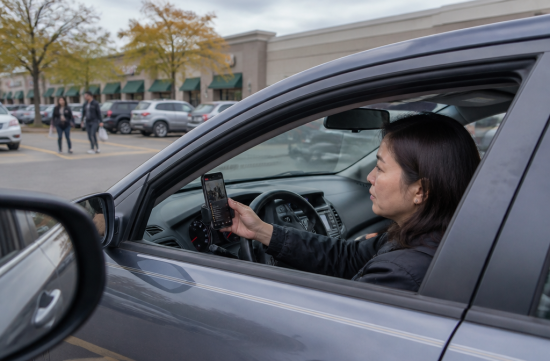
A few days ago, I saw a car at a traffic signal on Franconia Road with a phone mounted vertically in the driver's seat, and comments were scrolling up on the screen.
The driver was live streaming while driving. When the light changed, that car disappeared onto the 495. The driver seemed to be engaged in conversation with viewers on the screen.
Seeing that scene reminded me that, as of July 1 of this year, this has officially become illegal in Virginia.
The law is called House Bill 320, introduced by Delegate Joshua Cole from the Fredericksburg district.
Governor Spanberger signed it, and it became Law 1047 in 2026, included in Virginia Traffic Code 46.2-818.3.
The details are more specific than you might think. It prohibits anyone driving a moving vehicle on Virginia roads from starting or participating in a live stream, or interacting with a device to engage with a live stream. This includes tapping the screen to respond to comments.
Touching the device to keep the live stream going is also separately prohibited. It's best to set it up before you start driving and not touch it at all.
The live stream referred to here means broadcasting real-time video or audio on social media platforms.
So, Instagram Live, TikTok Live, and YouTube Live all fall under this definition.
On the other hand, video calls or video conferencing apps are excluded from this definition. This means that joining a Zoom meeting during your commute is not subject to this provision. It seems the law intentionally draws a line here.
However, that doesn't mean you can relax. Virginia has already prohibited holding a cellphone while driving since 2021.
This handheld ban is under section 46.2-818.2, with a first offense costing $125 and subsequent offenses $250. If caught in a construction zone, even the first offense incurs a mandatory $250 fine. So, if you're holding your phone for a video call, you could be subject to this provision.
The penalties for the live streaming ban are even stricter. The first offense can result in a fine of up to $500.
From the second offense onward, your license can be suspended for 30 days, and for the third offense and beyond, it can be suspended for 90 days. There are cases where a restricted license may be allowed at the court's discretion.
If an accident occurs during a live stream, an additional fine of up to $500 may be added.
Honestly, I was a bit surprised when I first read that it could lead to license suspension. I was only thinking about fines, but in a place where commuting is entirely by car, a 30-day suspension means life comes to a halt. You would have to rely on others for picking up kids, grocery shopping, and commuting to work.
However, there is an interesting caveat in this law. Police cannot pull you over solely for live streaming.
Any evidence obtained from such a stop cannot be used in any proceedings, as stated in the law. This is essentially a second violation type.
Delegate Cole explained that this provision was included to prevent pretextual stops. However, it would be a mistake to see it as a loophole.
A state police official mentioned that if a fatal accident occurs and a friend says that the scene was posted online, they can obtain a warrant afterward to address it.
When you think about it, live streaming is a broadcast that leaves a record. You are essentially creating evidence in real-time, making it difficult to avoid. Even if you delete it, someone may have recorded the screen.
There are also clear exceptions. Live streaming for emergency situations or to report a crime is not subject to this provision.
Devices that only record without broadcasting in real-time, like dash cams, are also fine. The same goes for safety recording systems installed in company vehicles.
Additionally, the law explicitly states that it does not grant police the authority to search your phone without a warrant.
On the other hand, some voices express disappointment. They point out that the law does not address FaceTime or watching movies while driving, indicating a narrow scope.
Compared to states like New York or South Carolina, which broadly encompass all cellphone use, Virginia's approach is indeed quite unique.
I believe this level of regulation is more realistic. It targets problematic behavior while reducing the potential for abuse of enforcement.
There are quite a few Korean restaurants, real estate agents, and insurance professionals in Annandale and Centreville who promote their businesses through social media live streams. Since cars are quiet, it's common for them to go live while on the move.
If you have a habit of going live while on the move, it's best to park your car first. This law only applies when you are driving a moving vehicle. Leaving five minutes earlier can solve the issue.
Personally, I would put my phone on do not disturb mode the moment I get in the car. A peaceful commute is worth much more than a $500 fine.
 googleidea


 road98 |
 Baguette Blog |
 Khan Film Blog Production |
 dermoon |
 hoosierdaddy |
 Tesla X |

 tervox95 |
 virex |
 Next Year, Let's Become Rich |
 Kondae Garusong Blog |
  Good Good |
  berion88 |
  bravo777 |
  skyblue |
  Project Tomorrow |
  apricotla |
  Soy Angelino |
  nati8 |
  NE Hodori Preik |
  washington mom |
  celtics |
  Balancework |
  round1 |
  Way to easy |
  musicque |
  Churros Train Conductor |
  gleeful |
  Burbank Lee |
  Olivia's Blog |