
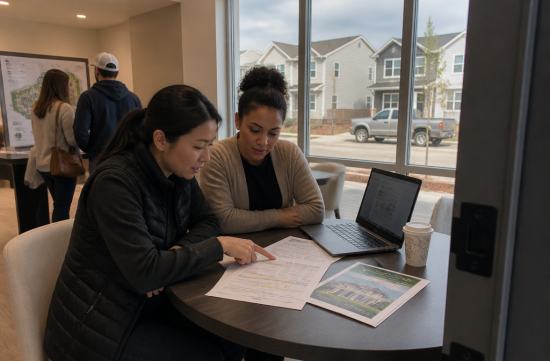
As of October 8, according to Freddie Mac, the average 30-year fixed mortgage rate has risen to 7.40%. However, if you look at advertisements for new construction developments, you'll see rates prominently displayed in the 3% and 4% range.
The reason for this significant difference in rates within the same market is primarily due to buy-downs, where builders pay to lower the interest rates. Today, we will calculate the actual value of this benefit in numerical terms.
To start, according to a September survey by the National Association of Home Builders (NAHB), 66% of builders were using incentives, an increase from 63% in August. Additionally, 38% of them directly reduced prices, with an average reduction of 6%.
Data from Realtor.com analyzing new listings in August showed that 13.8% of the properties advertised interest rate reductions, with an average advertised rate of 3.92%. This is more than 3 percentage points lower than the market average, making it hard to ignore. However, this average includes some temporary low rates and adjustable rates.
The Savannah area is also showing a favorable trend for buyers. According to Redfin's first-half data, the median sale price in the metro area is $362,419, down 3.3% from a year ago, and inventory has increased to 5.6 months' worth.
Now, let's break down the types of buy-downs. There are two main types: temporary buy-downs and permanent buy-downs.
The most common temporary buy-down is the 2-1 buy-down. In the first year, the rate is reduced by 2 percentage points, in the second year by 1 percentage point, and from the third year onward, it returns to the original rate.
A permanent buy-down involves the builder purchasing discount points to lower the rate for the entire loan term. The advertised fixed rates in the 5% range typically fall into this category.
For calculation purposes, let's assume a loan amount of $350,000, a 30-year fixed mortgage, and an original rate of 7.40%. In this case, the monthly payment for principal and interest would be $2,423.
If you receive a 2-1 buy-down, the first year's rate would be 5.40%, resulting in a monthly payment of $1,965, and in the second year, the rate would be 6.40%, leading to a monthly payment of $2,189. This means a savings of $458 in the first year and $234 in the second year.
When you add up the savings over the two years, it totals $8,304. The builder essentially sets aside this amount in advance to cover the difference, which represents the actual value of the 2-1 benefit.
From the third year onward, you will need to pay the full $2,423. Therefore, mortgage underwriting is typically based on the original rate, so you need to ensure you can handle that payment amount.
If the permanent buy-down brings the rate down to 5.99%, the monthly payment would be $2,096, saving $327 per month, or $3,926 per year. This benefit continues as long as you maintain the loan, making it significantly more advantageous for long-term ownership.
So how does this compare to a price reduction? If we reduce the home price by $20,000 under the same conditions, the loan amount would be $330,000, resulting in a monthly payment of $2,285 at the 7.40% rate, which is a reduction of $138.
Looking at the numbers, the interest rate benefit is much stronger than a price reduction when it comes to lowering monthly payments. This is definitely an advantage.
However, a price reduction also lowers property tax assessments, down payment amounts, and the baseline for future sales, which is a benefit that interest rate reductions do not provide.
Another point to consider is refinancing. If interest rates drop significantly in the future and you refinance, the lower rate obtained through a permanent buy-down may lose its significance at that time.
Therefore, if you plan to switch loans within a few years, the value of a permanent buy-down may be less than expected. Conversely, if you intend to hold onto the home for a long time, a permanent buy-down is definitely the better option.
Builder incentives usually come with conditions. The most common requirement is that you must use affiliated or designated lenders.
If the fees or base rates of the designated lenders are higher than those of outside lenders, some of the benefits may be offset. Therefore, it is advisable to obtain quotes from external lenders under the same conditions for comparison.
The Consumer Financial Protection Bureau (CFPB) recommends comparing rates, APRs, and fees from at least three lenders. Multiple mortgage credit inquiries within 45 days count as a single inquiry, so you don't need to worry too much about that.
Make sure to get estimates in the form of loan estimates. By placing the rates, monthly payments, and point amounts for fees side by side on the first page, you can easily see who is charging what.
It's also important to check the contract price. Compare it with similar resale homes or previous transactions in the same development to ensure that the cost of the benefits is not added to the home price.
It's a good idea to prepare questions to ask the builder. Find out if the rate is temporary or permanent, what it will be in a few years, and whether the same funds can be redirected to a price reduction or closing costs, and get it in writing.
In my opinion, for those with tight cash flow in the first two years, a 2-1 buy-down can provide some relief. However, if you can't handle the payment in the third year, that's not a benefit but rather a deferred burden.
If you plan to stay in the home for a long time, a permanent buy-down is preferable, while if you're looking to refinance within a few years, it's more rational to consider price reductions or closing cost assistance first. Which option is best depends on your holding period and income plans.
Deciding based solely on the advertised interest rate can lead to significant differences. It's not too late to compare the same amount across three different methods and review the results in a table before signing.
 HoneyFlower






 moo moo |
 ultron78 |
 garlic bread |

 urbanmint |
 Golden life |
 savannah choi |
 Let's Be Like a Salt-like City Person |
 InJung Gu |
  bravo777 |
  berion88 |
  skyblue |
  Project Tomorrow |
  apricotla |
  Soy Angelino |
  nati8 |
  NE Hodori Preik |
  washington mom |
  celtics |
  Balancework |
  round1 |
  Way to easy |
  musicque |
  road98 |
  Churros Train Conductor |
  gleeful |
  Burbank Lee |
  Olivia's Blog |
  Bushing Around Life |