
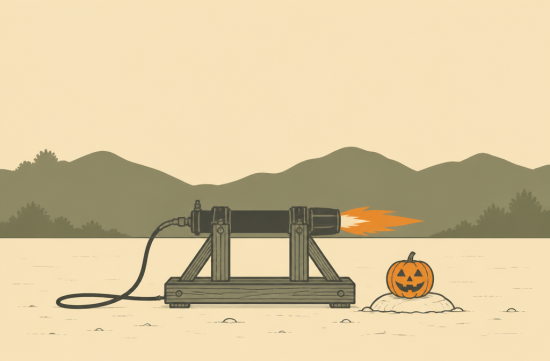
As you read news from Pasadena at the end of October, you often come across a sentence like this: "JPL celebrates its birthday on Halloween." When I first saw it, I thought it was just a clever promotional phrase.
However, upon further investigation, I found out it's not a joke. NASA's Jet Propulsion Laboratory, abbreviated as JPL, indeed considers October 31, 1936, as its starting point.
Since this year is 2026, this Halloween marks its 90th birthday. So today, I will gradually explore why it falls on Halloween and what happened on that day.
Let's start with the location. To the west of Pasadena, there is a dry canyon called Arroyo Seco. In Spanish, it means "dry creek," and it's mostly just dirt except when it rains.
On Halloween in 1936, graduate students from Caltech's Guggenheim Aeronautical Laboratory and their friends took equipment down to this canyon. Their goal was to ignite a rocket motor they had built themselves.
The central figure was Frank Malina. He was a graduate student studying under the famous aerodynamicist Theodore von Karman.
Joining them were self-taught rocket enthusiasts Jack Parsons and Edward Forman, who had no formal scientific education. The combination of a theoretical graduate student and hands-on amateurs makes for quite an interesting team.
The commemorative plaque erected at the site also lists names like Apollo M.O. Smith and William Boland. However, the exact number of people present that day varies across sources, so I prefer to remember it as "about five or six young team members."
The experiment itself wasn't a clean success. They were using a motor that burned gaseous oxygen and methyl alcohol, but the ignition device failed to work a few times at first.
According to JPL historians, they finally got a flame on the fourth attempt. However, at that moment, the oxygen line came loose, spewing fire and causing everyone to flee in panic.
Honestly, I laughed when I read this part. The first day of the lab that now lands rovers on Mars involved running away from a flaming hose.
This team also earned a nickname on campus. They had several explosions while experimenting inside campus buildings, even embedding pieces of instruments into the lab walls.
As a result, people referred to this group as the "Suicide Squad." Ultimately, their experiments were pushed out to Arroyo Seco, away from people.
This raises a question: why did they choose to mark the day of an experiment without an official organization as their birthday?
In my opinion, the reason is quite clear. This day marks when they first tested a rocket engine on the ground, and all subsequent organizations stemmed from this team.
Following the timeline on the plaque, it goes like this: In 1937, the Caltech Rocket Research Project was established, government support began in 1939, and by around 1944, it became known as the Jet Propulsion Laboratory.
For reference, JPL's official history states that this name was first used in a proposal in 1943, and Army support began in 1944. So, saying it was "established in 1944" isn't incorrect either.
People often ask why they chose the term "jet." At the time, the word "rocket" was considered science fiction, so they opted for "jet propulsion" to appear more serious in their research.
The subsequent history is what we know as JPL. In 1958, they created the United States' first artificial satellite, Explorer 1, and in December of that same year, they moved under NASA, which had just been formed from the Army.
Today, operations are still managed by Caltech under a contract with NASA. It's a unique structure where a government lab is run by a university, and understanding that it all began with graduate students experimenting in a canyon makes it easier to grasp.
Interestingly, the location of the lab is right near Arroyo Seco, at the foot of the mountains. It's as if they are still situated next to the canyon where they once fled 90 years ago.
While the address includes Pasadena, technically, most of the campus is located in the neighboring La Cañada Flintridge. It's amusing to see local residents subtly bicker about this.
So for JPL employees, Halloween is not just a day for trick-or-treating. Every year around this time, engineers are known for holding a pumpkin carving contest, making it feel like a birthday party and a fun tradition.
One thing that continues to resonate with me from this story is that the beginning of a great institution was not marked by a grand groundbreaking ceremony, but rather by a day of failures, laughter, and trying again.
Of course, there's another perspective. Jack Parsons has been quietly omitted from official history for a long time due to his personal life and occult activities, so there are critiques about romanticizing this myth too much.
I agree with that sentiment. However, I believe the most fair approach is to acknowledge a person's flaws while recognizing the results of that day's experiment as they are.
If you happen to be near Pasadena this Halloween, take a stroll by Arroyo Seco after the kids finish trick-or-treating. Even if you can't enter the lab, you can still feel the same air of that canyon from 90 years ago.
I would probably hold my child's hand and say, "This is where the journey to Mars began." That story might stick in their memory longer than candy.
 Worldone







 Twist Kim |

 U.S. Weather Bureau News |

 Community Cross |
 Conflite Teacher |

 SEVEN SEVEN |

 Cali M Law Group |


 Olivia's Blog |

 Various Knowledge and Information in the USA |

 dance dance |
 sweetpepe |
 vegas mom |
 cathywhite |
 heartbreaker |
 Giant Squid and Sweet Potato Soup |
 Valley Hong |
 The Gelaton |
 berlon93 |
 Physical Laws and Science |
 good thinking |
 Solo Yolo |
 Mr Oh |
 laro90 |
 San Diego TOP Idol |
 Round and Round Children's Song Kingdom |
 American Golf Course Travelogue |
 MEDBIO American Doctor Blog |