

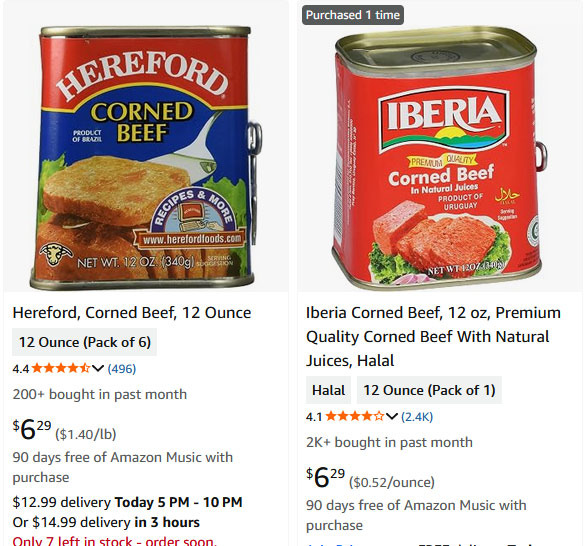
Having lived in the U.S. for a long time, it frustrates me when foods that used to be cheap become expensive products.
Big Macs, rice, meat, and even canned goods like Spam.
In 2016, at a 99-cent store in LA, a 12-ounce can of Iberia corned beef was $1.99.
At that time, it had a strong image as a cheaper canned meat compared to Spam made from pork.
It was a bit greasy, but when cooked, it tasted somewhat like ham, making it quite palatable.
However, as of 2026, the price of corned beef sold in the U.S. is about $6 per can.
That's an increase from $1.99 to $6, which is a whopping 200% rise.
Interestingly, Spam made in the U.S. was also sold for $2 to $3 ten years ago, and it still retails for around $2 to $3 at big box stores today.
Of course, we can't directly compare discounted prices to regular retail prices, but it's clear that the price increase for corned beef feels particularly significant.
So why has corned beef become so expensive?
The first reason is that the export price of Brazilian beef has risen.
In the past, Brazil had a competitive edge due to low labor costs and vast pastures, but recently, countries around the world, including China, have been importing large quantities of Brazilian beef.
According to trade statistics from the Brazilian government, the average export price of beef from January to September 2016 was about $3,960 per ton, while during the same period in 2026, it rose to about $6,137.
This is an increase of about 55%. Of course, this is the average export price for all Brazilian beef, not the factory price for corned beef cans.
Still, it shows important changes in the raw materials market.
The second reason is U.S. import tariffs and trade policies.
The U.S. has applied a tariff system based on the quantity of Brazilian beef imported. If a certain quantity is exceeded, higher tariffs are imposed.
The U.S. Department of Agriculture explains that this system affects the competitiveness of Brazilian beef exports to the U.S.
Additionally, due to trade conflicts between the U.S. and Brazil in 2025, additional tariffs were introduced, increasing the cost burden and uncertainty for importers.
However, the tariffs applied to regular beef do not necessarily apply to corned beef cans, so tariffs alone cannot explain the price increase of Iberia.
The third reason is transportation costs and distribution expenses within the U.S.
For corned beef produced in Brazil to reach the shelves of stores in LA, it goes through several stages.
Canned goods are produced at local factories, transported to ports, and then shipped to the U.S. Once in the U.S., they go through customs, warehousing, and wholesale delivery before being sold at retail stores.
Over the past ten years, international shipping costs have fluctuated significantly, and labor and warehousing costs in the U.S. have also risen.
Especially for imported foods with relatively low sales volumes, it is difficult to spread these costs as easily as for high-volume products.
So why is Spam made in the U.S. relatively stable in price?
Spam has been a popular brand in the U.S. market for a long time.
It has large production and distribution scales and is consistently sold through major retailers like Walmart, Costco, and Sam's Club.
In contrast, the price of Iberia corned beef can vary significantly depending on the import process and the pricing policies of retailers.
Ultimately, the reasons for the price increase of Brazilian corned beef likely stem from a combination of rising international beef prices, import costs, distribution expenses, and retailer pricing policies.
Ten years ago, I thought Spam was expensive and picked up a $1.99 can of Brazilian corned beef, but now Spam might actually be the cheaper option.
Looking at a can of corned beef, I can feel how much the global beef market and the U.S. import food distribution environment have changed over the past decade.
What used to be a cheap food is now something we have to check the price of before buying.
 SodaQueen
 ShareDonkey







 quanta7 |
 Helpful Life Stories |
 wendra |
 moonshine 7 |
 golfmaster |
 Cali M Law Group |
 Olivia's Blog |
 Various Knowledge and Information in the USA |
 Whoever It Is, I Don't Know |
  Golden life |
  andrew park |
  Peter Pan Pet |
  Balan |
  neroyo |
  Dreams Come True as Desired |
  Khan Film Blog Production |
  coloradoman |
  Living Economy Information Blog |
  rustley |
  Shim Ramen |
  Cool Beach Freeway |
  Exploring American Life Information |
  Mental Health Psychiatrist |
  element |
  Koreab Date |
  CA Real Estate |
  yolanda78 |
  Round and Round Children's Song Kingdom |