
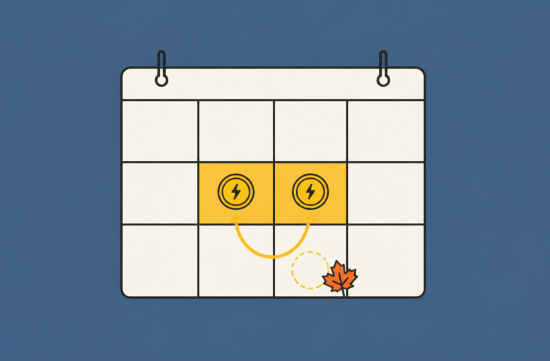
For those who opened their October bill and thought, "Huh? Why is there no credit?" I can't be the only one. The California Climate Credit that usually comes in the spring and fall is missing this October.
To get straight to the point, it's not that it's missing; you've already received it. This year, the payment schedule has changed entirely.
Originally, the PG&E residential electric credit was issued twice a year, in April and October. However, the CPUC decided on March 19 (D.26-03-013) to suspend the April payment for now.
The reason is simple. April and October are months when electric rates are generally lower across the state, so any discount during those times wouldn't be very noticeable.
Then, on April 30, the CPUC made a final decision. PG&E, SCE, and SDG&E residential electric customers will receive credits on their August and September bills.
For PG&E, the credit was $36.18 in August and $36.18 in September, totaling $72.36. Since it came during a month when air conditioning was heavily used, the timing was actually much better.
I honestly want to applaud this decision. Even if it's the same amount, it makes sense to give it during the toughest months. It's always welcome when the government thinks about everyday living.
By the way, the total amount for this year's residential electric credits is $894 million, and for gas, it's $520 million. I was a bit surprised when I saw those numbers.
The gas credit was already issued in April this year. Starting in 2027, it will be moved to February, which is when heating is used the most.
For those running small businesses, the situation is different. The small business electric credit was $36.18 in April, and the same amount will be issued in October.
If you receive electricity from San Jose Clean Energy (SJCE), don't worry. PG&E sends the bills, so the Climate Credit will also appear on the PG&E bill.
Now, how do we prepare for the fall bill without the credit? The first thing to know is that starting October 1, PG&E rates will switch to winter season rates.
PG&E divides the year into summer from June 1 to September 30 and winter from October 1 to May 31. The Baseline Allowance, which is the cheapest usage tier, also varies by season, location, and heating method.
If you heat your home with an electric heater or heat pump, make sure to check that your heating method is properly registered with PG&E. Electric heating households have a separate baseline allocation.
The second thing is the Time-of-Use hours. Most households use E-TOU-C, where peak hours are every day from 4 PM to 9 PM, including weekends and holidays.
As the days get shorter in fall, it's easy for lighting, ovens, and heaters to all be used at once in the evening. Delaying laundry and dishwashing until after 9 PM is the easiest and most effective way to save.
E-TOU-D has peak hours only on weekdays from 5 PM to 8 PM, so it might be better depending on your household's routine. You can check the rate plan comparison screen by logging into your PG&E account.
The third thing to be aware of is the Base Services Charge that started in March this year. In exchange, the rate per kWh has decreased, and PG&E explains that this is not a new fee but a structural change.
For households enrolled in CARE, this fixed charge is discounted to $6, and for FERA households, it's $12. So if you qualify for CARE or FERA but haven't applied yet, now is the time to do so.
CARE offers a 30-35% discount on electric bills and a 20% discount on gas bills, while FERA provides an 18% discount on electric bills. The income criteria are surprisingly generous, so I recommend checking for your retired parents as well.
There's also some good news. PG&E announced that it lowered electric rates in January and March this year, and the residential bundled rate is now 13% lower than in January 2024.
However, it's too early to relax. With the credit missing, the October and November bills may feel relatively heavier.
So, I'll share what I'm doing this fall. First, I opened the usage graph for the past year in the PG&E app.
I checked last year's usage for October and November and set my goals for this year. Then, I adjusted the thermostat to 68 degrees during the day and even lower at night.
I also added weatherstripping to block drafts around the door. It only costs a few dollars at the hardware store, but the difference is quite noticeable.
Considering Budget Billing is also worth it. It averages your payments over the year, which definitely reduces the feeling of a bill shock in winter.
One more thing, the CPUC mentioned that the credit amount or the timing of the next payment could be adjusted in future proceedings. It's safer to check the official announcements for next year's schedule.
In summary, the October credit hasn't disappeared; it's just been moved to summer. Instead, this fall is the season where we need to manage our bills ourselves.
If it were me, I would do just two things tonight: compare rate plans in my PG&E account and check my CARE or FERA eligibility.
Small habits can really change the winter bill. Let's get through this fall smartly together!
 moonriver82








 SKy Face |

 gleeful |

 forevergee |

 mortrix |

 cherrydino |

 Living Economy Information Blog |

 Churros Train Conductor |

 Rushing Youngest Rabbit Toto |

 Western US Medical Student Association |

 Time is GOLD |
 Physical Laws and Science |
 good thinking |
 Solo Yolo |
 Mr Oh |
 laro90 |
 San Diego TOP Idol |
 Round and Round Children's Song Kingdom |
 American Golf Course Travelogue |
 MEDBIO American Doctor Blog |
 Hot Seat Driver |
 bryvexi |
 koala organic farm |
 riverstone |
 My Antonio |
 California Information News |
 chilli chilli |
 Moon Su San |
 vanilla |
 U.S. Weather Bureau News |
 norvexi |