
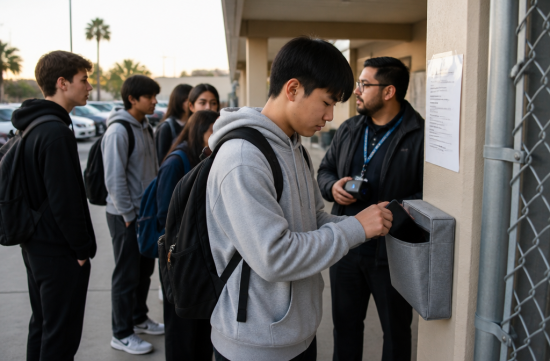
These days, discussions about cell phones in parent group chats are never-ending. Comments like, "Our school uses pouches," and "I heard they just have to put them in their bags" keep circulating.
Why do schools have such different policies? It all starts with California state law AB 3216, known as the Phone-Free Schools Act.
This law was passed in 2024 and requires all school districts, charter schools, and county education offices to establish student smartphone usage policies by July 1, 2026. So, the deadline has already passed.
There's a common misconception here. The state law does not mandate a "complete ban."
The legal wording states that schools must "restrict or prohibit" smartphone use under staff supervision. How strict this will be is determined by each school district.
There are also exceptions. These include emergencies or perceived threats, when a teacher or administrator grants permission, when a doctor deems it necessary for health reasons, or when it is included in an IEP.
Additionally, when creating policies, input from teachers, students, and parents is required, and these policies must be updated every five years. In fact, since AB 272 in 2019, districts could create policies, but this time it has become mandatory.
So, how different are the policies across districts? Even comparing a few nearby districts shows significant differences.
The strictest is LAUSD. The Board of Education passed a resolution in June 2024 with a 5 to 2 vote, which went into effect on February 18, 2025.
LAUSD prohibits phone use from the time students arrive until they leave, including during lunch and breaks. Reports indicate that devices like smartwatches and earbuds are also included in this ban.
Storage methods vary by school. The most commonly used is the Yondr pouch, which locks magnetically, while some schools use classroom storage lockers, and others simply require students to turn off their phones and put them in their bags.
LAUSD even allocated separate budgets for schools to purchase these storage devices. Honestly, I was a bit surprised at the extent they went to just to restrict phone use.
Glendale Unified takes a different approach. The new policy approved by the Board of Education divides rules by grade level.
Elementary and middle schools require devices to be turned off and stored in bags or classroom lockers. Exceptions are made for medical needs, such as apps for checking insulin levels.
High schools do not have a unified district policy; instead, each school will have teachers, students, and parents collaborate to create their own rules. Wearables like smartwatches are also included in the policy scope.
During this process, 631 parent survey responses were collected. There was strong support for a strict ban during class time, and many favored having different rules by grade level.
Burbank Unified has not publicly confirmed the final policy details at the district level. However, there is a record of John Burroughs High School running a pilot policy for one semester starting in January 2025.
At that time, students could bring phones to campus but had to turn them off and keep them out of sight during prohibited times. Each teacher determined the storage method during class, and violations were subject to a progressive discipline structure.
The rules currently in effect may have changed since then. Be sure to check the school website, student handbook, or Board of Education meeting minutes for the latest version.
In summary, there are four key points of divergence: whether the restriction is all day or just during class, whether physical blocking like pouches is used, whether rules are divided by grade level, and whether smartwatches are included.
Pouches are not a foolproof solution. There have been reports that students at LAUSD have found ways to circumvent the pouches.
Ultimately, I believe consistent enforcement is more important than the equipment itself. If standards vary from classroom to classroom, students will quickly find the loopholes.
From a parent's perspective, the biggest concern is emergency contact. While the law does allow for exceptions in emergencies, how to contact the school varies by institution.
So, if I were in your shoes, I would save the school office number at the beginning of the semester and prepare any necessary documents for your child's IEP or 504 plan.
Also, ask when phones are allowed during pick-up after school. Since the state law does not specify this, directly asking the school is the most reliable way to find out.
Personally, I think the approach of allowing the state to set the framework while letting districts decide is reasonable. Each community has different circumstances, and it's much more practical than having Sacramento dictate everything.
However, I believe that for middle schools, a bell-to-bell approach is the right way to go. While exercise is important, focus is a skill that needs training, and removing excuses is the quickest way to achieve that.
For high school students, the Glendale approach of granting some autonomy and responsibility isn't bad either. They need practice managing themselves as they are about to become adults.
What is your school's approach? Check your district's policy and share any changes you find.
 OceanFlower







 new sugar |

 Way to easy |

 Magic Cabbage School of Martial Arts |

 Vacation on Hawaii |

 morvex37 |

 garlic bread |


 Burbank Lee |

 Popular Song Exciting Song |


 Yo Lock Me Up |
 San Diego TOP Idol |
 American Golf Course Travelogue |
 Hot Seat Driver |
 bryvexi |
 koala organic farm |
 riverstone |
 My Antonio |
 California Information News |
 chilli chilli |
 Moon Su San |
 vanilla |
 norvexi |
 Lunch and Dinner Mexican Taco |
 skykong |
 My Circle |
 novapixel |
 urban legend |
 coolriver |
 Good Neighborhood, Wealthy District Information |
 Ro Ro Car |