
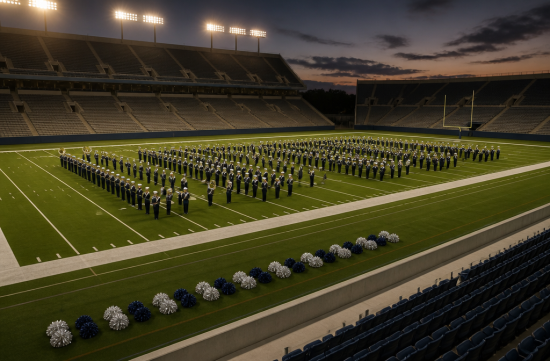
Last weekend, I went to a local college football game and saw cheerleaders perform during halftime. A young friend sitting next to me suddenly asked if cheerleading should still exist, questioning whether it was a completely outdated form of gender discrimination. I couldn't answer right away. On the surface, it does seem like a scene where young women in flashy uniforms are smiling and dancing in front of male spectators, which could lead to that impression. However, I believe the answer is not that simple.
In fact, cheerleading was originally a male domain. In the 1880s, there was a cheer squad at Princeton University made up entirely of male students, and records show that in 1898, a student named Johnny Campbell from the University of Minnesota led the first organized cheers. At that time, cheerleaders were elite male students who combined gymnastics, stunts, and leadership, and were considered a symbol of masculinity just as much as football.
Women became the majority in cheerleading only after World War II. As male students went off to war, female students began to fill that void, and since then, cheerleading has solidified as a female domain. This means that it was not a culture created to showcase women from the beginning, but rather a result of changing gender ratios due to the circumstances of the time. Understanding this background makes it difficult to definitively label cheerleading culture as inherently sexist from its inception.
Interestingly, there are still male cheerleaders today. However, many point out that they must endure a certain stigma. Due to the prejudice that cheerleading is an activity far removed from masculinity, male cheerleaders often become targets of ridicule. Ultimately, I believe the real issue surrounding this culture is less about whether it oppresses women and more about the stereotypes that dictate specific roles based on gender, making it strange when someone steps outside those roles.
However, the real problem lies elsewhere. It's about wages. Ten out of the 26 teams in the NFL have faced lawsuits for wage theft, unfair labor conditions, and sexual harassment. The lawsuit initiated by a cheerleader from the Oakland Raiders in 2014, who claimed she was paid less than $5 an hour, ended in a $1.25 million settlement.
There is also data indicating that the Tampa Bay Buccaneers settled for $825,000 and the Cincinnati Bengals for $255,000. Until a few years ago, the average salary for cheerleaders was around $22,500, which was lower than that of the team's mascot or waterboy staff. This is not a matter of tradition or culture; it is simply an unfair contract.
What's interesting is how this issue has been resolved. It wasn't the government that stepped in to regulate cheerleader wages; rather, the individuals involved filed lawsuits, and public opinion shifted, allowing the market to correct itself. The Dallas Cowboys cheerleaders saw their salaries rise by nearly 400% ahead of the 2025 season. The principle that one should receive fair compensation for skill and labor was realized not through bureaucratic regulation but through contracts and negotiations. I believe this approach is ultimately the most sustainable solution.
In conclusion, cheerleading should not be viewed as an outdated relic that needs to be abolished. The transition of a culture created by men to one that is now gradually opening up to both genders is a natural change. Preserving tradition and demanding fair treatment within that tradition are not conflicting values. Rather, the principle that one should be compensated according to their skills and efforts is the most reasonable standard. However, we must continue to monitor whether those working in this field receive fair compensation and whether opportunities are open to both men and women. Respecting tradition while critically assessing the value of labor is, I believe, a balanced perspective.







 logger |
 Conflite Teacher |
 Unknown Dog Walk blog |
 Khan Film Blog Production |
 Yoyma |
 Olivia's Blog |

 Various Knowledge and Information in the USA |


 Cali M Law Group |
  colo colo |
  U.S. Weather Bureau News |
  Dragon Lee |
  American Food Information & Calories |
  zephyrs |
  ness 6 |
  Montgomery Mom |
  SteelOrbit |
  Puddle Puddle |
  Arizona Cowboy |
  macaronpop |
  marydock |
  peachpanda |
  U.S. College Admission Information |
  Fruitop |
  Exploring American Life Information |
  sing sing |
  ORAVEZIN Oppa |
  Lego My Ego |