
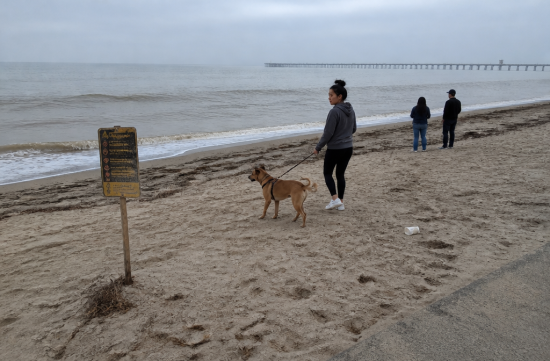
Whenever the topic of the ocean south of San Diego comes up, my friends have two reactions: "Is it still closed?" or "Is it about the smell?"
Honestly, I initially thought it was just a temporary beach closure. But after doing some research, I realized this is more than just a "no swimming today" issue.
The problem starts with the Tijuana River. Untreated sewage from Mexico flows across the border into the ocean near Imperial Beach.
At the end of September, San Diego County banned all water contact at Imperial Beach due to the river carrying sewage into the swimming area.
The Border Field State Park and Tijuana Slough National Wildlife Refuge had already been closed prior to this. The county stated they would keep the closures in place until safety could be confirmed through sampling and on-site inspections.
So, what exactly is the problem with entering the water? The county's warning explains that bacteria levels exceed the threshold and could cause illness.
Local reports indicate that the biggest concern is gastrointestinal illness. In simple terms, this includes stomach upset, diarrhea, and vomiting. Problems can arise if bacteria and viruses from the sewage enter through the mouth or wounds.
The county health department even created a website to monitor gastrointestinal illnesses in the southern region. However, they announced that the investigation found no significant increase in gastrointestinal illnesses or related emergency room visits in South Bay.
At this point, one might think, "I just need to avoid the water." But the real twist is related to the air.
Sewage decomposes and releases a gas called hydrogen sulfide. This is the source of the rotten egg smell. The issue is that even if you don't go to the beach, if the wind blows, this gas can come to you at home.
In September, the CDC's Agency for Toxic Substances and Disease Registry (ATSDR) released a draft report on the air quality in the area. They analyzed data from four monitoring stations from September 2024 to May 2025.
The conclusion is quite direct. At the Leon Avenue monitoring station, and possibly at the Berry Elementary School station, hydrogen sulfide levels rose to health-hazardous levels for short periods, which they deemed a public health threat.
Possible effects include headaches, dryness of the nose and throat, and for sensitive individuals, the potential for respiratory distress. I find it particularly concerning that the name of an elementary school appears in the report.
The highest recorded level cited in the reports was a 30-minute average of 3,021 ppb at Leon Avenue in September 2024. The threshold mentioned for health effects is 2,000 ppb, so just looking at the numbers is alarming.
However, there's no need to panic. The same report noted that long-term exposure of more than 14 days is not expected to pose additional public health risks beyond symptoms caused by the smell itself.
The smell itself is not something to ignore. The report indicated that symptoms related to the odor could include headaches, nausea, stress, nasal congestion, and throat irritation.
For reference, this is still a draft. Public comments are open until November 21, after which a revised final version will be released. A second report addressing chemicals in water, soil, and sediments is also in preparation.
So, is a solution in progress? The South Bay International Wastewater Treatment Plant in the U.S. has increased its daily processing capacity to 35 million gallons.
According to the EPA's third-quarter update, a major construction contract to expand this to 50 million gallons per day was signed in September. In December 2025, the U.S. and Mexico also signed a new agreement called Minute 333.
There is progress being made. But for local residents, the urgency is more about whether they can open their windows tonight than the news of construction contracts.
I see this as a matter of fairness. It's not right to expect people living near the border to endure smells and closures for years just because of their location.
So, here are some practical survival tips. Before heading to the southern beaches, check the closure status at sdbeachinfo.com.
You can also confirm by phone. The county information number is 619-338-2073.
If there are closure signs, it's best to skip surfing or even dipping your toes in the water. Be especially cautious after rain, as more river water flows in.
If your kids or pets enjoy playing near the water, you need to be extra careful. It only takes a moment for them to put their hands in their mouths after playing in the sand.
On days when the smell is strong, closing windows and moving outdoor exercise to another neighborhood is also a good idea, especially if you have family members with respiratory sensitivities like asthma.
If you go into the water and end up with stomach issues, or if the smell causes headaches and breathing difficulties, don't try to tough it out alone. Symptoms can vary from person to person, so be sure to consult a doctor or pharmacist.
Personally, I think I would enjoy the southern beaches visually for a while and swim at the northern beaches. The ocean isn't going anywhere.
Instead, I'll try to keep this issue in the news to ensure that clean oceans and breathable air remain basic options for everyone.
 SpringView








 Diana Blues |

 Dragon Lee |

 Churros Train Conductor |

 Tora Tora |

 neroyo |

 Learn English Accurately |

 Egg Steamed Pot |

 Balancework |

 U.S. Supreme Court Judge Kim |

 laro90 |
 San Diego TOP Idol |
 American Golf Course Travelogue |
 Hot Seat Driver |
 bryvexi |
 koala organic farm |
 riverstone |
 My Antonio |
 California Information News |
 chilli chilli |
 Moon Su San |
 vanilla |
 norvexi |
 Lunch and Dinner Mexican Taco |
 skykong |
 My Circle |
 novapixel |
 urban legend |
 coolriver |
 Good Neighborhood, Wealthy District Information |