
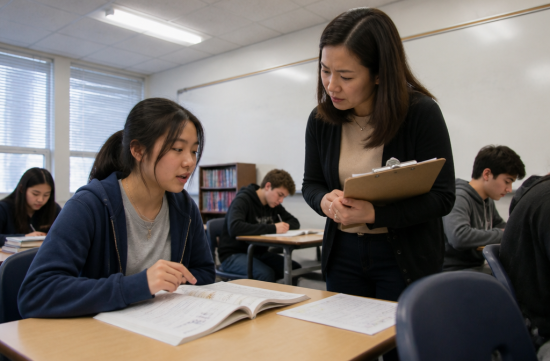
Recently, many parents in Fullerton have been asking, "Can our child receive the Seal in Korean?" It's a shame if they speak Korean at home but have no evidence of it on their high school diploma.
The Seal referred to here is the State Seal of Biliteracy awarded by the California state government. It certifies high school graduates who demonstrate high proficiency in speaking, reading, and writing in English and at least one other language.
The program started on January 1, 2012, when the law AB 815 was enacted. The Seal is affixed to diplomas or transcripts, making it easy to include a line on college applications or resumes.
According to the California Department of Education (CDE), the number of Seals awarded in the 2025-26 school year reached a record high of 79,397. Just looking at the numbers, you can tell this is not just an award for a select few anymore.
However, starting January 1, 2024, the implementation of AB 370 has changed the criteria significantly. If you rely on outdated information to prepare, you might end up wasting your efforts, so let's clarify the current standards.
First, let's discuss the English requirements. You only need to meet one of the following four criteria.
You must complete all required English (ELA) courses for graduation with an average GPA of 3.0 or higher. Previously, the requirement was 2.0, but it has been raised to 3.0 with AB 370.
Receiving a score of Standard Met or higher on the 11th-grade CAASPP English exam is also acceptable. A score of 3 or higher on the AP English exam or 4 or higher on the IB exam is valid as well.
Achieving a score of 480 or higher on the SAT Evidence-Based Reading and Writing section is another option. Students classified as English Learners (EL) must also achieve a level 4 on the ELPAC oral comprehensive score.
Now, the real focus is on the Korean requirements. This is where many people initially get stuck.
For Spanish or Chinese, a score of 3 on the AP exam is sufficient. However, there is no AP course for Korean. Korean is also absent from the AP language list provided by the CDE.
In the past, the SAT Subject Test in Korean could be used, but the College Board eliminated Subject Tests altogether in 2021. This is why the experiences shared by older parents may no longer apply.
That said, there are still pathways available. The law outlines three main routes for Korean.
First, you can complete four years of high school-level Korean courses with a GPA of 3.0 or higher. Courses from overseas high schools, community colleges, CSU, or UC that are equivalent may also be accepted.
Second, there are standardized tests. A score of 4 or higher on the IB Korean exam, or the speaking interview (OPI) and writing test (WPT) from ACTFL are recognized as Korean subjects by the CDE.
Third, for languages without a suitable exam, school districts can create their own assessments. However, the district must certify annually to the state that the evaluation covers speaking, reading, and writing at a four-year course level.
If you are a Fullerton high school student, the first step is to check with your school. Sunny Hills High School in the Fullerton Joint Union School District offers Korean courses alongside Chinese, German, and Spanish.
According to the school's guidelines, to receive the Seal, students are advised to maintain a B or higher in one language throughout four years. It also mentions that strong students may be able to earn it through AP or IB exams in 11th grade.
One important aspect to note is the level testing. Students can take a test to skip a level or advance to a higher level in Korean or Spanish.
If your child speaks Korean at home, it would be a loss to overlook this. Starting at a lower level in 9th grade could make it challenging to complete the four-year requirement.
If your child attends a different school, ask the counselor three questions: How many levels of Korean courses are offered? Does the district recognize ACTFL or its own exams? What is the application deadline?
Some school websites may not have updated information. In fact, some school pages within the district still list the English GPA requirement as 2.0.
Therefore, it is recommended to verify the final criteria with the latest requirements on the CDE website and Education Code Section 51461. This article is based on the most current information available, so it should be checked again when the school year changes.
Let's also touch on costs. The CDE specifies that students cannot be charged a fee for the Seal itself.
However, fees for external exams like those from ACTFL may be separate, so be sure to ask whether the school covers those costs. Also, inquire about support for low-income families.
The application process typically occurs in 12th grade through the counselor. The district requests the Seal from the state, so individuals cannot apply directly to the CDE.
I am genuinely pleased with this program. It officially recognizes the language skills that immigrant families' children have developed at home as an asset rather than a deficiency.
However, it is unfortunate that languages like Korean, which do not have an AP option, still require students and parents to seek additional pathways. This is an area where more support from the school district is needed.
If it were me, I would have my child take a level test before starting 9th grade and prepare for both the four-year Korean course and the ACTFL exam as a two-track approach. If one path is blocked, the other can still be pursued.
If your child finds Korean to be a hassle, show them this golden Seal as a goal. It provides much more motivation than a vague "You should learn Korean." You've got this!
 Diadromes
 goldenriverfox1952





 Texas Migration Story |
 seadoll |

 Round and Round Children's Song Kingdom |

 new sugar |

 Way to easy |

 Con Cheese |
 Sunny Fullerton |

 Until the Day It Gets Better |

 ssome |
 skykong |
 Shining Our Own World |
 gardener 007 |
 golfmaster |
 Nanana Nanana Nanana |
 Who's watching? |
 endone |
 RockStar |
 Casa Mia |
 You Only Live Once |
 Hardworking CPA |
 Joyce 77 |
 Runner Kim |
 My Town My Way Blog |
 My Miami Stories |
 Entip |
 Tony Park |
 Jean Claude Bundang Blog |
 DJ DC BLOG |