
I once attended a networking event hosted by my company, standing in a corner with just a drink in hand. I received a few business cards, but I couldn't even remember most of the names.
If you're someone who finds it uncomfortable to approach strangers and promote yourself, this experience might not be unfamiliar. The problem is that in American workplaces, there aren't many ways to avoid networking.
In fact, a recent survey revealed some interesting statistics. Among 1,000 adult workers in the U.S., 54 percent reported that they got their current job through acquaintances or connections, which was a surprisingly high number.
Another intriguing point from the same survey was that 21 percent of respondents said they had never asked anyone for a recommendation in their lives.
The means they found most helpful in their job search varied. Thirty-two percent said personal connections helped, while 28 percent said connections made at work were beneficial.
In the same survey, 34 percent of respondents cited a lack of confidence as the reason they couldn't network more actively. Nearly 60 percent of job seekers reported that they only contacted a few close acquaintances or didn't reach out to anyone at all.
This indicates that the issue isn't solely about being introverted. It suggests that nearly half of Americans also struggle with the discomfort of reaching out and asking for help.
When it comes to company referrals, the numbers are significant. In 2024, 17 percent of hires were made through employee referral programs.
Although referrals accounted for only 2 percent of all applications, they led to 11 percent of actual hires. Just looking at the numbers shows how much weight a single referral application carries.
The speed of the hiring process also differed. Hires made through referrals took an average of 29 days to complete, while those through other channels took an average of 39 days.
The retention rate for employees hired through referrals was 45 percent higher than for those hired through other means. From a company's perspective, there's no reason to overlook hiring through connections.
Why is networking so important? Many American companies prefer to look internally for known individuals before posting job openings.
This means there are more positions filled quietly without ever being posted on company bulletin boards. If you don't know about these positions, no matter how well you write your application, you won't have a chance to apply.
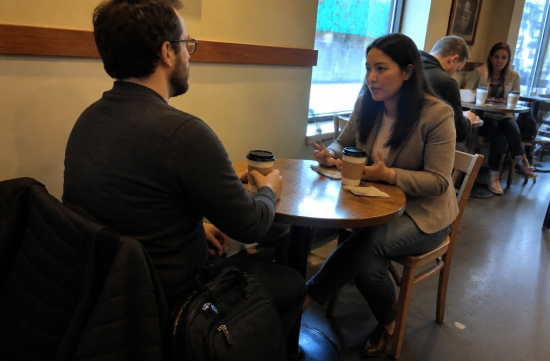
Networking in the U.S. doesn't mean making flashy connections at parties. It includes short messages suggesting a coffee meeting, a few exchanges on LinkedIn, or casual conversations during lunch.
Just looking at LinkedIn gives a sense of its scale. The number of LinkedIn members in the U.S. has surpassed 270 million.
So, simply writing a great resume and waiting isn't even half the strategy. Managing your profile and maintaining at least a minimal online network is just as important as your resume in this environment.
Introverts often think they are at a disadvantage in networking, but that's not necessarily true. While they may struggle to keep small talk going with strangers, they excel at listening intently to one person's story.
Therefore, one-on-one meetings often suit them much better than large events. Instead of trying to come up with conversation in a crowded setting, having a genuine conversation over coffee with one person can be much more rewarding.
Preparing a few questions in advance before attending an event can also be helpful. If you try to come up with something to say on the spot, your mind might go blank, but having two or three prepared questions can keep the conversation flowing easily.
Checking the names of attendees on LinkedIn before the event is another good strategy. If you recognize at least a name, it lowers the barrier to approaching them significantly.
After meeting someone, it's important to reach out within 24 to 48 hours, even if it's just a brief message. If you just collect business cards and put them in a drawer, that connection ends the moment you leave.
Deciding in advance how long you'll stay at the event is also a good tactic. If you've had meaningful conversations with one or two people, that's enough, and you don't need to stay until the end.
Instead of trying to perform well in front of strangers, it can be helpful to practice with familiar colleagues or friends first. Getting comfortable with the flow of greetings, introductions, and questions can help reduce anxiety in unfamiliar settings.
Ultimately, having a meaningful conversation with one person is often more valuable than superficial greetings with ten. For introverts, choosing depth over quantity is a more fitting strategy without exhausting themselves trying to increase numbers.
Many people feel burdened by the idea of asking someone for an introduction or help, but in this environment, it's not seen as an impolite request; it's more like a natural exchange. The person who asks for help can repay the favor when the time comes.
While I don't naturally excel at speaking in front of people, I've learned that quietly setting up coffee meetings and sending LinkedIn messages ultimately leaves a more lasting impression than just making a flashy entrance and leaving.
 LunaStar
 urban89







 coloradoman |
 pintos |
 mapsina |
 Mr. Largo |
 Victory 1988 |
  Rynex |
 calvix |
 Kansas City Representative Singer |
 selviro |
 Ansaso |
  French fries |
  Caribbean |
  Let's Be Like a Salt-like City Person |
  Belgray Miscellany |
  sweetvan |
  Augusta Univ |
  Round and Round Children's Song Kingdom |
  butter 90 |
  Lando Mao |
  Washington Denzel DJ |
  LIZ Legal Information Blog |
  vegas mom |
  Sandiego Auntie |
  Premium Gas Camp |
  Things to know |
  TEXAS Fishing Boat |
  AUTO OK |
  aaoaa |
  Florida King |