
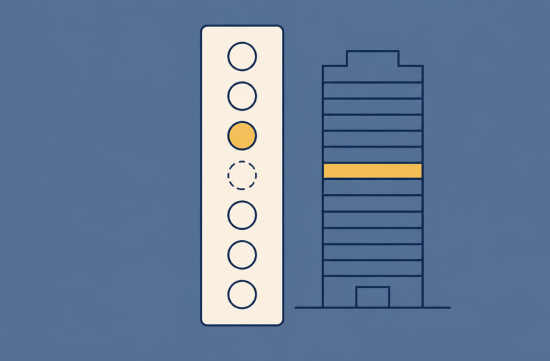
Recently, I took an elevator in a hotel during a business trip, and I noticed that after the button for 12, it went straight to 14. Many of you have probably seen this before. However, when you ask for the reason, the only response you often get is, "Americans dislike the number 13."
So this time, I decided to dig deeper. Is it really due to superstition, or is it ultimately a matter of money? To sum it up, both are true, but one side is more heavily weighted than the other.
First, let's look at the numbers. In 2002, an executive from the elevator company Otis estimated that 85% of buildings with elevators that have a 13th floor do not include a button for 13.
New York is even more extreme. In 2013, the real estate data company CityRealty analyzed documents from 1,500 condo buildings in Manhattan and Brooklyn, and less than 5% labeled the 13th floor as the 13th floor.
Honestly, I was a bit surprised by these numbers. New Yorkers don't seem like superstitious people. Yet, in the building industry, almost without exception, the number 13 was omitted.
So how much do people actually care? In February 2007, USA Today and Gallup conducted a survey asking if people would be concerned about staying in a hotel room on the 13th floor.
The results were interesting. Only 13% said they would be concerned. 9% said they would ask to change to a different floor.
This brings up a key point. Just over one in ten people feel uncomfortable, yet in the building industry, 85% to 95% have removed the number 13. The ratio of concerned individuals does not match the ratio of buildings that omit the number.
This gap can be explained by business logic. Think from the perspective of a developer. If the number 13 could cause them to lose one out of ten customers, the cost of changing the button number is almost negligible.
In New York's development industry, there's no reason to exclude buyers who believe in superstitions. Removing the number 13 can also create the effect of making the building appear slightly taller.
So, strictly speaking, the 13th floor hasn't disappeared. Physically, the 13th floor still exists; it just has a label of 14. Residents on that floor might not even realize they are living on the 13th floor.
There are various ways to eliminate the number. Some skip to 14, while others label it 12A or 12B, or even use the 13th floor as a mechanical or service floor.
There are also cases where the floor numbering has been exaggerated. Manhattan's Trump Tower is advertised as having 68 floors, but according to the CTBUH standards for high-rise buildings, it actually has 58 floors. They skipped ten numbers due to the height of the lower floors.
This is somewhat different from the superstition surrounding the number 13, but it clearly shows that floor numbering is ultimately a marketing tool.
So where did the fear of 13 come from? There are various theories, and it can't be neatly summarized into one origin. However, records show that it was already quite widespread in 19th century America.
On January 13, 1881, the first meeting of the Thirteen Club, led by Civil War veteran William Fowler, was held in New York. Thirteen people dined in room 13, deliberately passing under a ladder and spilling salt.
The sole purpose was to demonstrate that superstitions have no basis. Afterward, similar clubs sprang up across the United States, and some members later became presidents.
Interestingly, even after that era of openly mocking superstitions, 20th-century high-rise buildings leaned toward omitting the number 13. One might say that the enlightenment movement lost to elevator buttons.
In fact, we're not in a position to judge others. We've all seen elevators in Korea that label the 4th floor as F, due to the fact that the word for four sounds like the word for death.
The avoidance of 13 in American buildings and the avoidance of 4 in Korean buildings are structurally the same. The believers are a minority, but the side that changes the numbers doesn't want to lose that minority.
On the flip side, there's also the argument that removing the number 13 keeps the superstition alive. Because everyone avoids it, it makes the number 13 seem like it really has some significance.
There are practical concerns as well. If the labeled floor number differs from the actual floor number, it could confuse someone who is visiting for the first time. However, I couldn't find any definitive statistics on how much of a problem this actually causes.
Conversely, there are certainly buildings that keep the number 13. Looking at the earlier New York condo statistics, there are places that still call the 13th floor the 13th floor, and there's no evidence that such places are failing in business.
To summarize my thoughts: the absence of the 13th floor started with superstition, but it has survived due to business logic. I'd say it's about 30% superstition and 70% business.
Most people don't care, but from the perspective of building owners, there's no reason to take on the risk. The cost is almost nothing, and it can prevent potential losses. This is more about American risk management than superstition.
Next time you see a 14 button after 12 in an elevator, take a moment to count. That 14th floor is actually the 13th floor, and that single button carries over a century of psychology and calculations.
If someone asked me to live on the 13th floor, I would just do it. In fact, I'd be even happier if they offered to lower the rent a bit. How about you? Are you okay with pressing a button labeled 13?
 TootButler







 daisypat |
 Anjollinya Blog |
 Anova US Beauty Information |
 anchor |
 Korea Tiger News |
 dictionary |

 cathywhite |

 bada2002 |
  horizon |
  Nanana Nanana Nanana |
  victoria jung |
  Kkikki Ppappa Shout Out Loud |
  Lululala |
  Toaster Pizza Magic Show |
  Utah, the Most Livable State |
  nortrix |
  Mau Nui |
  novapixel |
  fixed |
  AL ALASKA |
  amola |
  History Repeats Itself |
  Doori Ark |
  Rainbow Bridge to the Sky |
  Sunny Fullerton |
  U.S. Weather Bureau News |