
Every year around this time, I find myself checking the potted plants by the living room window. It's the time when the night air gets noticeably colder, and I start to wonder whether I should turn on the heater.
But to be honest, I confess that a few years ago, I nearly killed my beloved fern pot during winter. I watered it regularly, but the tips of the leaves turned brown and crispy, and it ultimately couldn't recover.
Later, I found out that the problem wasn't the water but the air. Today, I'll summarize what I learned back then step by step.
The first cause is humidity. According to the University of Missouri extension materials, most indoor plants prefer relative humidity between 40 and 60 percent.
The problem is that the indoor air in winter doesn't even come close to that range. According to Penn State extension materials, the humidity in homes during winter typically hovers around 10 to 20 percent.
The University of Missouri materials even state that the average winter humidity in homes is lower than that of the Sahara Desert. I was genuinely shocked when I read that for the first time.
The principle is simple. Cold outside air naturally holds less moisture, and when you heat that air, the relative humidity drops even further.
So, the browning and drying of leaf tips are often due to dry air rather than a lack of water. Like me, many people make the common mistake of adding more water, thinking the plant is thirsty, when in fact the soil is already damp.
The second cause is overwatering. In winter, the days get shorter, causing plant growth to slow down, which means they use less water.
The materials from Missouri identify overwatering as the leading cause of indoor plant death. If the soil is constantly wet, the roots can't breathe and start to rot.
The third factor is light. The same materials indicate that inadequate light is the second most common cause of failure, right after watering mistakes.
Plants that receive proper light can better withstand high indoor temperatures and low humidity, which I believe is quite crucial. Ultimately, it's a battle of endurance.
During the short days of winter, even moving just a little away from the window can significantly reduce light. If a pot placed in a corner of the living room looks particularly weak, this could be a major reason.
So, how do you revive them? I'll share the steps that have worked for me in order.
First, change their location. It's best to avoid placing them right next to the heater vent, radiator, or near frequently opened doors.
If hot air directly hits the leaves, they can dry out in an instant. Conversely, being in a spot where they get cold drafts every time the door opens is also stressful.
The most effective way to increase humidity is still a humidifier. Just placing a small portable humidifier near the pot can make a noticeable difference. It's also good for your skin and throat, so it's a win-win.
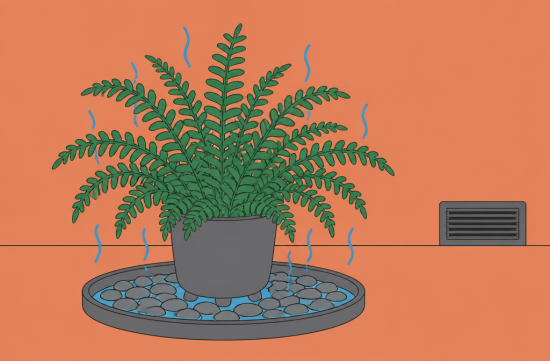
If you want to avoid spending money, a pebble tray is a good alternative. Fill a tray with pebbles and add water, then place the pot on top of the pebbles.
The key point here is that the bottom of the pot should not be submerged in water. It should sit on the pebbles; if it's submerged, the roots will rot instead.
Grouping pots together can also help. Plants release moisture through their leaves, so when they are close together, the surrounding air becomes a bit more humid.
Moving them to naturally humid areas like the bathroom or kitchen is also an option, as long as there's a window for light.
When it comes to watering, you should actually reduce it. Instead of setting a specific day to water, develop the habit of checking the topsoil with your finger and only watering when it feels dry. Be sure to discard any standing water in the saucer.
For light, it's essential to move them to the brightest window during winter. If dust accumulates on the leaves, wiping them with a damp cloth can also help.
If you have pots that spent the summer on the balcony or deck, make sure to check them before bringing them inside. Extension materials recommend bringing them in when nighttime temperatures start to drop near 50 degrees Fahrenheit.
At this time, you should carefully inspect the undersides of the leaves, stems, and the outside of the pots. Pests like aphids, scale insects, and spider mites can easily hitch a ride indoors and spread quickly.
If you see pests, it's commonly recommended to wash the leaves with water or use insecticidal soap. I usually give them a shower with a hose before bringing them in and keep them separated from other pots for about a week to monitor them.
In this area, concerns about frost start around mid to late October, so now is actually the perfect time to bring them in. If you delay and they get hit by frost overnight, tropical plants can struggle to survive.
Finally, if you're not confident in your care, focusing on drought-resistant plants is a realistic choice. Cacti, succulents, pothos, philodendrons, and dracaenas are good examples.
In summary, winter plant care is about managing air and light rather than just giving more water. If it were me, I would start with a humidifier and a pebble tray.
These days, my pots are actually greener during winter. This year, I hope your window sills can also stay green until spring.
 DownVulture








 Let's Be Like a Salt-like City Person |
 Springs Korea |
 US Legal Consultation on Trials |
 Study Abroad Life Know-How Tips |
 Best Frozen Yogurt |
 Rynex |
 calvix |
 Iri Jori Missouri |
 calviro |
 Kansas City Representative Singer |
  Kims Spring |
  White bunny |
  shadow 007 |
  sun walker |
  Choco Choco Star |
  midnight blue |
  honeypot |
  summer |
  adventure77 |
  flexible |
  Shintongbangtong Shin Naerin James Park |
  truepixel |
  Kathy's Blog |
  Hae Naem |
  quatspace |
  Marisol |
  Glassroom |
  Granola |
  joyfull yang |