
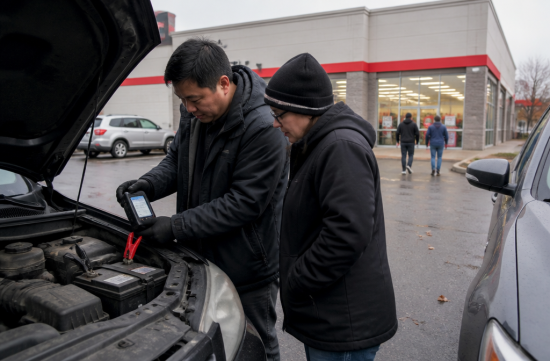
This happened around this time last year. I tried to start my car at 7:30 AM to go to work, but the engine just sputtered and died.
It finally started on the second try, but the sound kept echoing in my head all day long, making me uneasy even during the meeting. Exactly a week later, it was completely dead in the company parking lot, and I had to ask a colleague for a jump.
Looking back, the signs were already there. I just ignored them.
Why does the battery suddenly die when it gets cold? At first, I thought I was just unlucky.
According to AAA, the reasons are quite clear. When the temperature drops to 32 degrees Fahrenheit, the battery's power drops by 35%, while the power needed to start the engine increases by 1.5 times.
The principle is not complicated. The chemical reactions that generate electricity inside the battery slow down in the cold, and the engine oil thickens, making it harder to turn the engine over.
It gets worse as the temperature drops to 0 degrees. The battery's power decreases by 60%, but starting the engine requires twice as much power.
I was honestly a bit shocked when I saw those numbers. The power is cut in half, but the workload doubles; it reminded me of our team's situation during year-end closing.
So, it's not surprising that a battery that was fine in the summer fails during the first cold snap. What was already weak becomes apparent all at once due to the cold. Batteries usually don't fail suddenly; they gradually weaken and then give up when the cold hits.
So what are the early warning signs? I'll list the ones I experienced and found out about in order.
The first sign is a slow start. If the engine doesn't start immediately when you turn the key or press the button and makes a sluggish sound, that's almost a first warning.
The second sign is that the headlights or interior lights seem dimmer than usual. Especially when starting the engine, if the dashboard lights dim significantly and then come back, it's worth being suspicious.
The third sign is if the battery warning light appears on the dashboard. This could indicate a problem with the battery itself or the charging system, so it's essential to get it checked.
The fourth sign is age. Car batteries typically last about 3 to 5 years, but this can vary significantly depending on driving habits and weather conditions.
My battery was exactly 4 years old at that time. If I had just looked at the date, I could have prepared in advance.
Additionally, if you see white or bluish powder around the terminals or if the battery case looks swollen, don't ignore that either.
If you have a multimeter at home, you can check the voltage. After turning off the engine and letting it rest, if it shows around 12.6 volts, that indicates a fully charged normal state.
However, it's difficult to judge solely based on voltage. Even if the numbers look fine, there are batteries that can't hold up under load.
So the most reliable method is a load test. Stores like AutoZone or O'Reilly will test your battery for free while it's still in the car.
After my experience last year, I stopped by on my way home, and it took less than 5 minutes. The results showed that my battery was recommended for replacement, and the staff said it would be tough to get through the winter in that condition.
Of course, since they are selling batteries, they have to recommend a replacement. Still, it's worth it to distinguish whether the issue is with the battery or the charging system, like the alternator.
AAA recommends getting your battery tested after 3 years and then annually thereafter. I've now marked the first week of October on my calendar for this.
If you're struggling with a weakened battery, there are tips for starting it. Turning off all lights, radio, navigation, and heater before starting the engine reduces the load on the battery.
Making short trips of just 10 or 15 minutes between home and work is also not good for the battery. There's not enough time to recharge it after using it to start.
It's also best not to leave your car parked for several days during a cold snap. You need to start it and drive it regularly so the alternator can recharge the battery.
With more people working from home, many are not driving their cars for two or three days at a time. This can be surprisingly risky in winter.
If you have a garage, try to keep your car inside during winter. You'll definitely notice that starting it in the morning is much easier than if it were parked outside.
I recommend keeping a set of jumper cables or a portable jump starter in your trunk. Asking a colleague for help can only go so far, and it feels awkward to bother them during busy mornings.
Michigan winters are long, and those sub-zero mornings come around faster than you think. I still vividly remember waiting in the parking lot, shivering that morning.
My conclusion is simple. If the engine hesitates even once, get a free test done within that week, and if the test results are weak after 3 years, I would choose to replace it before the first cold snap hits.
It's cheaper in the long run to replace the battery early than to risk being late and needing a tow. I hope everyone can start their cars smoothly this winter every morning.
 StarlitMania






 Giant Squid and Sweet Potato Soup |

 choi family |

 What can make money? |

 road98 |

 Baguette Blog |

 vibranto |

 sugartrail |

 vanillastorm |

 bloom |
 raspberry7 |
 crystal |
 Good Hotels |
 Que que |
 Well Done Sir |
 dance dance |
 sweetpepe |
 vegas mom |
 Olivia's Blog |
 cathywhite |
 heartbreaker |
 Valley Hong |
 The Gelaton |
 Twist Kim |
 berlon93 |
 Physical Laws and Science |
 good thinking |
 Solo Yolo |
 Mr Oh |