
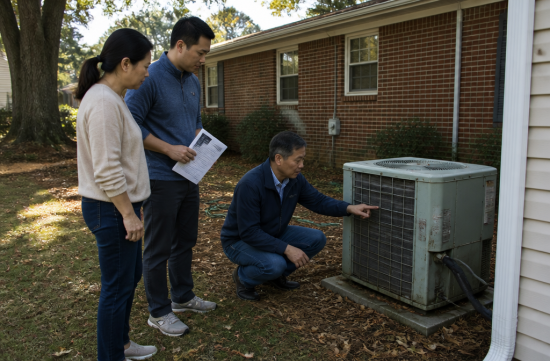
Let me start with a story about a couple I consulted last month. They contracted a single-story house that was over 20 years old, and just before closing, the seller offered to include a one-year home warranty. Their question was whether it would be worth paying for it after a year.
To get straight to the point, the answer varies depending on the condition of the house and the couple's financial situation. However, knowing exactly what you are purchasing makes the decision much easier.
A home warranty is not insurance. It is a service contract where a company agrees to cover the repair or replacement of mechanical systems that tend to break down over time, such as air conditioning, heating, water heaters, plumbing, electrical systems, and kitchen appliances, under certain conditions.
Damage to the house itself from fire, storms, or leaks falls under homeowners insurance. Structural elements like roofs, foundations, walls, and floors are typically excluded from most warranty contracts. Many people are surprisingly disappointed because they do not understand this distinction before signing up.
The cost structure is twofold. First, there is an annual plan fee, and then there is a separate service call fee that you pay each time you call a technician for repairs.
Comparing various consumer guides, the service call fee generally ranges from $75 to $125 per visit. The annual fee varies widely depending on the company and plan, with Consumer Reports citing a basic plan costing between $300 and $600 per year.
One important point to note is that the service call fee is charged regardless of whether the repair is approved or denied. It is common not to get that fee refunded if the technician determines that the issue is not covered.
Returning to the couple's house, the outdoor unit of their air conditioner was nearly 15 years old, and the water heater was also nearing replacement time. In such a case, a warranty might seem reassuring.
However, this is where the fine print in the contract becomes crucial. Almost all home warranties do not cover pre-existing issues, known as existing defects.
Consumer Reports also pointed out that claims can be denied due to neglect, improper installation, or issues that existed before enrollment. The older the equipment, the more likely the technician may conclude that it was already worn out.
You should also pay attention to coverage limits. Many plans set a payout limit of $1,500 to $3,000 per item. If you need to replace an entire central heating and cooling system, this limit may not be sufficient.
There are also exceptions at the component level. For example, a refrigerator may be covered, but the ice maker might not be. Some companies may approve a replacement but only pay the depreciated amount, leaving the homeowner to cover the rest.
In Georgia, another factor to consider is the reliability of the company itself. Home warranty companies are not as tightly regulated as insurance companies, so it is more important than you might think to know whether the company has the financial capacity to handle claims.
There is a real case to consider. On April 10, 2024, the Georgia Office of Insurance and Safety Fire Commissioner announced that Choice Home Warranty was prohibited from selling or soliciting warranty and service contracts in the state.
The reason was that they failed to pay a minimum $100,000 surety bond required under Georgia law Title 33, despite multiple warnings. A cease and desist order had already been issued in March of that year.
Fortunately, existing policyholders were told that their coverage would remain in effect until their contracts expired. Still, it is worth remembering that even well-known companies can face such issues.
So when is it worth signing up? In my experience, it makes sense for homes with mid-aged systems and a maintenance record, especially if the household cannot afford sudden expenses of thousands of dollars.
This is also relevant for first-time homebuyers in the U.S. If you do not yet know a reliable repair technician, having a service that sends someone with just one phone call saves time.
On the other hand, if the home is new and has a builder's warranty or if you have recently purchased new appliances, there is a high chance of overlap. Consumer Reports also recommends checking existing manufacturer warranties or extended warranties from credit card companies.
If you have the capacity to set aside emergency funds, you might consider saving the annual fee in a separate account. If you go several years without a breakdown, that money remains intact. However, the downside is that if a major issue arises early on, the financial burden can hit all at once.
If you decide to enroll, I recommend not just comparing quotes but also requesting sample contracts first. You must check how existing defects are defined, what the limits are for each system, and whether there are depreciation clauses.
You can verify whether the company is operating normally in Georgia through the Insurance and Safety Fire Commissioner's website or customer service. If the conditions seem complicated, it is more accurate to contact the office directly.
Also, keep a record of your maintenance history. Having records like filter replacements and regular inspection receipts makes it easier to respond to denials based on neglect.
Ultimately, the couple decided to keep the one-year plan offered by the seller but scheduled inspections for the air conditioner and water heater within that year. They agreed to decide on renewal based on the condition of the systems at that time.
I found this choice quite reasonable. They are maximizing the benefit of the free coverage while postponing the decision to pay until they have more information.
A home warranty is not a product that everyone needs, nor is it something to avoid at all costs. If it were me, I would read the exceptions in the contract first and assess whether the remaining value exceeds the cost after excluding those exceptions.
Numbers vary by company and year. The fees and limits mentioned in this article are based on consumer data verified at the time of posting, so be sure to check the latest contract before enrolling.
 JeanBundang








 moo moo |

 ultron78 |

 garlic bread |


 urbanmint |

 Cherokee Rose |

 Good Hotels |


 Korea Tiger News |

 Mini Mee |
 Total Beauty |
 crystal |
 raspberry7 |
 Que que |
 Well Done Sir |
 dance dance |
 sweetpepe |
 vegas mom |
 Olivia's Blog |
 cathywhite |
 heartbreaker |
 Giant Squid and Sweet Potato Soup |
 Valley Hong |
 The Gelaton |
 Twist Kim |
 berlon93 |
 Physical Laws and Science |
 good thinking |
 Solo Yolo |