

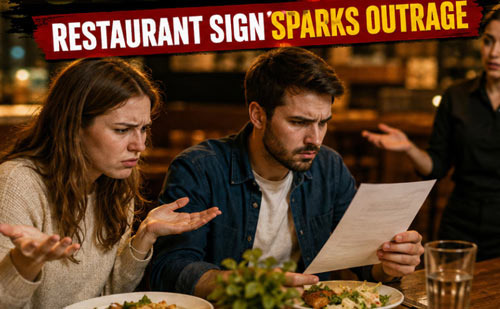
When I visit my family in LA's Koreatown on the weekends and go to a restaurant, I often find myself calculating tips.
With a food bill of $100 plus tax and a 20% tip, I sometimes wonder, "Did I just eat, or did I pay the staff's salary too?"
However, while researching the tipping system in the U.S., I came across a more shocking number.
$2.13 per hour.
In 2026, the federal minimum cash wage that employers can directly pay tipped employees is still $2.13.
At first, I thought I had misread data from the 1990s. The principle is called tip credit.
The federal minimum wage is $7.25, but for tipped employees like restaurant workers, employers can pay $2.13 and the remaining maximum of $5.12 can be covered by tips from customers.
Of course, if the total of tips and wages does not reach $7.25, the employer must make up the difference.
Interestingly, not all states in the U.S. accept this system.
Currently, seven states, including Alaska, California, Minnesota, Montana, Nevada, Oregon, and Washington, do not allow this tip credit.
In these states, no matter how much tips a waiter receives, the employer cannot reduce the base minimum wage because of it.
In simple terms, wages are wages, and tips are tips.
California, where I live, is a prime example.
California firmly established this direction 50 years ago in 1975.
At that time, the state legislature amended the law to prevent employers from using tips received by employees to reduce their obligation to pay minimum wage.
The intent of the legislation is quite easy to understand.
Tips are additional money given by customers for good service, not a substitute for the wages that the restaurant owner is originally obligated to pay.
As I read this part, I thought, "Ah, that's why California's restaurant wage structure is different from other states."
In 2026, California's state minimum wage is $16.90 per hour.
This means that a restaurant server subject to the generally applicable minimum wage in California must receive at least $16.90 from the employer, with tips being an additional amount on top of that.
In LA, the minimum wage set by the city may be even higher, so actual workplaces must consider local regulations.
On the other hand, in states that allow tip credit, the situation is completely different.
Some states have set the cash wage that employers must pay higher than the federal standard, while in some areas, the federal $2.13 structure may still apply.
So, not all waiters in the U.S. earn $2.13, nor do they all receive tips added to the minimum wage like in California.
Crossing a state line can change how wages are calculated. Knowing this made me see the tipping culture in the U.S. a bit differently.
Those who want to eliminate tips argue, "Why should customers be responsible for employees' wages?"
Conversely, the restaurant industry claims that servers in restaurants with good tips can earn significant income and that the existing system works well.
I can understand both sides.
However, from my perspective as a resident of LA, one thing is certain.
When the card terminal at a restaurant shows 20%, 22%, or 25%, I don't need to feel guilty thinking, "This person earns $2.13 an hour, so I can't not tip..."
In California, that $2.13 system does not apply.
That doesn't mean you shouldn't tip, though.
In the U.S., tips remain an important part of server income and are culturally ingrained.
Ultimately, the complexity of the tipping culture in the U.S. seems to stem from this.
Customers view tips as a reward for service, employees see them as a crucial part of their income, and in some states, employers include them in wage calculations.
However, California already made a statement in 1975.
"Tips given by customers are the employees' money, and wages should be paid separately by the employer."
Knowing this principle that has been upheld in LA for over 40 years, the TIP line on restaurant receipts looks a bit different to me now.
 EricUnisex
 LakeTalk







 coloradoman |
 Living Economy Information Blog |
 Tomato Health Club blog |
 Banana Style Life |
 crystalo |
 Chino Min |
 Cap Com |
 DREAM BIG |

 Korean Mom |
  My NYC |
  moo moo |
  Mr Oh |
  forevergee |
  festival |
  manchester |
  constant |
  Leapfrog Move |
  vibranto |
  Tora Tora |
  yellowbutter |
  Dolly |
  US Embassy |
  NYC saladbar |
  Finding Superfoods |
  lightyear |
  song bang |
  vexomo |
  Indiana Jones |