
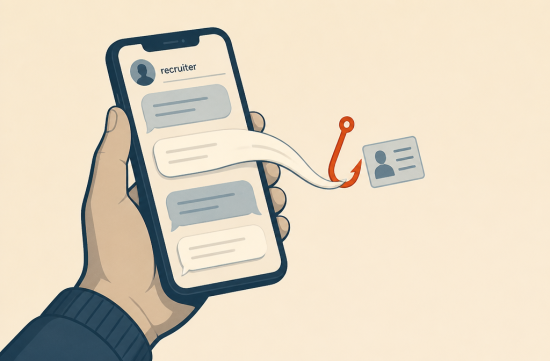
These days, I often hear people say, "I received a strange job offer."
They suddenly get high-paying work-from-home job offers via text or email and receive acceptance notifications without even a video interview.
At first, they feel lucky, but when they start preparing their employment documents and are asked for their Social Security number and bank account information, they realize something is off.
Such cases have been increasing lately, and statistics show that this is not just a coincidence but a clear trend.
According to the Federal Trade Commission (FTC), the number of reports related to job scams rose from about 38,000 in 2020 to approximately 105,000 in 2024.
This means it has nearly tripled in four years, and during the same period, the reported losses increased from $90 million to $505 million.
In the fourth quarter of 2025 alone, there were 25,002 reports of job-related scams, with losses reaching $150.4 million.
The median loss per victim was around $2,000.
A survey conducted by PasswordManager.com among job seekers in 2025 is also noteworthy.
Six out of ten job seekers reported encountering fake job postings, and one in four admitted to falling victim to job scams.
What's even more concerning is what happens next. Nearly half of those who fell for the scam provided personal information such as Social Security numbers, passwords, and bank details, and one in ten even sent money directly.
It's important to note that scammers don't just use any name. The survey revealed that the companies most commonly impersonated by scammers were Amazon, Google, FedEx, UPS, and Walmart.
These are all companies that actually hire for remote or part-time positions, making them easy to trust without suspicion.
The methods of contact are also varied. Emails accounted for 72%, followed by text messages at 62%, phone calls at 38%, and LinkedIn messages at 29%.
In a legitimate hiring process, communication usually comes from an official company domain email, whereas fake postings often use personal email addresses.
It's also troubling that fake postings don't only appear on suspicious sites. They are often posted on familiar job platforms like Indeed and LinkedIn, so you can't just feel safe based on the platform name.
If the salary or hourly wage is significantly higher than the market rate for the same position, it's reasonable to take that as a warning sign. Legitimate companies don't typically rush to hire with conditions that far exceed the market rate.
A type of scam that has noticeably increased in recent years is the so-called 'task-based' scam.
In 2020, there were virtually no reports of this type, but in the first half of 2024 alone, about 20,000 were received, accounting for roughly 40% of all job scam reports that year.
These scams involve asking for simple tasks via apps or messengers, such as clicking on product reviews or rating them, and initially depositing small amounts to build trust before demanding larger sums, claiming that you need to deposit money first to withdraw.
By the time you reach this stage, you often have already provided your name, date of birth, account information, and a copy of your ID.
Personally, I find this part the most disheartening. In a normal hiring process, there's absolutely no reason to ask for a copy of your ID or Social Security number before your employment is confirmed.
So, if you remember just one principle, you can significantly reduce your chances of making a mistake: never disclose your Social Security number until you receive a formal offer letter and sign the documents.
If you see a job posting, it's a good idea to check the company's official website to see if the same position is actually listed there.
It's also worth making it a basic verification step to search for the name of the person claiming to be the interviewer and check if their LinkedIn profile and email address actually match.
If they ask you to send money upfront for equipment or training costs before you start, you can safely assume it's a scam at that point.
There's also a method where they don't ask for money directly but send you a check first. After you deposit the check, they instruct you to buy equipment with part of it and send it to a specific account, but if the check bounces a few days later, the money you've already withdrawn becomes your debt.
If you've already sent personal information, the next step is to report it to the FTC's reporting site and the FBI's IC3.
It's also worth considering a credit freeze to temporarily block credit inquiries.
It's important to note that as the job market tightens and more applicants flood in, these scams become more effective. Those who need to find a job quickly are more likely to make poor judgments, and scammers specifically target that vulnerability.
While the saying "the more urgent, the more you should slow down" may sound cliché, I believe it is the most reliable principle in this matter.
 googleidea








 Always Dreaming of Big Success |
 happy 9 |
 coloradoman |
 pintos |
 mapsina |
 Sugar Cream Door Bulletproof Noodles |
 DaeBak Electronics CNET |
 Peter Pan Pet |
 Nuchuhan Exploration BLOG |
  my town K blog |
  bloomberg |
  morninpo |
  bravik31 |
  Various Knowledge and Information in the USA |
  orvik90 |
  San Gabriel Mountains |
  quanta7 |
  Fransco Family |
  leonee |
  Augusta 90 |
  Project Tomorrow |
  DOCTOR MED |
  Say IT Now |
  Alpha and Omega World |
  NEXT ROUND |
  Helpful Life Stories |
  Healthy Local Fresh Information |
  molten |