
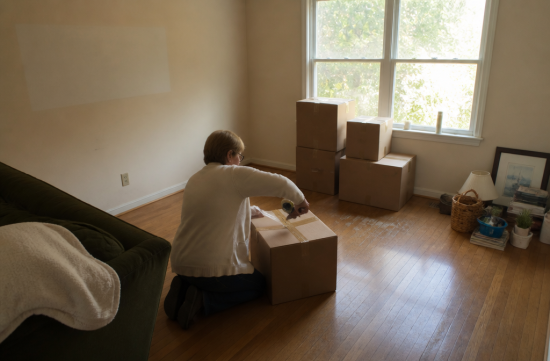
Recently, a couple I know shared a story with me. They are planning to sell their two-story house, where they have lived for nearly 40 years, and move to a two-bedroom condo.
Their children have all grown up and become independent, and the large house now feels like a burden to just the two of them.
At first, I wondered why they would want to downsize from such a spacious and nice home, but looking around, I noticed that they are not alone in this choice.
In the U.S., this trend is tracked separately in statistics. Households with two or more spare rooms after their children have moved out and who have lived in their homes for over ten years are categorized distinctly if they are 55 years or older.
Research shows that these households make up 16 percent of all American families. This means that more than one in ten homes has empty rooms, which is a larger scale than one might think.
Moreover, there is also data indicating that baby boomer households, which consist of just the couple or one or two children, own 28 percent of large homes in the U.S.
In contrast, only 16 percent of families from the millennial generation, who actually need larger homes, own them.
This mismatch between those who need homes and those who own them has led to discussions in the U.S. real estate industry about how this generational shift could be key to housing supply issues.
Among economic experts, this mismatch has even been referred to as a "silver tsunami."
However, even when they do decide to move, older Americans tend to prefer not to go just anywhere; they often favor locations near the cities where their children live or coastal areas. This has raised concerns that such preferences could drive up housing prices in those regions.
Interestingly, most older Americans are not particularly eager to move.
AARP research found that 79 percent of baby boomers want to stay in their current homes for as long as possible.
Another study revealed that one in three baby boomers who own homes stated they would never sell their house.
Despite saying this, when it comes time to make the decision to move, many end up choosing smaller homes. Research on those who have actually moved after retirement found that about half of them relocated to smaller homes than they had before.
More than half of baby boomers planning to move said they are looking for single-story homes without stairs, and three-quarters of them are considering downsizing to even smaller single-family homes.
This suggests that while they generally prefer not to move, once they decide to do so, most tend to choose smaller options.
Curious about the reasons behind this decision, I looked into a few more cases and asked around, and the most common reason was surprisingly simple.
They feel that having less space to clean and maintain makes life easier. Many have mentioned that climbing stairs has become burdensome, and tasks like mowing the lawn and raking leaves are no longer as manageable as they used to be.
The second reason is financial. The larger the house, the higher the property taxes, heating costs, and insurance premiums, so moving to a smaller home can significantly reduce monthly fixed expenses.
The third reason is a bit more emotional: they do not want to leave a burden of sorting through their belongings for their children after they are gone.
If a large house is filled with decades' worth of belongings, the responsibility of clearing it out ultimately falls to the children.
Knowing this, they seem to feel a desire to organize things themselves while they are still alive.
Psychological research has shown that the process of decluttering can reduce stress and lighten one's mood, so this is not just about thinking of their children.
Of course, not everyone moves with such a clear mindset. There are certainly cases where individuals are forced to downsize due to the loss of a spouse or sudden health issues.
It seems a bit irresponsible to lump all these situations together and say that everyone feels liberated; there is a significant difference between being pushed to downsize and choosing to do so.
Considering that those aged 50 and older hold 74 percent of all home ownership in the U.S., the choices this generation makes will inevitably affect the overall market atmosphere. Thus, downsizing is a topic that goes beyond personal circumstances.
Overall, it appears that this downsizing is more of an attempt to take control of their situation rather than a forced choice.
It feels less about reducing the number of rooms and more about determining the size of their future lives.
Maintaining a large home is a skill, but knowing when to downsize is also a significant decision.
Sometimes, it seems braver to acknowledge the space that is no longer needed and to organize it rather than holding on and enduring for too long.
There is a saying that as we age, it takes more courage to let go than to hold on, and every time I hear this, it comes to mind.
If it were me, I would prefer to make a clean decision when the time is right rather than holding on out of attachment. I believe that the decision to downsize is ultimately about defining the next chapter of one's life.
 ShinRamen


 Alpha and Omega World |
 Florida King |
 AH LALA |
 Victory 1988 |
 Panorama Kstar |
 Rolling Joy Life |
 Dollydori, Lover of Movies |

 Supplemental Security Income (SSI) Information |
 ringwinds |
 quanta7 |
  Fransco Family |
  leonee |
  Augusta 90 |
  Project Tomorrow |
  DOCTOR MED |
  Say IT Now |
  Always Dreaming of Big Success |
  NEXT ROUND |
  Helpful Life Stories |
  Healthy Local Fresh Information |
  molten |
  Way to easy |
  intact |
  happy 9 |
  Park M.Y. |
  tredon |
  Poppin News |
  metsoo |