
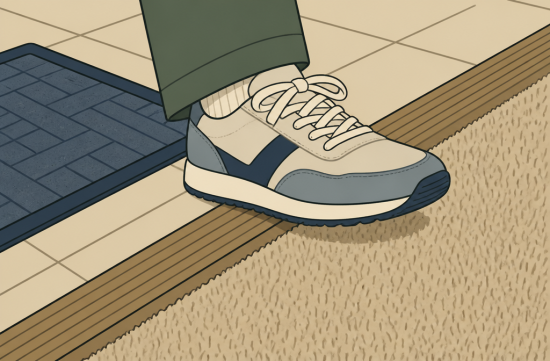
I still vividly remember the scene from a few years ago when I was first invited to a friend's house in America. As soon as I opened the front door, my hand instinctively paused before I could untie my shoelaces.
Everyone was casually sitting on the living room sofa with their shoes on, even walking across what looked like a brand new white rug.
If this were Korea, I would have been scolded by the adults, so I rubbed my eyes several times to confirm what I was seeing.
Why is it so different? It seemed too simplistic to attribute it solely to differences in hygiene concepts, so I later did some research.
It turns out the answer lies in the fact that the structure of homes and the traditional ways of living are fundamentally different.
In Korea and Japan, people have been sitting, lying down, and even sleeping on the floor for a very long time. Meals are served on low tables, and the whole family gathers around, meaning the floor and the body are always in close contact.
Whether it's ondol or tatami, the floor itself has been both a living space and a sleeping area, so the standards of cleanliness naturally had to be higher.
Therefore, if the floor is dirty, it directly affects the body, making it more of a survival habit than a matter of etiquette to take off shoes.
In contrast, Western cultures have lived primarily with chairs, beds, and tables for a long time. The body remains elevated well above the floor.
The floor was merely a passageway, not a place where people would sit or lie down.
As a result, people didn't feel particularly uncomfortable walking around with their shoes on, and this habit has been passed down through generations.
If this is the historical background, looking at recent survey data reveals another picture.
In a 2023 survey conducted by CBS News and YouGov, 63% of Americans reported that they regularly take off their shoes when they come home. This number is significantly higher than expected, diverging from common perceptions.
I was a bit surprised when I first saw this figure and looked at it again for a while.
However, only 24% of respondents asked guests to take off their shoes.
This indicates that while they may take off their own shoes, they do not impose that on others, which I found quite characteristic of American culture.
The generational differences revealed in the same survey were even more interesting. Among respondents aged 65 and older, only 7% requested guests to remove their shoes.
For those aged 45 to 64, the figure was 13%, while it rose to 44% among the younger generation aged 18 to 29.
This shows a nearly six-fold difference between older and younger generations, signaling a shift beyond personal preferences, indicating changing times. The younger generation, who are more concerned with hygiene and interior design, likely treat their homes with greater care.
Looking back further, a 2018 YouGov survey showed that only 31% of respondents said they always take off their shoes.
However, when combining those who said they take them off at least sometimes, the number rose to 87%, which is worth noting.
This suggests that the image of Americans always wearing shoes indoors is somewhat exaggerated compared to reality. It may be a stereotype formed solely from scenes in movies or dramas.
Still, when considering why this hasn't become a matter of etiquette or rules, it seems to align with a culture that respects individual choice.
Even in someone else's home, the attitude of doing what feels comfortable is seen as natural rather than rude.
This is a sense that would be hard to imagine in Korea, but I believe it's not a matter of right or wrong; it's just a difference in roots. Acknowledging that made me feel more at ease.
The opposite situation is also quite interesting. When I invite an American friend to a gathering in the Korean community, I've seen them look slightly surprised when asked to take off their shoes.
Some have felt embarrassed, saying their socks had holes, while others laughed and put their shoes back on, saying their feet were cold.
Conversely, there have been moments when a Korean person visiting an American friend's house unconsciously took off their shoes at the entrance and stood awkwardly, leading to an awkward moment for both parties. In such cases, having a few pairs of indoor slippers for guests at the entrance can eliminate the need for either side to feel uncomfortable.
Recently, more homes in America are using hardwood or tile floors instead of carpets, and with growing concerns about hygiene, the number of homes where shoes are taken off is gradually increasing.
The earlier mentioned figure of 44% among the younger generation seems to be related to this trend.
Personally, I find it much more comfortable to take off my shoes indoors, and it feels less unpleasant when something spills on the floor. Moreover, the moment I take off the shoes I've been wearing all day feels like a signal of relaxation.
Ultimately, there are no right answers in culture, but understanding the background makes it feel lighter when crossing the threshold of someone else's home. The next time I'm invited to someone's house, I think I can comfortably ask about taking off my shoes without hesitation.
 RocketTiger


 Alpha and Omega World |
 Florida King |
 AH LALA |
 Victory 1988 |
 Panorama Kstar |
 breezem |

 silverleaf |

 eatontown blog |
 Kentucky Fried Chicken |
  bloomberg |
  morninpo |
  my town K blog |
  bravik31 |
  Various Knowledge and Information in the USA |
  orvik90 |
  San Gabriel Mountains |
  quanta7 |
  Fransco Family |
  leonee |
  Augusta 90 |
  Project Tomorrow |
  DOCTOR MED |
  Say IT Now |
  Always Dreaming of Big Success |
  NEXT ROUND |
  Helpful Life Stories |
  Healthy Local Fresh Information |