
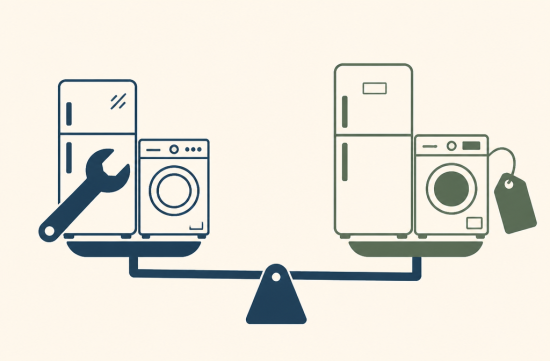
When a refrigerator makes strange noises or a washing machine fails to spin, the first thought is often whether to repair it or buy a new one.
Even before calling a repair technician, you start calculating in your head, but when you receive the estimate, the amount can often be more ambiguous than expected.
The average repair cost for a refrigerator typically ranges from $300 to $400.
However, if there is a major issue like a compressor or refrigerant system failure, the costs can rise to between $600 and $1,000.
In contrast, washing machines are relatively cheaper, with average repair costs around $200 to $250.
Of course, if key components like the drum bearing or control board fail, the repair bill for a washing machine can also reach between $300 and $550.
The problem is that to determine whether these repair costs are high or low, you need to compare them with the price of new products.
Currently, new refrigerators are sold for between $600 and $2,300, and if you choose a decent mid-range model, you should budget around $1,000 to $2,000.
Washing machines are slightly lower, priced between $500 and $1,800, with popular models typically falling in the $800 to $1,300 range.
This leads to what is commonly referred to in the industry as the 50 percent rule. If the repair cost exceeds 50 percent of the price of a new product, it is generally more economical to replace rather than repair.
Recently, a 50/10 rule has emerged, suggesting that if the repair cost exceeds 50 percent or the appliance is over 10 years old, you should consider replacing it if either condition is met.
For example, if a $1,200 refrigerator has a compressor failure with an estimate of $700, that is nearly 60 percent of the new product price, making replacement more appealing.
On the other hand, if replacing a door seal on the same refrigerator costs $150, it is obviously more beneficial to repair it, regardless of age.
The average lifespan of a refrigerator is typically between 10 to 15 years, with top-freezer models lasting about 14 years and side-by-side or French door models lasting around 12 years, which is slightly shorter.
Washing machines have a similar expected lifespan of 10 to 15 years, but there are differences based on the type, with front-loaders lasting about 11 years and top-loaders around 14 years.
Consumer surveys indicate that about 20 percent of washing machines fail within 10 years, so it's not entirely a matter of luck.
Ultimately, if the appliance is relatively young and the repair cost is only 20 to 30 percent of the price of a new product, repairing it makes sense. However, if it's over 10 years old and the repair cost is nearly half, replacement becomes more reasonable.
Neglecting appliance maintenance can often lead to earlier breakdowns. For instance, if dust accumulates on the condenser coils at the back of the refrigerator, it can put extra strain on the compressor, leading to repairs sooner.
Similarly, if detergent residue or mold builds up on the rubber seals of a washing machine, it can easily lead to pump or valve failures. Remembering to clean them every few years can help reduce repair costs.
One variable that is easy to overlook is the diagnostic fee. The service call cost for a technician to come and assess the problem typically ranges from $75 to $150, but this fee is often deducted from the repair cost if the repair is actually performed.
It's easy to feel compelled to go ahead with repairs to avoid losing the diagnostic fee, but that decision should be weighed against the actual economic sense.
Energy efficiency is also a factor to consider. New refrigerators and washing machines are about 20 to 40 percent more energy-efficient than older models, potentially saving $50 to $150 on annual electricity bills.
When you accumulate these savings over 5 or 10 years, the conclusion may differ from simply comparing repair costs and new product prices.
From an economic standpoint, the residual value of appliances over 10 years is essentially negligible.
Spending a significant amount on repairs for an asset that has already depreciated is, frankly, likely to be akin to pouring water into a bottomless pit.
Extended warranties that come with new products should also be factored into the equation. Extended warranty costs typically range from 10 to 20 percent of the product price, but if the model already includes a 5-year parts warranty, additional coverage may not be necessary.
When disposing of an old product, it's also wise to budget for an additional $25 to $50 for the delivery service to handle the disposal of the new product.
New appliances can be significantly cheaper during sale seasons like Black Friday or Memorial Day, so if you decide to replace, timing your purchase can also be a way to save.
If you decide to go ahead with repairs, it's safer not to rely on just one estimate and to compare at least two or three options.
There can be a considerable price difference between original manufacturer parts and compatible parts, so it's also a good idea to ask the technician which parts they will use.
If I were in your position, I would consider the remaining warranty period and energy efficiency for appliances that fall into a gray area before making a decision.
Rather than emotionally clinging to an item, developing the habit of making decisions based on numbers will ultimately protect your wallet.
 BurningTruck






 Silent Sea |
 Pointy |
 Idaho's Sumi's House |
 holy cheese |
 Michigan Enthusiast |
 lavender |

 linex |

 Kentucky Fried Chicken |
  bloomberg |
  morninpo |
  my town K blog |
  bravik31 |
  Various Knowledge and Information in the USA |
  orvik90 |
  San Gabriel Mountains |
  quanta7 |
  Fransco Family |
  leonee |
  Augusta 90 |
  Project Tomorrow |
  DOCTOR MED |
  Say IT Now |
  Alpha and Omega World |
  Always Dreaming of Big Success |
  NEXT ROUND |
  Helpful Life Stories |
  Healthy Local Fresh Information |