
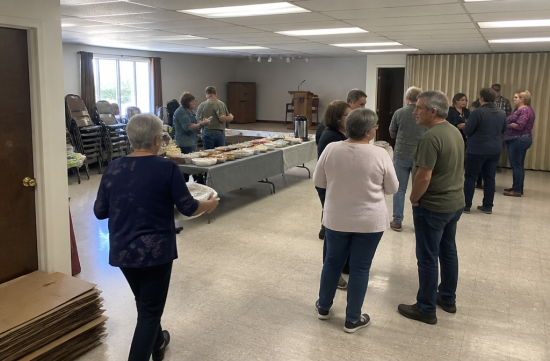
Last month, my neighbor moved out, but the people who helped with the move were not from a moving company; they were members of the local church's youth group. It turns out that the neighbor had never attended the church.
At first, I thought it was just a volunteer activity, but in the U.S., such scenes are surprisingly common.
Churches are not just places for worship; they serve as actual hubs for taking care of the community.
If you look at American church buildings, many have gyms, large kitchens, and meeting rooms next to the worship hall. Initially, I wondered why they were built so large, but they were actually designed to function like community centers.
Sociologist Ray Oldenburg stated that for a community to thrive, there needs to be a 'third place' that is neither home nor work. In the U.S., churches have long filled that role.
According to a Pew Research survey, 40% of American adults reported participating in religious services at least once a month. This includes both online and in-person attendance.
Of those, about one-third attend services in person, while the rest either watch online or do not attend at all. The same survey found that 49% reported rarely attending services, so churches are certainly not places for everyone.
Interestingly, even those who do not attend services often utilize church-run services like free meal programs, after-school programs, and sobriety meetings. They are using the services regardless of their faith.
If you visit a church parking lot during the day, it is common to see it being used as a polling place, hosting Boy Scout meetings, or conducting yoga classes. The building is active throughout the week.
A Lifeway Research survey of Protestant pastors estimated that an average of 42% of congregants take on regular roles within the church, and 27% engage in community service outside the church. People are continuously active, whether inside or outside the church.
When considering why this is particularly pronounced in the U.S., it is significant that there have not traditionally been many public spaces for neighborhood gatherings.
Unlike Korea, where community centers are available in every apartment complex and local government programs are well-structured, neighborhoods that require driving often lack walkable gathering places.
Sociologist Robert Putnam pointed out in his book "Bowling Alone" that Americans have noticeably distanced themselves from neighborhood gatherings and club activities over the past few decades. While traditional neighborhood organizations like bowling leagues and parent groups have declined, churches have remained relatively resilient.
Churches have filled that void, and I personally believe this is more about infrastructure than a matter of faith.
So, what about Korean churches?
A closer look at Korean immigration history reveals that churches have long served as the first settlement points for immigrants.
English classes, immigration paperwork assistance, and job information sharing have occurred within churches as naturally as worship.
For the older generation, teaching English and for the children born and raised in the U.S., teaching Korean language and holiday customs have been significant roles for many Korean churches. The church has filled gaps that schools or academies could not.
According to a Pew Research survey, 59% of Korean Americans identified as Christians, while only 32% of people living in Korea identified as such in the same survey.
It is hard to believe that faith suddenly doubled upon immigration. It seems more accurate to view the church as a place that simultaneously resolves language, information, and social connections in a foreign land.
In fact, when listening to stories from early immigrants, many often express that a cup of coffee and a meal after service were more crucial than the service itself.
In that sense, Korean churches can be seen as having rapidly and compactly fulfilled the 'third place' function that American churches took a long time to develop.
However, there are aspects that differ from American churches. Many American churches often keep their facilities open to local residents who are not members.
In contrast, Korean churches tend to create a tighter community among people with the same language and background, which can make them feel somewhat closed off to outsiders. This is more a matter of structural difference than a question of good or bad.
Among the second generation, there are often comments that they do not feel the church is the center of the community as much as their parents did.
Having become more comfortable with English, some have expressed that they find Korean services burdensome, leading to a natural decline in attendance.
This is not so much a matter of faith but rather a change in habits regarding where to meet people as generations shift, making it difficult to place blame on anyone.
Personally, I often feel a similar function in hiking groups or running clubs.
When sweating with the same people at the same time each week, information is exchanged, and everyone checks in on each other. Ultimately, this is not much different from the role the church used to play.
Conversations shared while walking a mountain trail often feel fundamentally similar to those shared in a church lobby.
Ultimately, what matters is not whether it is a church, but whether there is a place in the community where people regularly see each other and can help one another.
I believe that the Korean community would become healthier if it could expand beyond relying solely on the church to include various outlets like hiking groups or hobby clubs.
 dreamer1981




 Alpha and Omega World |
 Florida King |
 AH LALA |
 Victory 1988 |
 Panorama Kstar |
 AliAluAlo Blog |
 KGOMIO Blog |
 morvex37 |

 U.S. Weather Bureau News |
  my town K blog |
  bravik31 |
  Various Knowledge and Information in the USA |
  orvik90 |
  San Gabriel Mountains |
  quanta7 |
  Fransco Family |
  leonee |
  Augusta 90 |
  Project Tomorrow |
  DOCTOR MED |
  Say IT Now |
  Always Dreaming of Big Success |
  NEXT ROUND |
  Helpful Life Stories |
  Healthy Local Fresh Information |
  molten |
  Way to easy |
  intact |