
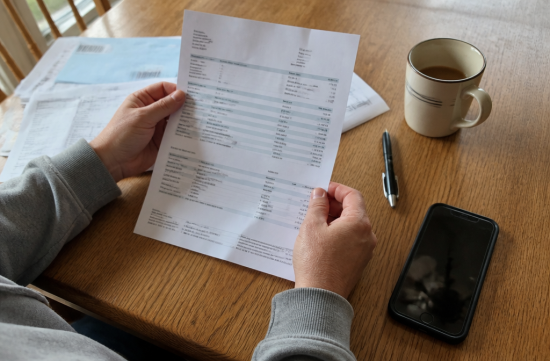
After visiting the hospital, when a bill arrives in your mailbox a few weeks later, the total amount immediately catches your eye.
If the number is larger than expected, it can be a bit shocking, but many people end up just pulling out their card anyway. It seems like there's a general attitude that hospital bills are just something you have to deal with.
However, very few people actually know what the few lines on that piece of paper mean.
Typically, you only receive a summary that lumps together charges like room fees, treatment fees, and testing fees. Unless you specifically request it, you will never find out how many times a treatment was billed or how much each charge was.
Instead of this summary, you can formally request a document from the hospital called an itemized bill.
This document includes medical codes known as CPT or HCPCS attached to each item, with a price assigned to each code.
This allows you to check if the same treatment was billed twice or if there are tests you didn't receive included in the charges.
The catch is that very few hospitals provide this upfront. Most patients just receive the summary and pay, so from the hospital's perspective, there's no reason to offer it first.
It's important to know that requesting an itemized bill is a patient's rightful entitlement.
According to HIPAA regulations, hospitals must provide an itemized bill within 30 days of a patient's request.
If they can't meet that deadline, they can extend it for another 30 days, but they must inform you in writing about the delay.
This regulation applies regardless of whether you have insurance, and hospitals cannot charge a separate fee for providing this document.
The request process is not difficult; a simple phone call to the hospital's billing department or patient services department will suffice. Just saying you want to request an itemized bill is enough, and if you want to keep a record, you can also request it via email or through the patient portal.
Many hospitals now operate online patient portals, so you might be able to submit your request without having to visit in person.
When you actually receive the bill, you may find that it's not as clear as you expected.
For example, if you had an X-ray or CT scan in the emergency room, you might find that the same item is listed in two separate lines, each billed twice.
According to one study, 80 percent of all hospital bills contain at least one error.
Duplicate billing is particularly common, with analyses showing it occurs in 30 to 49 percent of all bills.
There are also instances where treatments that were never received are included, or where the billing is switched to a more expensive medical code.
The larger the bill, especially those exceeding $10,000, the greater the potential error amount, with an average discrepancy of about $1,300. That's a significant amount to overlook.
If you find strange items on your itemized bill, you can dispute them with the hospital's billing department.
It's effective to go through the date, time, and quantity of each item, specifically asking about items you did not receive. Being vague about the bill being strange is less effective than pointing out specific item numbers.
In fact, when patients directly inquire, 37 percent of bills are corrected, 18 percent are adjusted for payment plans, and 17 percent have the amounts reduced, according to research.
This means that if you do nothing, you won't gain any of these benefits, so asking is definitely advantageous.
If your income is below a certain threshold, you might also qualify for discounts or waivers through the hospital's financial assistance program, so it's good to ask about this while reviewing your itemized bill.
Having insurance doesn't mean you can skip this entire process; there are still cases where your out-of-pocket calculations can be incorrect. Discrepancies between what the insurance company billed and what the hospital charged you can be revealed by comparing the itemized bill.
While disputing charges, there's no need to rush to pay the full amount, but ignoring it completely can lead to delinquency records later, so it's wise to inform the hospital that you are inquiring.
Just like reviewing numbers in a business or contract, hospital bills are ultimately just another type of invoice, so the verification process isn't anything out of the ordinary.
I believe it's much better to request the itemized bill first, rather than trusting the bill amount and paying right away, even if it's a bit of a hassle.
It only takes a phone call and a little waiting for the document, but the amount you can verify is quite significant.
The next time you receive a hospital bill, I recommend not pulling out your card right away, but instead requesting the itemized bill first.
 ChocoJoyful




 Silent Sea |
 Pointy |
 Idaho's Sumi's House |
 holy cheese |
 Michigan Enthusiast |
 parlon |
 yentra |
 So Good Day |
 Virginia Butterfly Mom |
 Various Knowledge and Information in the USA |
  orvik90 |
  San Gabriel Mountains |
  quanta7 |
  Fransco Family |
  leonee |
  Augusta 90 |
  Project Tomorrow |
  DOCTOR MED |
  Say IT Now |
  Alpha and Omega World |
  Always Dreaming of Big Success |
  NEXT ROUND |
  Helpful Life Stories |
  Healthy Local Fresh Information |
  molten |
  Way to easy |
  intact |
  happy 9 |
  Park M.Y. |