
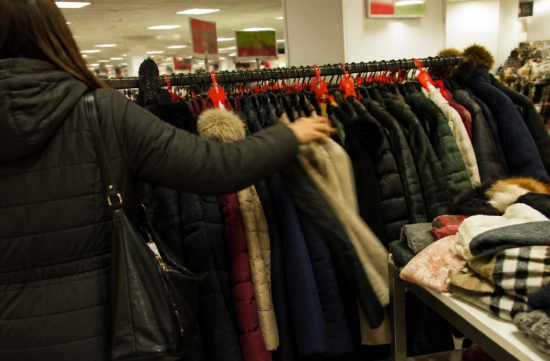
Have you ever noticed thick padding and coats pushed to the corners when you visit a supermarket or department store outlet around March?
If you look at the sale tags attached, the prices drop significantly, making it hard to resist for many shoppers.
It's natural to wonder why people buy clothes that they won't wear right away and stash them deep in their storage or closet.
To put it simply, this isn't just a frugal habit; it's a strategy that accurately understands the discount cycle in American retail.
Winter outerwear discounts typically start around mid-January, but at this point, the discounts are not very steep, usually around 30 percent.
However, as February rolls in, brands like North Face and Columbia often see discounts reaching up to 50 percent. If you check the clearance section in department stores during this time, you'll find similar reductions on products from Ralph Lauren and Michael Kors.
The real deals happen in March, where one department store chain recorded discounts on winter coats ranging from 70 to 88 percent.
For kids' padding, prices can drop by as much as 80 percent towards the end of the season. One sporting goods store runs sales from February to April, with March being the best time for a balance of stock and discount depth.
However, the catch with this timing is that as the discounts increase, the desired sizes or colors are often sold out.
So, savvy shoppers find a reasonable compromise between discount rates and remaining stock.
You might wonder why they would wait until the next winter to wear these clothes, and the answer lies in the variable of price increases.
Recent data shows that the prices of winter jackets and outerwear have risen by an average of 24 percent compared to the previous year.
Considering that the average price of a winter coat from brands like Columbia, LL Bean, and Dick's Sporting Goods ranges from $100 to $300, this increase is quite noticeable. Premium brands like Canada Goose maintain prices around $950 without discounts, indicating significant differences among brands.
Thus, a coat purchased at a 70 percent discount at the end of this season will be much cheaper than the regular price of the same brand next year.
Buying it for less than a third of the regular price and storing it for a year is definitely more advantageous than paying full price next year.
But the process doesn't end with the purchase; the real challenge is storage.
Maintaining the condition of the clothes while storing them for over six months can be more labor-intensive than expected.
The first thing to consider is the storage location, which should be cool, dry, and away from sunlight.
Spaces like attics or basements with fluctuating humidity and temperature can damage the fabric, so it's best to avoid them.
Many people opt for vacuum bags to save space, but if it's down padding, this is something to reconsider.
Excessive compression can reduce the down's ability to regain its shape, making it less warm the following year.
While vacuum bags are fine for bulky knits or scarves, it's safer to store padding or coats in a spacious under-bed storage container. Labeling each container with its contents can save you time when retrieving items the following year.
Using mothballs can leave a smell on the clothes, requiring another wash the next year, so many prefer cedar chips or lavender sachets instead.
Including moisture absorbers in the storage containers can help reduce musty odors and mold concerns.
Before storing, it's essential to wash or dry clean the items, as leftover food stains or sweat can attract pests more easily.
Despite knowing the effort involved, people stick to this method because the savings can be substantial.
Buying a $200 coat at a 70 percent discount means you only pay $60. If you repeat this over three years, you save over $420 compared to buying at full price. When you look at the numbers, it seems worth the effort to make some space in your closet.
Of course, there are counterarguments; children can grow quickly in a year, making sizes unsuitable, and changing fashion trends pose risks.
Thus, those who use this strategy tend to focus on basic designs that are less trend-sensitive or adult outerwear to minimize risks.
Personally, I feel that this seasonal discount structure encourages stock clearance rather than planned consumption.
However, that doesn't mean ignoring this trend and buying at full price is more rational; I believe consumers should navigate wisely within the given structure.
If it were me, I would probably only stock up on one or two basic outerwear pieces that I wear frequently during this timing.
 SodaSleepLab







 Silent Sea |
 Pointy |
 Idaho's Sumi's House |
 holy cheese |
 Michigan Enthusiast |
 Northeastern |
 sparklingo |
  Fransco Family |
 DelphiaMo |
 BOOM BOOM BOOM |
  San Gabriel Mountains |
  quanta7 |
  leonee |
  Augusta 90 |
  Project Tomorrow |
  DOCTOR MED |
  Say IT Now |
  Alpha and Omega World |
  Always Dreaming of Big Success |
  NEXT ROUND |
  Helpful Life Stories |
  Healthy Local Fresh Information |
  molten |
  Way to easy |
  intact |
  happy 9 |
  Park M.Y. |
  tredon |
  Poppin News |