
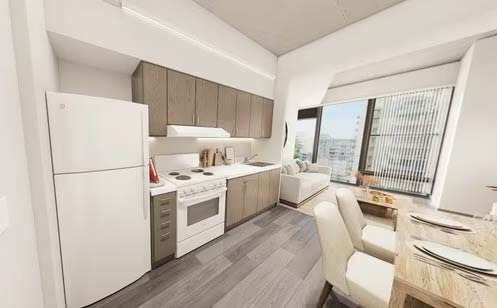
If you're moving to San Francisco, the first thing you should check is the rent prices rather than the home prices.
I used to think I was used to high rents when I lived in California, but looking into SF rents makes me realize it's on a whole different level.
As of 2026, you should expect to pay around $3,000 a month for a 1-bedroom apartment in San Francisco.
A decent place will easily exceed $3,000. Of course, there are significant differences depending on the neighborhood.
In popular northern areas like Marina, Pacific Heights, and Russian Hill, you should be prepared to pay over $3,500 for a 1-bedroom.
Places with good views, remodeled homes, or included parking can go for over $4,000.
New apartments in the SOMA area are also not cheap. Luxury apartments with amenities like pools, fitness centers, and doormen can end up being much more expensive once you factor in all the additional costs.
On the other hand, if you go down to Excelsior, Outer Mission, or southern areas, you might find relatively cheaper homes. However, even for the same 1-bedroom in SF, prices can vary by hundreds of dollars based on the building's age, parking availability, laundry facilities, and proximity to public transportation.
And a really important factor here is rent control.
San Francisco has many older rental units, and a significant number are subject to rent increase restrictions. So if you plan to live there long-term, it might be much more important to check if the place is rent-controlled rather than just looking for a unit that's $100 or $200 cheaper.
For those who manage to get in at a good price and stay for 5 or 10 years, the difference can be huge.
However, there's something to be cautious about. Don't assume that "any building built before 1979 is automatically rent-controlled." There are exceptions based on the type of building, ownership, and applicable state laws, so it's best to check what regulations apply to the unit before signing a lease.
You also need to be quick when looking for a place.
If a property you like comes up and you plan to check it out with your partner over the weekend and decide next week, it might already be rented by someone else. It's convenient to have your credit score, proof of employment and income, bank statements, and previous landlord contacts ready in advance.
Especially for families immigrating directly from Korea or coming as expatriates, it can be tricky since they may not have a credit history in the U.S. Even if you have money, landlords may find it hard to assess you without a U.S. credit record. In such cases, you might be asked for a guarantor or an employment verification letter from your company.
Also, it's important to be aware of the security deposit regulations in SF. Starting in 2024, California will implement a system that limits security deposits for most residential rentals to one month's rent. There are exceptions for some small landlords, so you should read the lease carefully.
When looking for a home, Korean residents don't need to limit themselves to American sites like Zillow or Apartments.com. The Korean community in the Bay Area also posts rentals, roommate opportunities, and subleases. Especially if you're new to SF and unfamiliar with the area, it might be a good idea to live temporarily for a few months to experience the neighborhoods before signing a long-term lease.
And if you have a car, you can't just look at the rent.
In SF, parking can add several hundred dollars to your monthly expenses. Conversely, if you live close to BART or Muni and eliminate your car, you can save on car payments, insurance, gas, and parking fees all at once.
Ultimately, if you're looking for a 1-bedroom in San Francisco, it's reasonable to consider around $3,000 a month as a starting point.
SF is indeed very expensive. However, by changing neighborhoods a bit, looking for older rent-controlled apartments, and calculating whether you really need a car, there are definitely ways to reduce costs.
In San Francisco, finding a good home is important, but how long you can live in a place at a stable price is even more crucial.
 urbanforesttraveler1923







 Valley Hong |

 Mr Oh |

 ollege Mom |

 Helpful Life Stories |
 prixon74 |

 Nuchuhan Exploration BLOG |

 Moscow Kim |
 Peter Pan Pet |


 U.S. Weather Bureau News |
 Giant Squid and Sweet Potato Soup |
 The Gelaton |
 Twist Kim |
 berlon93 |
 Physical Laws and Science |
 good thinking |
 Solo Yolo |
 laro90 |
 San Diego TOP Idol |
 Round and Round Children's Song Kingdom |
 American Golf Course Travelogue |
 MEDBIO American Doctor Blog |
 Hot Seat Driver |
 bryvexi |
 koala organic farm |
 riverstone |
 My Antonio |
 California Information News |