
Last week, while enjoying a latte at a local café, I overheard a conversation at the next table. They were talking about how their dog had eaten something on a walk and had to go to the emergency room, resulting in a hefty credit card bill for just one night.
It didn't feel like someone else's story. My cat has also been leaving food lately. I thought it was nothing serious, but the thought of potential vet bills weighed on my mind.
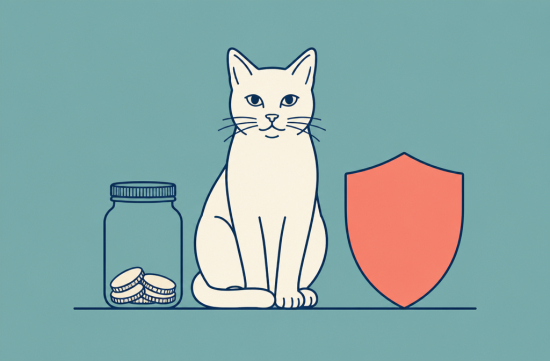
So, I decided to take a closer look at whether getting pet insurance would be better or if I should just save money each month.
First, let's talk about some surprising numbers. According to the North American Pet Health Insurance Association (NAPHIA) report from 2026, only 4.27% of pets in the U.S. are insured.
For dogs, the rate is 5.99%, and for cats, it's 2.29%. This means that most cat owners are essentially going it alone.
So, how much does insurance cost? Based on the same report, the average premium for accident and illness coverage in the U.S. in 2025 was $836 per year for dogs and $435 for cats.
Dog premiums increased by 11.5% from the previous year, while cat premiums rose by 12.6%. While prices are rising everywhere, this seemed a bit steep.
If you divide the dog insurance premium by 12, it comes out to $69.67 a month. That's quite a bit for just a few cups of coffee.
However, when you look at the numbers for veterinary costs, your perspective might change. In a 2026 survey by Spot Pet Insurance, one in five households reported that they couldn't handle a $500 bill.
Only 18% of people said they could pay high veterinary bills without cutting back on other expenses.
According to a 2026 report by Rover, 38% of dog owners said they couldn't afford emergency care without going into debt.
A survey by MetLife found that four out of five pet owners experienced unexpected veterinary costs, with an average amount of $1,100.
Of course, these surveys were conducted by insurance or pet service companies, so it's wise to take them with a grain of salt. Still, it's clear that sudden veterinary expenses are a burden for many households.
Now, let's see how pet insurance actually works. The most important thing to know is that you typically pay the full veterinary bill upfront and get reimbursed later.
When you submit a claim, they deduct your deductible from the total and then multiply the remaining amount by your reimbursement rate. The reimbursement rate usually ranges from 70% to 90%. Many companies state that it can take anywhere from 5 to 30 business days to receive your money back, depending on the insurer.
For example, if a surgery costs $3,000 and you have a $250 deductible with an 80% reimbursement plan, you would get back $2,200. This means you would only pay $800 out of pocket.
There's an important catch to be aware of. Most pre-existing conditions are not covered by insurance.
There's also a waiting period. One insurance company's policy states that you must wait 14 days for illnesses and 2 days for accidents before coverage begins.
Some places require a 180-day waiting period for orthopedic issues like ACL tears or disc problems. This means that if you wait until you know there's a problem, it's too late to get coverage.
Routine care costs like vaccinations, regular check-ups, and dental cleanings are also not included in basic plans. You would need to add a wellness option for those.
Additionally, premiums tend to increase as your pet ages. This means that as your pet is more likely to need veterinary care, your costs will also rise.
So, what about saving separately? If you save the average dog insurance premium each month, you would have $836 saved up after a year.
If your pet stays healthy, that money is all yours. There are no conditions like pre-existing conditions or waiting periods, and you can use it for whatever you want, whether it's for dental cleanings or check-ups. This is the biggest advantage of the savings approach.
The problem is timing. If you have to pay for a $3,000 surgery just three months after adopting, the money you saved won't be enough.
Ultimately, the decision comes down to whether your savings can handle a sudden expense of several thousand dollars. If you can manage that, saving makes sense; otherwise, leaning towards insurance is more natural.
If it were me, I would mix both approaches. When my pet is young and healthy, I would choose a plan with a high deductible for accident and illness coverage to lower the premium.
I would save up at least the amount of the deductible in a separate account. This way, I could cover small vet bills with savings and use insurance for major surgeries. Setting up an automatic transfer on payday means I wouldn't forget about it.
If my pet is older or has pre-existing conditions, the situation changes. Since many aspects would be excluded from coverage, focusing on savings might be more realistic.
Before signing up, make sure to check the definitions of pre-existing conditions, waiting periods, annual limits, and age-related increases in the policy. The conditions can vary significantly between insurance companies. It's a good idea to get quotes from at least two or three companies and compare them side by side with the same deductible and reimbursement rate.
Tonight, I'm planning to sit next to my cat's food bowl and open a new savings account. Preparing before a health issue arises is ultimately the most cost-effective approach.
 midnightfoxwalker1956


 SKy Face |

 gleeful |

 forevergee |

 mortrix |

 cherrydino |

 road98 |


 Goroke Geureoke News |

 greenloop |

 U.S. Weather Bureau News |

 nexabyte |
 bryvexi |
 koala organic farm |
 riverstone |
 My Antonio |
 California Information News |
 chilli chilli |
 Moon Su San |
 vanilla |
 norvexi |
 Lunch and Dinner Mexican Taco |
 skykong |
 My Circle |
 novapixel |
 urban legend |
 coolriver |
 Good Neighborhood, Wealthy District Information |
 Ro Ro Car |
 Amber H |
 new sugar |
 Palm 1000 |