
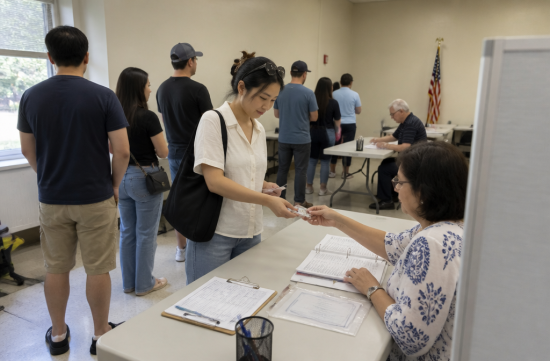
After the oath ceremony, I stepped out of the auditorium, and there was a long table for voter registration right at the entrance. It felt a bit surreal to be filling out the voter registration application just 10 minutes after receiving my certificate.
And this month, I finally cast my first vote. It turned out to be quite confusing, so I'll outline the steps for those who, like me, are facing their first election.
This Texas general election's Election Day is Tuesday, November 3. Polling places will be open from 7 AM to 7 PM.
The first thing to know is the registration deadline. In Texas, the deadline is 30 days before the election, so for this election, applications had to be received or postmarked by October 5.
Unfortunately, Texas does not allow same-day registration. If you missed the deadline, it's tough luck for this election, and it's best to register early for the next one.
Also, first-time registrants cannot register online. You must fill out a paper application and mail it to or deliver it in person to your county's voter registration office.
You can obtain the application at the county election office, post office, or places like libraries. I submitted mine right at the oath ceremony, which I found to be the most convenient method.
After registering, you'll receive a yellow card called a voter registration certificate in the mail. It usually arrives within 30 days after applying, but mine came quite late, which made me a bit anxious.
It turns out there were reports this year of delays in sending out cards statewide. They said it was due to redistricting and issues with the new registration system.
However, you can still vote without this card. The card is just for verification; what really matters is whether your name is on the registration list.
So don't wait for the card; check your registration status directly on the Texas Secretary of State's website. Just enter your name, date of birth, and county, and it will show up immediately.
Next is the ID requirement. Texas requires a photo ID, and there are seven types that are accepted.
These include a driver's license, state ID, election identification certificate (EIC), handgun license, military ID, U.S. passport, and a photo citizenship certificate. Most are valid for up to four years after expiration, and the citizenship certificate has no expiration.
Here's a point that immigrants should definitely check. If you're still using a temporary or limited-term driver's license from your permanent resident days, there's a note to bring your citizenship certificate along.
I hadn't changed my license yet, so I brought my certificate in a clear file. I ended up not needing it, but I would have been quite stressed without it.
If you genuinely cannot obtain a photo ID, you can fill out a Reasonable Impediment Declaration. In this case, you'll need to show supporting documents like a utility bill.
Now you just need to decide when to go. Early voting in Bexar County runs from October 19 to 30, and you can go to any early voting location within the county.
The main polling place, the South Presa Street election office, is open from 8 AM to 6 PM on weekdays during the first week, and from 7 AM to 7 PM during the second week. On Saturday the 24th, it's open from 7 AM to 7 PM, and on Sunday the 25th, from noon to 6 PM.
However, some locations may be closed on weekends, so be sure to check the county election office website for locations and hours before you go.
On Election Day, Bexar County does not have designated polling places. It's a county-wide voting center program, so you can go to any vote center, and you'll receive a ballot that matches your address.
Mail-in voting has strict eligibility requirements. You must be over 65, have a disability, or be absent from the county during the election period, and your application must arrive by October 23.
When you enter the polling place, you'll show your ID, find your name on the list, sign in, and go to the machine. It actually goes by pretty quickly.
The most surprising thing for me was the length of the ballot. It included federal, state, county, judicial, and school board races, along with local propositions.
Since 2020, Texas has eliminated the straight-ticket voting option, so you have to select each candidate individually. I highly recommend reviewing a sample ballot beforehand.
Using a cell phone is prohibited inside the polling place, so I took notes on paper to bring with me. This saved me a lot of time.
Honestly, I've heard complaints about the photo ID requirement being cumbersome, but I actually think it's reasonable. You have to show ID to open a bank account, and a vote carries more weight than that.
The democratic issues I memorized during my citizenship interview really hit home that day. The responsibility of choosing with my own hands felt greater than I expected.
If I were to do it, I'd check my registration status, verify my ID, review a sample ballot, and go during the first week of early voting on a weekday morning.
Your first vote only happens once. Don't get tired of the long lines, and prepare well so you can enjoy the experience.
 CocoHello







 choi family |

 What can make money? |

 road98 |

 Baguette Blog |

 Khan Film Blog Production |

 Make My Day |

 History Repeats Itself |

 Helpful Life Stories |

 USA Pharmacy Pharmacist |

 TEXAS Fishing Boat |
 koala organic farm |
 riverstone |
 My Antonio |
 California Information News |
 chilli chilli |
 Moon Su San |
 vanilla |
 norvexi |
 Lunch and Dinner Mexican Taco |
 skykong |
 My Circle |
 novapixel |
 urban legend |
 coolriver |
 Good Neighborhood, Wealthy District Information |
 Ro Ro Car |
 Amber H |
 new sugar |
 Palm 1000 |
 loran |