
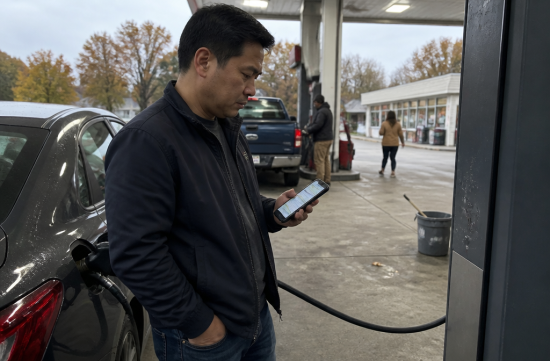
If you received a renewal notice this time, you might have paused at the numbers. Maryland's car insurance rates have once again ranked among the highest in the nation.
So today, let's keep the commentary brief and focus on what Baltimore drivers can actually do this month.
First, let's look at the numbers. According to Experian's 2026 report, Maryland's average annual full coverage rate exceeded $4,000, making it the highest among all 50 states.
In the same report, the national average was $2,926 per year, or $244 per month. This means Maryland drivers are paying over $1,000 more than the average.
However, rankings and amounts can vary significantly from study to study. NerdWallet estimated Maryland's average full coverage at $3,016 per year as of August 2026, while Insurify named Washington D.C. as the most expensive area, not the state itself.
The differences arise from the sample drivers and quote data used by each company. One thing is clear: no matter which report you look at, Maryland is consistently at the top.
Insurance rates in downtown Baltimore are even higher. According to Insurify's 2025 data, full coverage in Baltimore was $421 per month, while the state average was $292 per month during the same period.
This means that even within the same state, insurance rates can vary significantly based on just one ZIP code. If you're planning to move, be sure to get quotes for your new address before signing a contract.
Let's also address why it's so expensive. The state government insurance, MAIF, is the last resort for drivers who have been denied coverage elsewhere, but it has faced ongoing financial issues.
The Maryland Insurance Administration (MIA) ordered MAIF in December 2024 to raise its rates to a reasonable level within two years. MAIF has already requested a 13.8% increase effective January 2025.
In May 2025, Governor Moore signed HB 1098, which establishes capital standards for MAIF and creates a working group to study the issue of insurance affordability.
Personally, I believe this structural approach is necessary. If MAIF, the only option for low-income individuals, raises its rates, the number of uninsured drivers will increase, ultimately raising everyone's insurance rates again.
However, we can't just sit back and wait for the law to change. So what can you do? Here's the main point.
The first step is to pull out your insurance policy's Declarations page. You need to check line by line how much you're paying for each coverage to see what you can reduce.
The minimum requirements in Maryland are $30,000 for bodily injury per person, $60,000 per accident, and $15,000 for property damage. Additionally, PIP of $2,500 and uninsured motorist (UM) coverage are mandatory.
PIP can be waived in writing, but it's advisable to consider your health insurance situation before doing so. UM is a mandatory item and cannot be excluded.
The second step is to get quotes from at least three different companies under the same conditions. The MIA advises that you should compare with the same coverage limits and deductibles to see the actual savings.
According to NerdWallet's April 2026 analysis, Baltimore's liability insurance was found to be the cheapest at $1,960 per year with GEICO. Of course, this doesn't guarantee the same for your specific conditions, so you need to get your own quotes.
Many Korean Americans tend to stay with the same company for ten years, but loyalty doesn't always translate into discounts. Don't assume you're safe just because you've been with them for a long time.
The third step is to time your renewal strategically. The MIA identifies shopping for insurance before buying a car, adding a driver, and just before renewal as key times to look for better rates.
The fourth step is adjusting your deductible. If you have some emergency funds, you can raise the deductibles for collision and comprehensive coverage to lower your monthly premium.
The fifth step is to check for discounts. Make sure you're not missing out on bundling discounts with home or renter's insurance, telematics discounts based on driving habits, or safety device discounts by making a quick phone call.
Sometimes, group rates are available through company benefits, banks, or alumni associations. The MIA guide also mentions this route.
If you have a student driver in the family, ask about good student discounts. Each company has different criteria, so only those who inquire will receive the discount.
The sixth step is to evaluate whether full coverage is really necessary for an older car. If the collision insurance premium exceeds the car's market value by one to two years, it might be worth reconsidering.
If your insurance rates have increased unreasonably, you can file a complaint with the MIA. The insurance administration is responsible for reviewing whether rates are excessive or unfairly discriminatory.
Personally, I would check my policy this weekend, get three quotes next week, and make a decision by 30 days before renewal. For the time invested, the returns can be quite significant.
Finally, be careful not to cut coverage too much, as one accident could end up costing you more. The goal this renewal season is to be smart, not just cheap.
 TacoBellCandy





 forevergee |
 mortrix |
 cherrydino |
 victoria 68 |
 American Man in a Mask |
 maryland park |

 mygoddess blog |
 Information on All Regions of the United States |
 frostpup |
  citrus pop |
  Onion Ring |
  phoenixia |
  viewtop |
  loverun |
  Kim Do Sun |
  SEVEN SEVEN |
  yentra |
  Make My Day |
  Victory 1988 |
  Tonky |
  viroma |
  cookie |
  Live and that's it |
  Alright Twain |
  eatontown blog |
  HAWAII Korean Church News |
  Amore |
  linex |
  Balancework |