

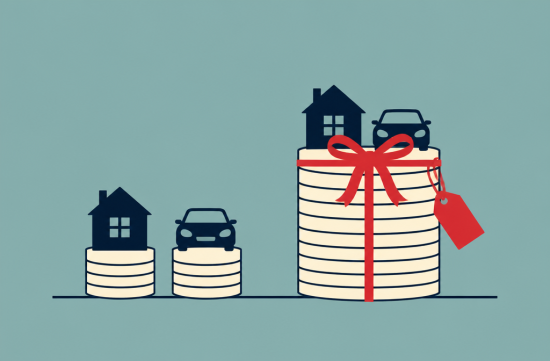
Last week, I received an email from an insurance company. "If you bundle your home and auto insurance, you can get a discount of up to several tens of percent." Honestly, at first, my eyes lit up. I had been sighing every time I looked at my insurance bill.
But I'm naturally skeptical. Is it really cheaper, or am I just falling for the word "discount"? So, I decided to investigate myself.
First, let's talk about what a bundle discount is. When you take out both home and auto insurance with the same company, they offer a multi-policy discount on one or both of them.
On average nationwide, this discount typically ranges from 10% to 25%. The big numbers you see in insurance ads are mostly based on "maximum" criteria, so you shouldn't take them at face value.
Louisiana is a bit different. The insurance premiums are so high that even the same percentage feels like a significant amount.
According to Experian's data from August 2026, the average auto insurance premium in Louisiana is $2,357 per year. For full coverage, it's about $3,322 annually, or $277 monthly.
Seeing this really left me speechless. That's enough money to buy several boxes of cherries.
When you add home insurance to that, the chunk that insurance takes out of your fixed costs becomes really large. That's why the bundle discount ads sound even sweeter.
So, how much can you save by bundling? Insurance.com has data comparing Louisiana rates from April 2026.
Here, State Farm showed a bundle discount rate of 18%, saving about $1,160. Farmers had a 14% discount, saving around $967.
Looking at just the numbers, it seems pretty good, right? However, there's a key point emphasized in the same data: bundling isn't always the cheapest option.
The reason is simple. Some companies have cheap auto insurance but expensive home insurance, and vice versa.
Let me give you an example. Let's say you're currently getting the cheapest home and auto insurance from different companies.
To make the math easy, let's use hypothetical numbers. Suppose your home insurance is $1,000 and your auto insurance is $1,200, making a total of $2,200.
But when you switch your home insurance to the auto insurance company, their base rate for home insurance is $1,500. With a total of $2,700 and a 15% bundle discount, it comes to $2,295.
Even with the discount, you're paying $95 more than before. If you don't look at how much the pre-discount price has increased, this can happen.
Even if the discount rate looks big, if the pre-discount base price is high, it doesn't mean anything. It's like a sale tag on an expensive bag. It says 30% off, but the original price was double.
The second trap is the fact that you're bundled. The moment you switch your home insurance elsewhere, you might lose the auto insurance discount as well.
This can lead to a situation where, even if the insurance premium slightly increases at renewal, you just leave it as is because it's a hassle. From the insurance company's perspective, it's good business because it makes it harder for customers to leave.
The third issue is renewal. There's no guarantee that the discount you received in the first year will remain the same in the following year, so you need to check your bill every year.
Fortunately, the home insurance market in Louisiana seems to be stabilizing a bit. According to state insurance department data, the average rate change was a 14% increase in 2023, but it has only been 0.1% so far in 2026.
That said, it hasn't dropped back to pre-hurricane levels, so comparisons are still essential. The time when the market shifts could actually be an opportunity to switch.
How do you compare? The Louisiana Department of Insurance has a tool called Shop Your Rates.
You can select conditions like home size, age, and driving experience to see approximate insurance rates by company. While it's not an exact quote, it's enough to get a sense of things.
Here's the order I've organized: First, write down the amounts you're currently paying for home and auto insurance separately.
Next, get bundle quotes and individual quotes from at least three different companies. The key is to compare only the final total amounts, not just the discount rates.
It's much easier to compare if you ask an independent agent who handles multiple insurance companies rather than an agent who only sells one company's products. Even if a few phone calls are a hassle, it's worth it for a year's worth of money.
Finally, make sure to check if the coverage details are the same. If the deductibles or hurricane deductibles are different, a cheaper option might not actually be cheaper. You might end up paying more out of pocket when an accident occurs.
If you've reinforced your roof or have security devices, be sure to ask about those discounts separately. You might miss out on other discounts while only focusing on the bundle discount.
I think I would get a bundle quote. But if the total isn't definitely cheaper than the individual combination, I wouldn't hesitate to go separately.
It's natural for everyone to be drawn in by the word "discount." Still, calculators are always on our side, and numbers don't lie.
There might be sweet traps hidden behind those enticing numbers. So today, let's choose carefully like a dinosaur and smartly like a cherry!
 BrainCTcity

 victoria 68 |
 American Man in a Mask |
 kuku 100 |
 novent |
 Silent Sea |
 ORAVEZIN Oppa |



 Eldorado 88 |
  cherrydino |
  garlic bread |
  middlekick |
  Moscow Kim |
  nivex85 |
  quanta7 |
  Tomato Health Club blog |
  horse |
  Egg Steamed Pot |
  Helpful Life Stories |
  UNI Lover |
  zen zeng |
  oh my salami |
  wendra |
  coloradoman |
  business life |
  candytip |
  churrotop |
  swiftlane |