

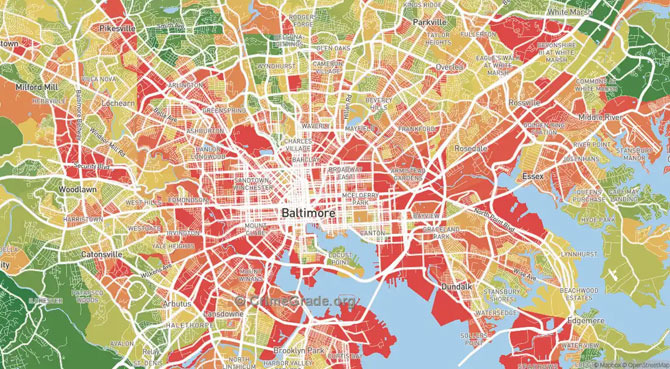
Baltimore has a chilling nickname: 'The Murder Capital of the United States'.
In fact, in 2015, there were over 350 murders in this city of just over 350,000 people. In terms of population ratio, it is much higher than New York or Chicago. On the surface, the harbor city's leisure and the unique charm of the East can be felt, but beneath that lies a serious safety issue.
Since the 1980s, as the industrial structure collapsed, jobs and taxes decreased, and the middle class moved to the suburbs, the downtown area rapidly became a slum. By the mid to late 1990s, drug trafficking and gang crime had become so severe that even the police hesitated to enter certain areas. The aftermath continues to this day, with safety in some neighborhoods still at a serious level.
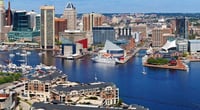
Thus, in Baltimore, the saying "Everything nice is surrounded by the hood" is widely known. For example, the Inner Harbor, a popular tourist destination, is filled with malls, aquariums, and hotels, brightly lit even at night, but just two blocks away, the atmosphere changes completely.
Between old brick buildings, broken windows are visible, the streets are sparsely populated, and tension flows in every alley. In fact, around the Johns Hopkins University campus, safety is strictly maintained, but just 2-3 blocks away, it is a completely different world. Even during the day, the atmosphere of the slums is thick, and at night, it is said to be dangerous for outsiders to walk around.
Locals particularly advise against acting suspiciously, such as looking around or taking out a camera. If you accidentally enter such an area, you should avoid eye contact, do not respond if called, and calmly return in the original direction as much as possible. The slums of Baltimore are not just 'poor neighborhoods' but are actually dangerous areas where gangs and drug organizations operate.
Since the 2000s, the city government has tried to restore safety through redevelopment and strengthening police forces, but the root causes of crime, such as poverty and educational disparities, have not easily disappeared. Interestingly, the safety map of Baltimore has changed over time. Before 2007, East Baltimore, particularly the Berea area, was known to be the most dangerous, but since the mid-2010s, West Baltimore, especially the Sandtown-Winchester area, has been identified as the center of safety instability.
This area gained attention in 2015 due to the 'Freddie Gray incident'. At that time, 25-year-old black youth Freddie Gray died from injuries sustained after being arrested by the police, leading to large-scale protests and riots against racial discrimination and police violence throughout Baltimore. Scenes of shops burning and vehicles overturning were reported in the news, and the world witnessed Baltimore's dark reality once again.
Since that incident, police reform and community programs have been promoted, but complete trust has not yet been restored. However, that does not mean that all of Baltimore is a dangerous city. During the day, tourists stroll around the Inner Harbor, families visit aquariums and museums, and students study in cafes near the campus.
However, one must not forget that the boundaries between safe and dangerous areas in this city are very close. A city where glamour and darkness coexist just a few blocks apart, that is the Baltimore of today.






 mygoddess blog |
 Information on All Regions of the United States |
 maryland park |

 frostpup |
  laro90 |
  MEDBIO American Doctor Blog |
  SWAT TEAM BLK |
  DREAM BIG |
  frostbite |
  330 Forever My Love |
  El Dorado |
  dralix58 |
  Gorama Round |
  Skydiving |
  dreamport |
  Yellow Snowman |
  Toaster Pizza Magic Show |
  velvetnom |
  Anytime Journey |
  Mrs. Duluth |
  jaxter |
  Atlanta Mama |
  Baguette Blog |
  Tan Sol |