

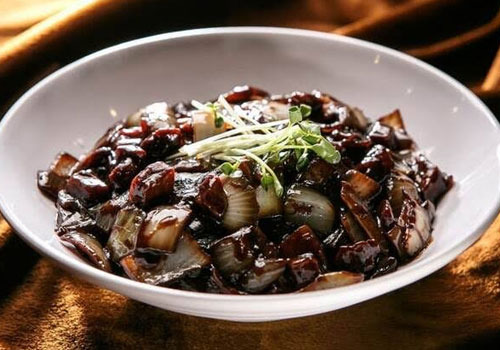
Strangely, whenever I plan to go to LA, there's a moment the day before when I suddenly crave jajangmyeon like crazy.
It's different from just being hungry. Once the thought of jajangmyeon enters my mind, other foods hardly catch my attention.
I think of the glossy black sauce and the noodles, the steam rising when I flip it with my chopsticks, and even a piece of pickled radish comes to mind.
So, after a 4-hour drive following Route 15 to my parents' house in LA, I end up taking my parents to a Chinese restaurant in the area.
While waiting for our order, I feel strangely happy. It's the thought that the jajangmyeon I've been craving will soon arrive.
I hear the sound of woks clashing in the kitchen and sneak glances at the food being served to other tables.
But the strange thing is that when the jajangmyeon finally arrives and I take a few bites, that intense happiness starts to fade away.
It's definitely delicious. The first bite is especially tasty.
But by the time I've eaten about half, the initial excitement is gone.
As I start to feel full, my pace slows down, and I wonder if I'm really the same person who craved jajangmyeon so much earlier.
This leads to an interesting thought.
Perhaps humans are happier when they think they will soon have something rather than when they actually possess it.
Travel is similar. The weeks spent waiting for the departure date after booking a trip are enjoyable.
I look up where to go, browse hotel photos, and search for good restaurants. The mental image of the trip is always perfect.
There's no rain, no flight delays, and the hotel room looks just like the pictures.
But when I actually go on the trip, it can be tiring. I have to wait at the airport, the weather might be hotter than expected, and the restaurant food may not meet my expectations.
This doesn't mean that travel isn't fun. It's just that imaginary trips don't have the inconveniences of reality.
The same goes for buying a new car or waiting for a new phone.
Before purchasing, I look at dozens of photos and read reviews. I think my life will change significantly once I have it. On the day of delivery, I keep checking the tracking.
But once I receive it and use it for a few days, it just becomes my item.
There seems to be a strange structure to human desire.
When what I want hasn't yet come into my hands, my imagination fills that void.
I create the best taste, the best trip, the best car in my mind, which don't exist in reality.
From the moment the actual item or experience arrives, the realm of imagination shrinks.
The same goes for jajangmyeon.
The jajangmyeon before eating is the most delicious jajangmyeon in the world.
Since I haven't tasted it yet, it can't be lacking in flavor, the noodles can't be overcooked, and the sauce can't be too sweet.
The memory of the best jajangmyeon I've had in the past combines with my current hunger to create a perfect jajangmyeon in my mind.
And that moment is happiness.
Philosophically, desire may generate more energy in the process of moving toward a destination than in arriving at it.
Because I haven't had it, I can anticipate it, and because I haven't arrived, I can imagine it.
Conversely, the moment desire is fulfilled, a small loss occurs.
There's no longer anything to wait for.
Ten minutes before the jajangmyeon arrives, the future of jajangmyeon still exists. When I pick up my first chopstick, that future becomes the present. After I finish eating, it becomes the past.
What we may regret is not the taste of the jajangmyeon, but rather that future that existed just moments ago.
So, it becomes strange to think of happiness as merely a result of possession.
It seems like buying a house will bring happiness, earning money will bring happiness, traveling will bring happiness, and achieving success will bring happiness.
Of course, those things can indeed improve life. But the human heart doesn't linger long at the destination. Once one thing is obtained, we quickly become accustomed to it and look toward the next.
Perhaps happiness is not just a result but also significantly resides in the anticipation of what is to come.
That evening when I plan to eat something delicious tomorrow, the moment I've booked a trip for next month, the time when something I wanted is on its way, or the moment I'm waiting to meet someone after a long time.
Nothing has happened yet, but we are already happy.
Thinking about it, a lot of happiness in life has been like this.
Perhaps happiness is not about the size of what we have, but rather the feeling that there is something worth waiting for tomorrow.
 Baconator
 CozyBreezeMan







 Study Abroad Life Know-How Tips |
 Best Frozen Yogurt |
 Mr Cleveland |
 solvix18 |
 RV Samuel's Dad |
 vegas mom |
 korvix |

 neroyo |
 US Legal Consultation on Trials |
  moname |
  mapleline |
  UNI Lover |
  Karina's Blog |
  California Dreamer |
  Choco Mint Creator |
  Chili Boy Club |
  NE Hodori Preik |
  Giant Squid and Sweet Potato Soup |
  torvik |
  charger |
  holy cheese |
  Pleasant K |
  Rolling Joy Life |
  lidus |
  French Macarons |
  Central Intelligence Agency Deputy Director |
  ATL Power 1 |
  MP Forever |