
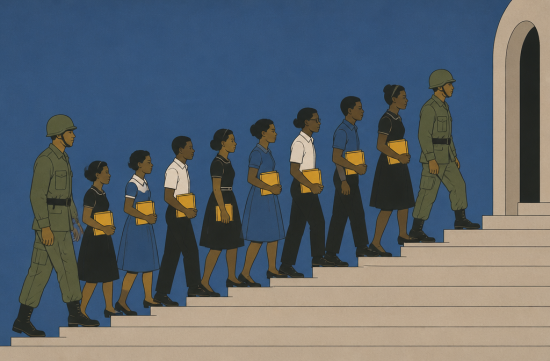
A fifteen-year-old girl stands alone in front of the school. Behind her, adults and peers are shouting and following her, while in front, armed National Guardsmen block the way.
This is a story about a photo taken on September 4, 1957, in front of Little Rock Central High School in Arkansas. I first learned about this incident through this photo rather than a single line in a textbook, and honestly, I couldn't move past it for a long time.
The student in the photo is Elizabeth Eckford. The reason she was alone is heartbreaking because it was so trivial.
Daisy Bates, the president of the NAACP Arkansas chapter, had changed the plan so that the students would attend school together, but Elizabeth's family didn't have a phone. She couldn't be contacted. So, she walked alone through that crowd.
Let's break it down. The Supreme Court ruled in the Brown case that racial segregation in public schools was unconstitutional in 1954. Three years had passed, but the situation remained unchanged.
When the Little Rock School Board decided to accept Black students at Central High School, Governor Orval Faubus appeared on TV just before the school year began on September 2, announcing that he would deploy the National Guard to prevent violence.
While he claimed it was to maintain order, the soldiers were actually blocking the students. On September 20, a federal judge ordered them to withdraw.
In fact, according to National Park Service records, ten students went to school on September 4. Among them, Jane Hill received death threats at home and, following her father's wishes, returned to her original school. That's why the number we know is nine.
On September 23, with the National Guard gone and only police remaining, the students finally entered the school. However, the crowd outside escalated to a riot level, and ultimately, the students had to be secretly evacuated that morning.
This is where President Eisenhower intervened. On September 24, he criticized the riots as shameful and ordered the deployment of the 101st Airborne Division, placing the Arkansas National Guard under federal command.
Then, on September 25, with 1,200 troops from the 101st Airborne Division mobilized, the nine students attended school under military escort. This was their first full day of classes. It took the military to attend a single class.
At this point, it seems like a happy ending. But the real struggle came afterward.
While the soldiers protected the entrance, they couldn't shield the students from the harassment in the hallways. They were kicked, shoved, and verbally abused in the bathrooms and locker rooms.
The nine students couldn't even attend the same classes or participate in extracurricular activities.
Minnijean Brown, unable to endure the bullying, fought back. She poured her lunch tray, containing chili, on two white male students, and after another altercation, she was expelled in February 1958. Ultimately, she moved to New York and graduated from high school there.
This part is the most bittersweet for me. The student who endured the bullying was the one expelled from school.
In May 1958, Ernest Green, the only senior among the nine, became the first Black graduate of Central High School. Martin Luther King Jr. attended that graduation ceremony.
The most surprising event came the following year. On September 12, 1958, when the Supreme Court ordered immediate integration, Faubus signed a related bill that very day. He closed all four high schools in Little Rock.
On the 27th of the same month, a local referendum overwhelmingly favored keeping the schools closed. The city chose to close schools rather than have Black students sit in the same classroom.
During this Lost Year, 3,665 students lost their schools. There were 2,915 white students and 750 Black students. They sacrificed their children's education to maintain discrimination.
The tide turned thanks to the citizens. In early May 1959, when the hardliners on the school board fired 44 teachers and staff, local women's groups and civic organizations initiated a recall campaign.
On May 25, three hardline board members were recalled, and in June, a federal court ruled the closures unconstitutional. The schools reopened on August 12.
I like this part. If the military opened the door, it was the votes of ordinary citizens that kept it from closing again.
There's also a backstory to the photo. Hazel Bryan, the white student who shouted at Elizabeth, later apologized, and in 1997, the two took a photo together in front of the school.
The recognition from the nation came quite late. Central High School was designated a national historic site on November 6, 1998, and received a Congressional Gold Medal at the White House on November 9, 1999. It took over 40 years.
You might wonder what this has to do with us. I believe it has a lot to do with us. The Immigration Act of 1965, which eliminated national origin quotas, emerged from the momentum of the civil rights movement, and the increase in Korean immigration occurred afterward.
Today, the reason we can send our children to public schools and protest against discrimination is largely thanks to those who walked those hallways first. So, I feel uncomfortable when I hear dismissive remarks about public education or diversity policies these days.
If you pass by, consider visiting the Central High National Historic Site. Since it's still an operating school, you can only see the interior through ranger tours, so check the time and reservations at nps.gov/chsc.
If you have children, it would be good to start by talking about the phone rather than just numbers or dates. That story is something kids can quickly understand. If it were me, I would start there.
 HyundaiKia
 PuddingFlyer


 Glow Yo |

 Michigan Enthusiast |
 xylora |
 Tan Zoo |

 hot chocolate |

 jondol |

 new sugar |


 Samttugi Grasshopper Noodle |

 Arkansas Kim |
 The Day the Sun Rises |
 citrus pop |
 DO Main TODAY |
 korvex93 |
 tacobunny |
 B.I.G. Victor |
 Conflite Teacher |
 cyvera80 |
 Springs Korea |
 Runner Kim |
 Physical Laws and Science |
 Lansinger |
 honey honey |
 dictionary |
 silverleaf |
 Bany T. |
 Korea Forever |
 wavey |
 Valley Bang |
 Enjoying Samba at Home |
 Goroke Geureoke News |