
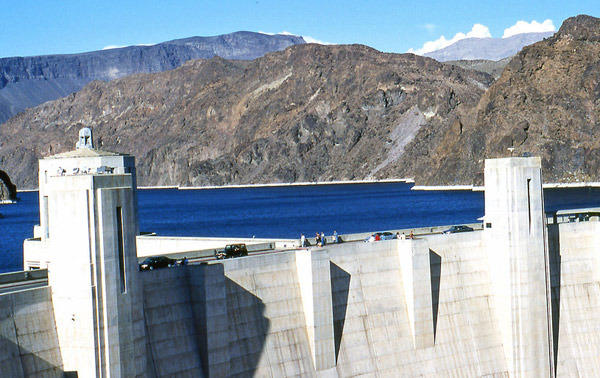
Located on the border of Nevada and Arizona, Hoover Dam is an important heritage of modern American history. Construction began in 1931 and was completed in 1936, making it a massive national project involving thousands of workers during the Great Depression, with the official dedication ceremony presided over by President Franklin Roosevelt on September 30, 1935.
Hoover Dam was built to block the flow of the Colorado River to prevent flooding and provide stable water and electricity to several western states. Initially named 'Boulder Dam,' it was later renamed 'Hoover Dam' after the 31st President Herbert Hoover. Due to its unprecedented scale for the technology of the time, it was referred to as 'a miracle made by humanity.'
It stands approximately 221 meters high and 379 meters long, and was recorded as the world's largest concrete structure at the time of its completion. The construction process was extremely challenging. Over an average of 5,000 workers labored daily for about five years, and a total of 96 workers lost their lives due to extreme heat and hazardous working conditions.
Working in the middle of the desert, summer temperatures often exceeded 45 degrees Celsius, and deaths occurred due to oxygen shortages in tunnels and heavy equipment accidents. Workers undertook the dangerous tasks of diverting the Colorado River and blasting rocks to stack concrete. Thanks to their sacrifices, the Hoover Dam we see today was completed.
The reservoir blocked by Hoover Dam is Lake Mead, which can store about 31 million acre-feet (approximately 38 cubic kilometers) of water at full capacity. However, in recent years, the reservoir levels have significantly decreased due to severe droughts and population growth in the western region.
As of 2022, the level had dropped to about 26% of its total capacity, and it still remains far below the average level. Hoover Dam generates electricity for parts of Nevada, Arizona, and California through hydropower, producing up to 2,080 megawatts (MW) of power at normal levels.
The electricity generated at this facility is distributed to the three states of Nevada, Arizona, and California, with about a quarter supplied to California. The Los Angeles Department of Water and Power (LADWP), Southern California Edison (SCE), and public power agencies like Burbank, Glendale, and Pasadena primarily use the electricity from Hoover Dam.
However, due to the declining water levels, the generation capacity has recently decreased to about 1,300 MW. If the water level falls below 950 feet above sea level, it will enter a 'dead pool' state, making power generation impossible. This could severely impact the western power grid and water supply systems, prompting experts to warn of the need for ongoing management.
The dam remains a popular tourist destination, attracting millions of visitors each year, located about 48 kilometers from Las Vegas. It is a popular day trip destination, reachable in about 40 minutes by car. Tourists can walk across the dam, experiencing the unique opportunity to stand on the border between Nevada and Arizona, and can also take tours of the internal power plant to observe the actual turbines and power generation process. Nearby is Boulder City, created as a residence for workers during construction, which has now transformed into a tourist spot with quaint shops and museums. Additionally, Lake Mead offers water recreation activities such as boat tours, kayaking, and fishing.
In summer, temperatures can exceed 40 degrees, so it is advisable to prepare sunscreen, hats, and plenty of water. Hoover Dam is not just a hydropower plant; it symbolizes an era when humanity attempted to control nature and serves as a warning sign for current climate change and environmental issues. The decline in reservoir levels is not merely an energy issue but a signal threatening the balance of the entire western ecosystem. Nevertheless, Hoover Dam remains a source of pride for America and a symbol of western civilization.




 Say IT Now |
 celion78 |
 neroyo |
 zanero |
 korvix |
  Tora Tora |
  yellowbutter |
  Dolly |
  US Embassy |
  NYC saladbar |
  Finding Superfoods |
  lightyear |
  song bang |
  vexomo |
  Indiana Jones |
  meloncat |
  novapixel |
  mortrix |
  Esther 1983 |
  fortbliss |
  Moscow Kim |
  My Two Way |
  toastyfox |
  FLORIDA Acus |
  tracker |