
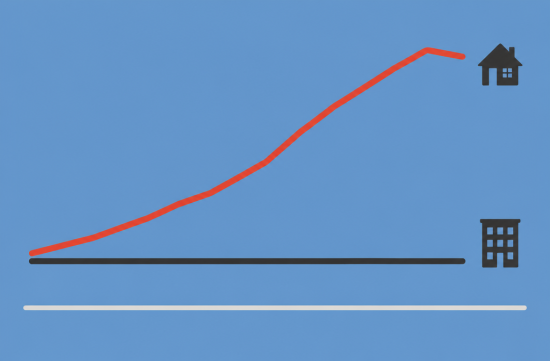
These days, the most common dilemma I hear is, "Should I rent more, or buy a house now?" In October, the key points for Sacramento show that rent remained steady while the burden increased on the interest rate side.
Let me clarify the reference point. The rent data for October is available, but the sales statistics I checked are from September, which is the most recent. I won't speculate on the October home prices as they have not been released yet.
According to the November report from Apartment List, the median rent in Sacramento for October is $1,666. This is a 0.1% increase from last month and a 0.9% decrease from a year ago.
A one-bedroom apartment averages $1,367, while a two-bedroom averages $1,727. The overall metro median is $1,754, which is higher than the city, and the year-over-year change is only -0.2%.
The data from Zumper on November 3 shows slightly different figures. The average for a one-bedroom is $1,495, which is the same as a year ago, and the two-bedroom is $1,828, down 1% from last year.
Since the methods of aggregation differ, we can't directly compare the amounts. However, both sources indicate a similar trend: stability or a slight decline.
When comparing the outskirts, the differences become apparent. According to Zumper, Elk Grove averages $2,600, which is down 3% from last year, while Roseville is also at $2,600, down 4%.
Forman is the only area that increased to $2,950, up 3%. Considering school districts, if you look at Elk Grove and Forman together, the difference is $350. Since the inventory varies, you should compare similar sizes.
If you're a tenant and receive a notice of rent increase, check the prices of new listings in the same complex. During periods of market stability, this number can serve as a basis for negotiation.
The annual increase cap under AB 1482 is the greater of 5% plus the local inflation rate, or a maximum of 10%. There are exceptions for buildings less than 15 years old, so check with your local tenant protection program to see if your home qualifies.
Now, let's move on to sales. According to the California Association of Realtors (C.A.R.) September statistics, the median price for single-family homes in Sacramento County is $555,000. This is a 1.1% increase from August and a 2.8% increase from a year ago.
Conversely, the transaction volume has decreased. It is down 1.8% from August and 2.7% from a year ago.
Inventory stands at 3.2 months, and the median time to sell is 28 days, which is the same as last September. The state overall has 3.7 months of inventory and 29 days, indicating a slightly tighter market.
Neighboring Placer County has a median price of $675,000, up 3.4%, while transactions have decreased by 5.6%. The price difference compared to Sacramento County is $120,000.
Signals from the asking prices are different. According to Realtor.com data posted on FRED, the median asking price for the county in September was $531,950, down 2.1% from a year ago.
Active listings have increased to 2,607, up from 2,460 a year ago. Inventory is rising while asking prices are falling.
Therefore, I do not interpret the 2.8% increase as a sign of strong home prices. The median can vary depending on which homes sold that month.
The real variable is the interest rate. The average 30-year fixed rate from Freddie Mac rose from 6.76% on September 10 to 7.40% on October 15, then slightly decreased to 7.24% on October 29. Last year on October 30, it was 6.17%.
Assuming a $555,000 home with a 20% down payment, borrowing $444,000 on a 30-year fixed mortgage, I calculated the payments. At 6.17%, the monthly payment is $2,711, and at 7.24%, it is $3,026.
That's a $315 difference for the same house. If calculated at 6.76%, the monthly payment is $2,883, meaning an additional $143 over the seven weeks. I even recalculated it myself.
It's hard to say that this shock is fully reflected in the September statistics. The C.A.R. also noted that the decrease in contracts in September suggests that transactions may slow further.
Now, let's compare rents. Zumper's two-bedroom at $1,828 and the above mortgage payment of $3,026 show a $1,198 difference. Even applying Proposition 13's basic tax rate of 1% would add $462 in property taxes monthly, plus insurance and repair costs separately.
Of course, you can't directly compare apartments and single-family homes. I recommend selecting one rental and one sale listing of the same size in your desired neighborhood to run this calculation.
It's not all bad news for buyers. In a time when inventory is increasing and asking prices are decreasing, there may be room to ask for seller credits. However, with only 3.2 months of inventory, buyers won't have the luxury of choosing freely.
For investors looking at rental income, the calculations are tighter. With rents stagnant and interest rates in the 7% range, large loans must be evaluated based on cash flow.
If I were planning to live for more than five years and could handle the monthly burden of 7% with my current income, I would start looking at properties. If I needed to increase my budget based on the assumption of falling rates, I would choose to rent for another year.
In the future, I will be looking at C.A.R.'s October county statistics, Freddie Mac's weekly rates, and the number of active listings. The calculations above are simple assumptions, so please verify with your loan officer based on your own conditions before making a decision.
 GrayPhone
 CrystalWave81








 silents |

 Choco Choco Star |

 gentle |
 neapolis |

 moo moo |

 Only Dentalbay |

 Grow Your Gut Bacteria Well |

 Tony Park |

 Physical Laws and Science |
 citrus pop |
 DO Main TODAY |
 korvex93 |
 tacobunny |
 B.I.G. Victor |
 Conflite Teacher |
 cyvera80 |
 Springs Korea |
 Runner Kim |
 Lansinger |
 honey honey |
 dictionary |
 silverleaf |
 Bany T. |
 Korea Forever |
 wavey |
 Valley Bang |
 Enjoying Samba at Home |
 Goroke Geureoke News |