
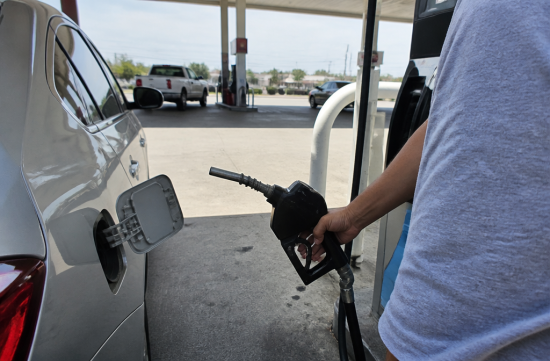
Last week, I was going through my gas app records and was a bit surprised. I had heard that gas prices were low, but my total gas expenses for the month were anything but cheap.
It's true that gas prices in Texas are low. According to AAA Texas data, the average price for regular gas in Texas was $3.93 per gallon in mid-September, and Houston had the lowest price among major cities surveyed at $3.83.
The state fuel tax in Texas is also just 20 cents per gallon. According to the state comptroller's office, it hasn't increased since October 1991, so there's a reason for the low prices.
However, even if the price per gallon is low, if there are leaks, your wallet will still feel lighter. I'll summarize three leaks I found through my own calculations.
The first leak is running the air conditioning while stuck in traffic. It's really hard to avoid this when driving in Houston.
According to a report from the Texas A&M Transportation Institute, Houston commuters wasted an average of 77 hours in traffic in 2024. This is the highest ever, up from 73 hours in 2023, and longer than the national average of 63 hours.
On top of that, there's the heat. According to the U.S. Department of Energy's fueleconomy.gov, using the air conditioning on very hot days can reduce the fuel economy of a typical vehicle by over 25%, especially during short trips.
I used to wait in the parking lot for 5 minutes with the engine running until the car cooled down. But that turned out to be the worst habit.
The Department of Energy recommends the opposite. They suggest keeping the air conditioning on and not idling, briefly opening the windows to let out the hot air, and then turning it on while driving. It cools down faster that way.
Repeatedly accelerating and braking in congested areas is also a problem. The same data shows that aggressive driving in stop-and-go traffic can reduce fuel economy by 10% to 40%.
So what can you do? Keep a safe distance from the car in front of you and practice lifting your foot off the accelerator instead of hitting the brakes. Just doing this can make a noticeable difference.
The second leak is speed on open freeways. When traffic is clear, it's tempting to speed up.
According to fueleconomy.gov, while it varies by vehicle, fuel economy often drops significantly once you exceed 50 miles per hour. For every 5 miles per hour over 50, fuel economy can decrease by more than 7%.
If you drive long stretches daily on roads like I-10 or Beltway 8, this difference adds up over the month. You might save a few minutes on arrival time, but you'll definitely use more gas.
Tire pressure is also related. Keeping the proper tire pressure can improve fuel economy by an average of 0.6%, and in some cases, up to 3%.
It may seem small when you look at the numbers. Still, it's an easy improvement to make, so there's no reason not to do it. The proper pressure is listed on the sticker inside the driver's door, so don't confuse it with the numbers on the tire sidewall.
The third leak is the choices you make at the gas pump. This is actually the easiest place to plug the leak, yet many people overlook it.
The most common mistake is putting premium gas in a car designed for regular. A 2016 AAA study found that using premium in vehicles designed for regular showed no significant improvement in horsepower, fuel economy, or emissions.
The same study estimated that American drivers spent over $2.1 billion on premium gas unnecessarily in a year. It's essentially paying extra for peace of mind.
Of course, if your vehicle manual states that premium is required, you should follow that. Just check whether it's recommended or required in the fuel cap or manual.
Choosing a gas station is also a habit. Even within the same neighborhood, gas prices can vary, so it's a good idea to compare nearby prices using a gas app before you head out.
However, it's not advisable to drive out of your way just to save a few cents. The gas you use to get there could exceed the savings. It's most practical to choose a station along your commute route.
You should also consider the payment method. Some gas stations charge different prices for cash and card due to credit card fees, and sometimes the cash price is prominently displayed.
Before you stand at the pump, check which price is being displayed. If the card rewards are less than the difference, paying with cash or a debit card might be better.
Grocery points can also add up. According to Kroger's official guidelines, you get a 10-cent discount per gallon for every 100 points, applicable up to 35 gallons per fill-up.
For example, if you use 100 points when filling up 15 gallons, you save $1.50. Since you earn points while grocery shopping, not using them is just losing money.
In summary, here's what you can do: turn off the engine while idling before you start, use cruise control on the freeway to maintain speed, and check your tire pressure once a month.
And when refueling, just remember to check for regular gas, compare cash and card prices, and apply points.
While we can't control gas prices themselves, we can definitely prevent leaks. I'm going to make sure to stop idling starting this month.
 TigerMilkFoam



 novent |
 Silent Sea |
 Pointy |
 Idaho's Sumi's House |
 holy cheese |
 4 Runner x100 |
 Premium Gas Camp |
 Texas Migration Story |

 Texas Real Estate Blog |
  Holy Cow |
  monster |
  houston mama |
  Reggae Party |
  Thou Thou |
  Tennessee Land |
  custardnew |
  Chimhanbang Korea ACU |
  See South Carolina |
  dorex |
  Taek Jun |
  Choi Cho |
  Anova US Beauty Information |
  whiskerbread |
  Yo Lock Me Up |
  pecantop |
  self-evaluation |
  |
|  stalion |
  anchor |