

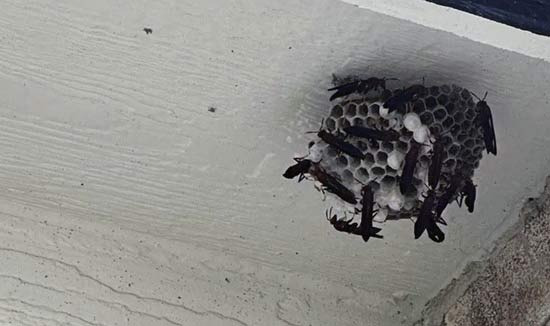
Living in Houston, it's normal to see lizards in the front yard and have a mosquito party when it rains, but one day I saw something round hanging above the entrance to the company warehouse and thought, 'What is that?' I got closer and was shocked.
It was a paper-like material close to cream color, divided into small rooms inside, and there were yellow-striped hornets flying around it.
It seemed to have grown to the size of a palm under the summer sun in Houston, and every time we opened and closed the warehouse door, they would fly around, causing the employees to start avoiding the warehouse altogether.
Honestly, at first, I had a moment of bravado thinking, 'I can handle this' with just a spray can in hand, but after watching hornet attack videos on YouTube, that courage disappeared completely.
So we started a strategy meeting.
Finish it off with spray when it's quiet. or call in a professional for safe removal.
Thinking about the cost, option one was tempting, but one employee strongly opposed it, saying they had been stung by a hornet before and their hand swelled up like a balloon.
Ultimately, we chose option two. I contacted a local bee removal service on the way home, and they said they could come the very next morning.
When the technician arrived, I was convinced that 'Ah... this is not something we should be doing' as I watched him put on goggles, gloves, and thick protective clothing.
As soon as he sprayed, the bees came pouring out, and without the protective gear, we would have probably been in serious trouble.
After about 30 minutes, the entire nest fell off, and inside were freshly hatched white larvae packed tightly.
I had heard that the warm climate in Houston makes it easy for nests to form, but seeing it with my own eyes made me understand why management is important.
After removal, I noticed holes around the entrance, so I sealed them with silicone and sprayed to prevent future infestations.
Peace returned to the employees' faces. Now, every time we open the warehouse door, we glance up once.
Once a nest forms, that spot becomes a target again, so I plan to keep an eye on it periodically in the future.
Now, if you see a small shadow above the entrance, don't just ignore it.




 moo moo |
 ultron78 |
 garlic bread |
 Sugar Cream Door Bulletproof Noodles |
 urbanmint |
 Things to know |
 U.S. Weather Bureau News |
 Texas Real Estate Blog |
 Premium Gas Camp |
 Texas Migration Story |
  Tonky |
  viroma |
  cookie |
  Live and that's it |
  Alright Twain |
  eatontown blog |
  HAWAII Korean Church News |
  Amore |
  linex |
  Balancework |
  laro90 |
  MEDBIO American Doctor Blog |
  SWAT TEAM BLK |
  DREAM BIG |
  frostbite |
  330 Forever My Love |
  El Dorado |
  dralix58 |
  Gorama Round |
  Skydiving |