
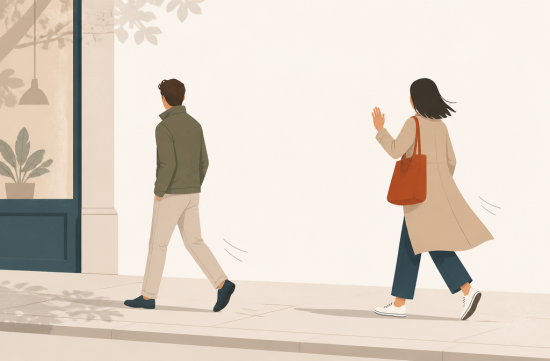
You may have heard the greeting "How are you?" while checking out at the grocery store or running into a neighbor on the street. When I first came to the U.S., I would prepare to answer this question sincerely.
However, just as I was about to respond, the other person would often be looking elsewhere or moving on. It felt rude at first, as they would ask the question but not wait for an answer.
Last week, a similar situation happened at a local café. The barista cheerfully asked how I was, but before I could respond, they were already taking the next order.
I stood there for a moment, realizing that this was a question that didn't require an answer. It's something I should be used to by now, yet it still feels a bit strange in those moments.
Upon reflection, this seems to be more of an American greeting habit rather than rudeness. "How are you" is often used more as a greeting than as an actual question.
Interestingly, this expression wasn't always a formal greeting. In the 1600s, the phrase "How do you do" was genuinely used to inquire about someone's health and well-being.
Over time, this question has evolved into a phrase that doesn't require a substantial response. Nowadays, it's more of a signal that acknowledges the other person, essentially meaning "I see you."
In linguistics, such expressions are referred to as phatic expressions. The anthropologist Bronisław Malinowski first introduced this concept in a paper in 1923, and later Roman Jakobson refined it in 1960 with his theory of language functions.
In essence, these greetings are not about exchanging information but rather serve as a means to maintain social connections between people. The goal is more about strengthening relationships than conveying content.
Interestingly, in the UK, the phrase "You alright?" serves a similar purpose. While the outward expression is different, it shares the characteristic of not expecting a significant response, much like American greetings.
Conversely, in Korea, it's more common to replace asking about well-being with a light nod or eye contact when greeting strangers. It seems that rather than one being better than the other, different societies have their own ways of signaling recognition.
Experiencing this culture has led me to think that the efficiency valued by Americans is reflected in their greetings as well. Even amidst a busy day, making eye contact and exchanging a brief greeting feels more friendly than skipping the greeting altogether.
Whether it's a store clerk or a hospital receptionist, that brief moment of asking how someone is can subtly soften the day. Even if they don't wait for a response, the act of asking carries a sense of care.
Of course, for those who are new to this country, there may be moments of awkwardness when they miss the timing to respond. However, now that I understand this brief greeting is not a mere formality but a form of kindness, I've learned to respond with a smile.
Among younger people, it may shift to more casual expressions like "What's up," but the expectation of not needing a response remains largely the same. Ultimately, even as generations change, the sentiment behind these greetings continues to resonate similarly.
In the end, it seems that the feeling behind the words at the moment of exchange is more important than the content of the words themselves. If someone passes by today and asks how you are, a light smile may be all that's needed instead of preparing a serious response.
 MaskMan



 Victory 1988 |
 Panorama Kstar |
 Giant Squid and Sweet Potato Soup |
 Lol Life |
 lavender |
 Questions about firearms while living in America |

 Colorado Lee |


 Springs Korea |
  nixon |
  mini hometown |
  Gleeee |
  MacMorningBlog |
  ASURA |
  Elastico |
  shaket |
  vionoo |
  chocolate |
  Whisper |
  Star Voyager |
  InDiGo |
  Rocky Mountains |
  Whoever It Is, I Don't Know |
  Why Not Me |
  Plastic Rose |
  Rice Shop Uncle BLOG |
  Gook Rule |