
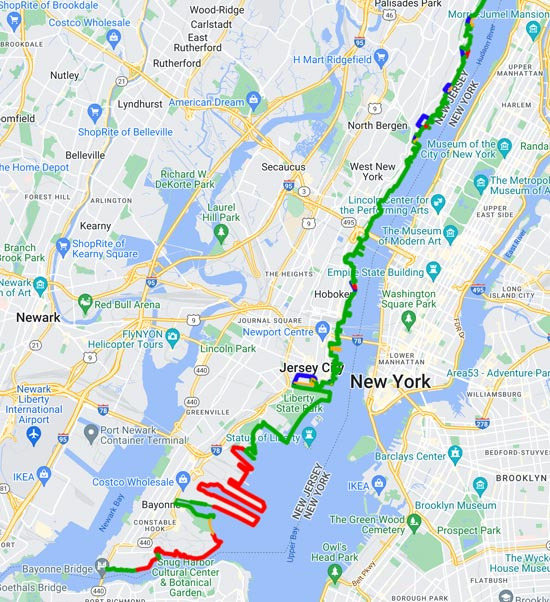
To understand the relationship between New Jersey and the Hudson River, you first need to take a good look at the map.
The Hudson River flows south along the center of New York State, cutting through Manhattan and New Jersey. That river becomes the boundary line between the two states. Simply put, the east of the Hudson River is New York, and the west is New Jersey.
Thus, cities at the eastern edge of New Jersey, such as Fort Lee, Jersey City, Hoboken, Weehawken, and Bayonne, all face Manhattan across the river.
This area is also famous for being the closest place to view the New York skyline. The George Washington Bridge, Lincoln Tunnel, and Holland Tunnel all pass above or below the Hudson River, connecting the two states. Thanks to this, the river has become not just a natural boundary but a passageway for life connecting New York and New Jersey.
Every day, hundreds of thousands of people cross this river for their commutes, and the cities formed along the river serve as satellite cities to New York. From the perspective of the Hudson River, New Jersey can feel like New York's backyard, but in reality, it is an independent living area. For example, people living in Fort Lee or Jersey City work in New York but are subject to New Jersey's housing and tax regulations.
This is one of the significant advantages of New Jersey. You can enjoy the economic opportunities of New York while also benefiting from relatively lower rent and a more spacious living environment. The river is not a symbol of division but rather a 'boundary of balance.' The Hudson River may seem like a symbol of New York, but it has played a very important role in New Jersey's history as well.
During the 18th-century War of Independence, the cliffs near Fort Lee were used as a strategic stronghold, and the river served as a route for ships transporting supplies. Now, the top of those cliffs has been developed into Palisades Interstate Park, a popular spot for citizens to walk and enjoy the scenery. The cliffs and parks along the river are also symbols of eastern New Jersey.
In fact, condos or apartments in New Jersey that have the term 'Waterfront' attached are mostly places where you can view the Hudson River. The real estate value in this area can vary significantly based on how well the Manhattan view is visible. The sight of lights from across the river coming through the windows becomes a premium feature. Additionally, the walkways and parks developed along the river provide residents with a spacious living environment.
Hoboken's Riverwalk and Jersey City's Exchange Place are bustling with people in the evening, and photographers line up to capture the New York skyline at sunset. The river is not just a natural boundary; it is a stage where the cultures and daily lives of the two states meet. Administratively, the Hudson River serves as the boundary line between New York and New Jersey, but it does not divide them exactly in the middle. Historically, the two states have long disputed which part of the river should be considered the boundary.
In an agreement made in the 1830s, it was decided that most of the river would be owned by New York State, but the western shore and some docks and facilities would be recognized as New Jersey's jurisdiction. Therefore, even today, Ellis Island and the Statue of Liberty, which float on the Hudson River, are geographically closer to New Jersey but administratively belong to New York. This unique boundary issue remains an interesting topic between the two states. However, for people, the 'connection of living areas' is more important than such legal distinctions.
For countless people who take the PATH train to Manhattan in the morning and return to their quiet homes in New Jersey after work, the Hudson River is not a boundary but a path of daily life. The view of the Manhattan skyline and the cliffs of New Jersey facing each other symbolically shows how these two states coexist.
Ultimately, the relationship between New Jersey and the Hudson River is a story of 'division' and 'connection.' The river divides the two states but also plays a role in uniting them. While New York has grown into a global city on the east side of the river, New Jersey has created a balance and leisure in life while looking at that city from the west.






 hoosierdaddy |
 Living in New Jersey blog |

 Uptown |
  US Embassy |
  Korean Mom |
  My NYC |
  moo moo |
  Mr Oh |
  forevergee |
  festival |
  manchester |
  constant |
  Leapfrog Move |
  vibranto |
  Tora Tora |
  yellowbutter |
  Dolly |
  NYC saladbar |
  Finding Superfoods |
  lightyear |
  song bang |
  vexomo |
  Indiana Jones |