
This morning, after finishing two cups of coffee, I finally started to feel like a person. While staring blankly at the café wall clock, a strange curiosity struck me.
Who decided the time that this clock is showing? I assumed it was the government, but it turns out that's not the case at all.
The first standard time zones in the United States were established not by Congress or the President, but by the railroads. This was 35 years before any related federal law was created.
Before 1883, the U.S. had different times for each town. This was because they used local solar time, which defined noon as the moment the sun was at its highest point in the sky.
The problem was that even a slight change in longitude could shift noon by several minutes. It was a world where you had to reset your clock when traveling to a neighboring city.
While this might not have mattered much when traveling by horse-drawn carriage, things changed when trains began crossing the continent. Each railroad company created schedules based on the time of their respective reference cities.
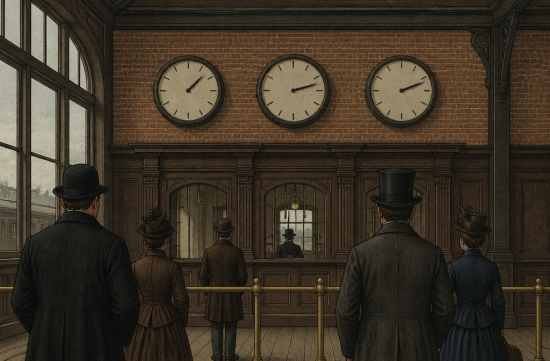
The best example of this confusion was the Buffalo train station, which reportedly had three clocks hanging inside.
One showed the time for New York City, used by the New York Central Railroad, another was for Ohio Columbus time for Lake Shore & Michigan Southern passengers, and the last one was for local Buffalo time.
To catch a transfer train, passengers had to check all three clocks and do some calculations. I would have probably just sat down there without my coffee.
Ultimately, the railroad companies took the initiative. On October 11, 1883, a coalition of railroad companies known as the General Time Convention met at the Grand Pacific Hotel in Chicago.
Just before that, on October 2, the Chicago Tribune reported that there were as many as 50 different time standards used by the railroads. It was more like a code than a timetable.
The proposal adopted at the meeting was from William F. Allen, the editor of the Traveler's Official Railway Guide. It suggested dividing the country into zones based on time differences from the Greenwich meridian at 75, 90, 105, and 120 degrees west.
These became what we now know as Eastern, Central, Mountain, and Pacific time zones. Including the Intercolonial for Eastern Canada, there were five zones in total.
Similar ideas had existed before. Educator Charles F. Dowd had proposed a standard time system for railroads, but his proposal was not adopted.
The D-day was Sunday, November 18, 1883. At the moment noon arrived in each zone, the clocks at the train stations were all reset simultaneously.
This day is referred to as the Day of Two Noons, as many cities experienced noon twice: once by the old local time and once by the new standard time.
Buffalo, being well west of the Eastern meridian at 75 degrees, had its solar noon occurring more than 15 minutes later than the standard noon. They effectively covered that discrepancy with one clock.
Here's the most surprising point: this was not a law but an agreement among the railroad companies, and within a year, 85% of cities in the U.S. and Canada voluntarily adopted it.
Of course, not everyone was pleased. The Indianapolis Sentinel published a sarcastic article saying that the sun could no longer command the work.
The most stubborn holdout was Detroit. In 1900, the city council ordered the clocks to be set back by 28 minutes, but half the citizens did not comply, leading to the order being rescinded.
Detroit officially entered the Central time zone after a public vote in 1905. The belief that the sun should determine time was that strong.
The government didn't officially step in until much later, on March 19, 1918. The Standard Time Act, also known as the Calder Act, was passed, incorporating standard time zones into federal law for the first time.
This law granted the Interstate Commerce Commission the authority to set and change time zone boundaries. Since this agency oversaw the railroads, it's clear where the starting point was.
The same law also introduced daylight saving time, which was abolished the following year in 1919. Only the standard time regulations remained.
Then in 1966, the Uniform Time Act standardized the operation of daylight saving time, and the current time zone boundaries are managed by the Department of Transportation. Isn't it interesting that time is still under the jurisdiction of the transportation department?
Knowing this story gives me a strange feeling. The time we've come to believe in as a natural law was actually a practical agreement made by companies trying to align train schedules.
However, it's not fair to say that the private sector was quick and the government was slow. The railroads laid the groundwork first, and the government solidified it into law 35 years later to ensure smooth operation.
Next time you see a train station or an old building clock, think about the fact that behind that hand lies the second noon of a Sunday in 1883.
As I finish this piece with my third cup in hand, I reflect that while the time zones may have been created by the railroads, my daily schedule is still dictated by espresso.
 TudariSmurf


 Anova US Beauty Information |
 anchor |
 Korea Tiger News |
 Alpha and Omega World |
 Florida King |
 Mr. Largo |

 chicpo |
 Delicious Food Finder |
 Banana |
 Belgray Miscellany |
  Sarah's Blog |
  Holy Cow |
  monster |
  houston mama |
  Reggae Party |
  Thou Thou |
  Tennessee Land |
  custardnew |
  Chimhanbang Korea ACU |
  See South Carolina |
  dorex |
  Taek Jun |
  Choi Cho |
  whiskerbread |
  Yo Lock Me Up |
  pecantop |
  self-evaluation |
  |
|  stalion |