
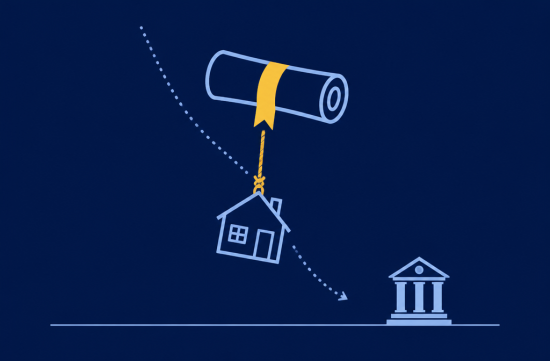
These days, the most common question I hear during consultations is this: 'The Fed didn't raise rates, so does that mean mortgage rates will go down?'
To put it simply, while the Fed's decisions and mortgage rates often move in the same direction, they are not one and the same.
Today, I will go through the numbers released after the October meeting and summarize how to interpret rates in November. The figures are based on the Fed's announcements, Freddie Mac's weekly survey, and data confirmed up to early November.
First, let's establish the facts. The Fed kept the target range for the federal funds rate at 3.75% to 4.00% during its meeting on October 27-28.
However, it wasn't unanimous. The presence of dissenting votes advocating for a rate hike was interpreted by the market as more significant than the freeze itself. This indicates that there are still considerable concerns about inflation within the Fed.
It's also important to understand the background. The Fed raised rates by 0.25 percentage points during its meeting on September 16, marking the first increase since 2023.
Thus, the October freeze should be viewed not as a 'signal for a decrease' but rather as a 'pause after a hike.'
So, what happened with actual mortgage rates? According to Freddie Mac's weekly survey, the average rate for a 30-year fixed mortgage was 7.40% on October 15.
It then dropped to 7.32% on October 22, 7.24% on October 29, and 7.18% on November 5, marking three consecutive weeks of decline.
In the same November 5 survey, the average rate for a 15-year fixed mortgage was reported at 6.57%.
This is a somewhat relieving trend. For those who were seeing rates at 7.4%, a drop of just over 0.2 percentage points is noticeable in monthly payments. However, considering that the 30-year fixed rate was 6.22% a year ago on November 6, 2025, it is still nearly 1 percentage point higher.
This is where many people get confused. The Fed raised rates in September and paused in October, so why did mortgage rates peak in mid-October?
The reason is that mortgage rates tend to follow the 10-year Treasury yield more closely than the federal funds rate.
Lending institutions set their rates by adding a certain spread, which is a margin over the 10-year yield.
The 10-year yield rose to 5.31% on October 5 but was reported to have dropped to 4.91% on November 2.
The decline in mortgage rates over three weeks can be seen as a reflection of this bond market trend. If you only look at the Fed meeting dates, you might miss this movement.
Having observed the market for nearly 20 years, I've noticed that the bond market often reacts before the federal funds rate moves, and mortgage rates tend to follow suit.
Therefore, I recommend checking three things when interpreting rates in November.
First, look at the trend of the 10-year Treasury yield rather than just the Fed's announcement date. If this number rises above 5%, mortgage rates will struggle to hold steady.
Second, consider the outlook for the December Fed meeting. Immediately after the October meeting, the market was reflecting a fairly high probability of an additional hike in December.
If the increase is already priced into the market, the actual impact on mortgage rates may be smaller than expected. Conversely, unexpected comments can cause significant fluctuations in a single day.
Third, remember that the average rates reported in the news may differ from the rate you receive. Surprisingly, many people overlook this and feel disappointed or reassured based solely on the article's numbers.
Freddie Mac's figures represent a weekly average, and even within the same week, different survey agencies may report slightly different numbers. Actual quotes depend on credit scores, down payments, and whether points are purchased.
So, what should those looking to buy a home do now? It's natural to wonder, 'Will rates drop to the 6% range if I wait a bit longer?'
To be honest, no one can pinpoint that timing accurately. Some experts believe rates could remain in the 7% range until 2027.
My advice is simple. If you find a home you like and can manage the monthly payments, base your decision on your budget rather than rate predictions.
Also, get quotes from at least two or three lenders on the same day for comparison. Don't just look at the rates; also consider the fees and points listed in the loan estimate. It's wise to ask about the rate lock period and extension costs as well.
If you've already locked in a rate in the mid-7% range, rather than rushing to refinance, calculate the costs and break-even points when rates drop significantly.
In summary, while the October freeze is good news, it's premature to conclude that it's a signal for a rate decrease.
By consistently monitoring the Freddie Mac figures released every Thursday and the 10-year Treasury yield, you can adequately read the market trends.
 MayoBike








 B.I.G. Victor |

 Amber H |

 uplifted |

 Dr. Kelso |

 silents |

 Macon Boy |

 H Leader |

 vivavida |

 Gouch Caps |

 Real Estate Investment Korean American |
 Good Hotels |
 heartwarming |
 Blogging with a Heart Like the Sun |
 peace |
 The Bread Lover Runs on Bread |
 yogurt 1 |
 Joyce 77 |
 The Yellow |
 bluebird |
 Epoca News |
 Samttugi Grasshopper Noodle |
 kansan55 |
 Skyline |
 Investment Information News Update |
 diamondo |
 Fairfax Fox |
 kuku 100 |
 US Embassy |
 Kims Spring |