
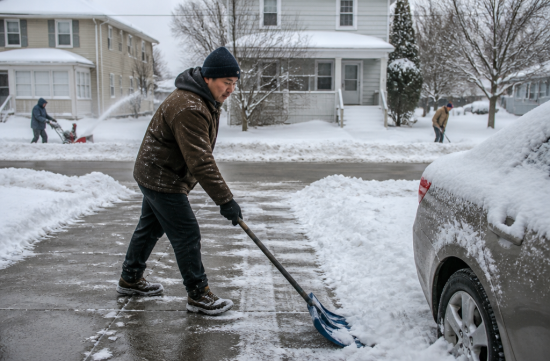
On a snowy morning, you have to go to work, but your car is buried in the driveway. The scene of grabbing a shovel and rushing out without even having a sip of coffee is something anyone who has experienced winter knows well.
However, this task is more dangerous than you might think. In November 2022, during a lake effect snowstorm, two men in Erie County died from heart issues while shoveling snow and operating snowplows.
At that time, County Executive Mark Poloncarz issued a warning to be careful. It's surprising to see people die from something we deal with every year.
According to Buffalo Airport data, the average annual snowfall from 1991 to 2020 is 95.4 inches. Heavy snow often comes from late November to early December, so now is the time to check your body and equipment.
So, how likely are injuries? A study published in the American Journal of Emergency Medicine in 2011 estimated that from 1990 to 2006, there were about 195,100 emergency room visits related to snow shoveling, averaging 11,500 per year.
The most common injuries occur in the lower back, accounting for 34.3% of all injuries.
In terms of causes, 53.9% were due to overexertion, while 20.0% were from slipping or falling. A staggering 95.6% of these incidents occurred at home or nearby.
The scariest factor is the heart. Although heart-related cases only accounted for 6.7%, all 1,647 recorded deaths came from this category.
The reason is simple. In experiments by heart expert Barry Franklin's research team, participants exceeded 85% of their maximum heart rate within just two minutes of shoveling snow. This surpasses the upper limits typically measured in exercise stress tests.
A 2025 analysis by Corewell Health reported even higher numbers. During 10 minutes of shoveling heavy snow, heart rates averaged 97% of the maximum measured on a treadmill.
There is also research from Quebec, Canada, covering 30 years of data. It found that men had a 16% higher chance of hospitalization for heart attacks and a 34% higher chance of death the day after a heavy snowfall, while no such increase was observed in women.
It's hard to say that snow shoveling alone is to blame. Still, for men, these numbers are hard to ignore.
The American Heart Association particularly warns certain groups to be cautious. This includes smokers and former smokers, those who are obese, have diabetes, high cholesterol, or high blood pressure. It also includes individuals who have experienced heart attacks or strokes.
If you have heart disease or risk factors, the association recommends letting someone else handle the shoveling. I tend to be frugal, but this is not an area to cut corners. When you compare the cost of hiring a snow removal service to a trip to the emergency room, the answer is clear.
If you don't exercise regularly or are on medication, consult with your doctor or pharmacist before the season starts.
Now, let's look at preparations before heading out. Warm up your body first, and avoid shoveling right before or after a large meal, as heavy meals put extra strain on the heart.
Avoid alcohol before and after as well. It can make you underestimate the strain that cold weather puts on your body.
The key to shoveling is to push rather than lift. The moment you lift heavy snow, your blood pressure spikes.
If you must lift, use a small shovel and take multiple small scoops. The desire to take a few big shovels and finish quickly is the most costly mistake. Taking breaks is also essential.
If it were me, I would wait until the snow stops before shoveling, doing it in sections. It may take longer, but it reduces the weight you lift at one time. Also, check the slippery ground before you start shoveling.
If you experience any of these symptoms, stop immediately: chest tightness, unusual shortness of breath, nausea, or cold sweats. Discomfort in the neck, arms, back, or jaw is also a warning sign.
If the symptoms don't subside after stopping, don't hesitate to call 911. Ignoring heart-related emergencies with thoughts like "I just need to rest a bit" can be the most dangerous mindset.
So, is using a snowblower the solution? While heart rates may rise less than with shoveling, it still poses risks.
According to the Consumer Product Safety Commission (CPSC), 6,000 people received emergency room treatment for snowblower injuries in 1995. Although this is an old figure, the warning about serious hand injuries, including finger amputations, remains relevant today.
The accident patterns are predictable. Wet snow can clog the machine, and people often put their hands in thinking the auger (the rotating blade that sucks in snow) has stopped. The CPSC explains that this is the most common scenario.
There is one rule: turn off the engine and use a long stick to clear the clog. Never put your hands inside.
Turning off the engine doesn't mean you're done. The clogged auger or impeller can suddenly spin when the snow clears. Even if you confirm that moving parts have stopped, continue using the stick.
Don't forget about carbon monoxide. Never run the engine in enclosed spaces like garages or sheds, as there have been fatalities. Always pull the machine outside before starting it.
Fill the gas tank outside before starting. Never add fuel to a running or hot engine. Also, avoid loose clothing near the machine.
In summary, my choice is simple: a small shovel, a stick, and an alarm set earlier than usual. These three items cost almost nothing and provide the best insurance, and being a little late for work is far cheaper than a trip to the emergency room.
 FilialFedor


 United States Army |

 premium |

 The Emperor Must Grow |

 squidogame |

 daddyyo |
 Darnignac |

 Holy Cow |

 Delicious Food Finder |


 American Golf Course Travelogue |

 See It |
 rockets |
 Smile Face |
 Polaris |
 Should we begin? |
 tarvion |
 kodak |
 Lifestyle Information Search USA |
 yenne |
 beerdreamer |
 Chino Min |
 ness 6 |
 Min's blog |
 American Politician Community |
 Sarah's Blog |
 james choi |
 solvix18 |
 Massachusetts |
 clouds 09 |
 Dr. Kelso |
 You Turn Me On |