
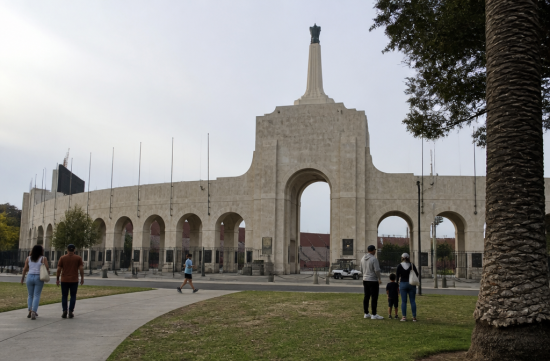
Honestly, when I first stood in front of the Coliseum, my reaction was, "Oh, it looks older than I expected?" But that old feeling is exactly the story of this stadium.
When the 2028 LA Olympics take place, the LA Memorial Coliseum will become the first venue in history to host the Summer Olympics three times: in 1932, 1984, and 2028.
It's quite crazy to think that one stadium will have hosted the Olympic stage three times over nearly 100 years. London and Paris have hosted the Olympics three times as cities, but not at the same stadium. Today, I'll unravel that story in order.
The story goes back to 1921. The Coliseum was originally planned as a memorial to honor LA soldiers who fought in World War I.
That's why the name includes Memorial. The first shovel was turned on December 21, 1921, and it was completed on May 1, 1923.
The design was done by John Parkinson and his son Donald Parkinson. It's quite surprising that they built it in just over 16 months by today's standards.
What's even more interesting is the timing. LA was selected as the host city for the 1932 Olympics on April 9, 1923, which was about a month before the stadium was completed.
So, they secured the Olympics based on a stadium that wasn't even finished yet. In today's terms, it was almost like a "trust us" level of betting.
During the 1932 Games, they even temporarily changed the name to Los Angeles Olympic Stadium. That shows how serious the entire city was about this event.
The problem was the timing. In 1932, the Great Depression was in full swing, making it a huge burden for European athletes to travel by boat across the continent to LA.
So, LA's idea was to create an athlete village. They built a village in Baldwin Hills for male athletes to stay together, which became the start of the Olympic Village concept.
Female athletes stayed at the Chapman Park Hotel on Wilshire Boulevard. It's quite satisfying to know that the concept of an athlete village originated in LA.
The medal podium also began to be used officially at this event. According to the LA84 Foundation, the audience numbered 1.25 million, and they even made a profit during the Great Depression.
Then, 52 years later, 1984 arrived. The atmosphere this time was the complete opposite of 1932.
Everyone saw how Montreal struggled with Olympic debt in 1976, so very few cities were willing to host the 1984 Games. Ultimately, LA was left standing alone.
The organizing committee chair, Peter Ueberroth, proposed a surprisingly simple idea: instead of building new venues, let's use existing ones.
At the center of this was the Coliseum. They brought back a stadium that had been used half a century earlier as the main stadium.
During the opening ceremony, the very same cauldron used in 1932 was lit. The person who lit it was Rafer Johnson, the decathlon gold medalist from the 1960 Rome Olympics.
Although countries from the Eastern Bloc, including the Soviet Union, boycotted the event, the result was a profit of over $200 million. Different sources report slightly varying amounts.
Out of that profit, $93 million was used to create the current LA84 Foundation, which continues to support youth sports programs and coaching education in Southern California.
Personally, I find this aspect the most appealing. Many cities end up with debt after hosting the Olympics, but LA has created a structure that benefits local kids.
Now, let's talk about 2028. According to the LA28 plan, the Coliseum will host athletics and Paralympic athletics events.
The opening ceremony will take place on July 14, 2028, split between the Coliseum and SoFi Stadium. It's a picture of the oldest stadium in LA opening alongside the newest one.
The closing ceremony will be held at the Coliseum on July 30, and the Paralympic closing ceremony will also take place at the Coliseum on August 27. Ultimately, the last farewell will be given by this historic stadium.
The schedule is also a bit unusual. Usually, swimming is in the first week and athletics in the second week, but LA28 has moved athletics to the first week.
This means that the Coliseum will set the tone for the early part of the competition. It's quite a significant role for a stadium that's over 100 years old.
To summarize, in 1932, a new model was created with the athlete village during the Great Depression, and in 1984, a model was shown that made a profit using existing facilities.
What kind of model the Coliseum will leave in 2028 is still unknown. However, I believe that this continuity is much more impressive than flashy new constructions.
If you happen to go to LA before 2028, try standing in front of the Coliseum. You might feel differently about why that old wall has been chosen three times.
 BasilaHouse


 Art patch |

 Rice Shop Uncle BLOG |
 Noodle Noodle |

 Chino Min |

 Glow Yo |

 Valley Hong |
 There Are Such Things in the World |

 Anjollinya Blog |

 Weekend Movie Blog |
 Good Hotels |
 heartwarming |
 Blogging with a Heart Like the Sun |
 peace |
 The Bread Lover Runs on Bread |
 yogurt 1 |
 Macon Boy |
 Joyce 77 |
 The Yellow |
 bluebird |
 Epoca News |
 Samttugi Grasshopper Noodle |
 kansan55 |
 Skyline |
 Investment Information News Update |
 diamondo |
 Fairfax Fox |
 kuku 100 |
 US Embassy |
 Kims Spring |