
When preparing for a job change, handling your 401(k) often gets pushed to the back burner. On your first day at the new company, while you're busy with benefits paperwork and setting up your workspace, it's common to leave your retirement account from your previous job untouched.
However, recent studies show that leaving these accounts unattended can lead to more than just a personal oversight. According to an analysis by the asset management firm Capitalize, there are 31.9 million abandoned 401(k) accounts across the U.S., holding a total of $2.13 trillion. With an average balance of $66,691 per account, this is not just someone else's problem.
The issue is that companies won't automatically manage these accounts for you. In fact, if the balance falls below a certain amount, the company may take the initiative to close the account themselves.
With the SECURE 2.0 Act amendment, the threshold for forced account closure has increased to $7,000. If the balance is below $1,000, a check will be sent directly, and if it's between $1,000 and $7,000, it will be automatically transferred to an IRA in your name.
These automatically transferred IRAs often sit as cash assets, yielding little to no investment returns. If you don't actively manage the transfer, they can remain dormant for years.
The real tax bomb detonates when you cash out the balance. If you withdraw from your 401(k) because you need cash during a job change, the IRS starts calculating taxes from that moment.
If you withdraw before age 59.5, you'll incur a 10% early withdrawal penalty in addition to federal income tax. For example, if someone in the 22% tax bracket withdraws $25,000, they will owe $5,500 in income tax and $2,500 in penalties, leaving them with only $17,000.
Even if you intend to do a rollover, choosing the wrong method can lead to similar pitfalls. A common example is the indirect rollover method, where the company issues a check made out to you.
In this case, the company withholds 20% of the total amount, sending you only 80% of the funds. If you had $300,000, $60,000 would go to the IRS upfront, and you would receive a check for $240,000.
However, the tax code requires that you deposit the entire original balance into a new account within 60 days. This means you must come up with the withheld $60,000 from another source to meet the 60-day deadline.
If you unknowingly only deposit the $240,000, the remaining $60,000 will be treated as a taxable withdrawal. If you also don't meet the age requirement, you could face an additional 10% penalty. While you can reclaim the withheld amount when you file your taxes, the cash being tied up in the meantime is a separate issue.
The 60-day deadline itself can be tighter than you think. If you miss it by even a day, the entire amount will be classified as ordinary income and taxed accordingly.
You also need to be cautious when designating a Roth IRA for your rollover account. Moving pre-tax balances to a Roth account is taxable in itself, meaning the entire amount will be counted as ordinary income for that year, potentially pushing you into a higher tax bracket.
However, there is one exception. If you leave your job in the year you turn 55, you can withdraw from that company's 401(k) without incurring the 10% early withdrawal penalty. However, you still need to account for income tax when filing.
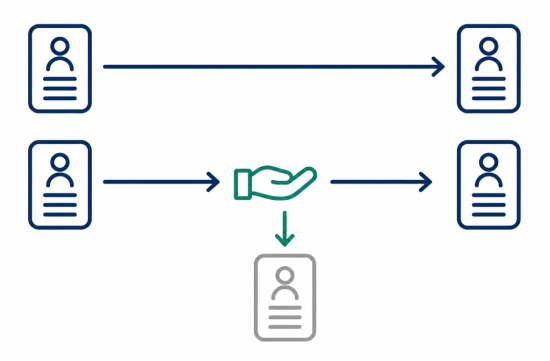
The surprisingly simple way to avoid all these traps is to request a direct rollover from your previous company's retirement plan department, allowing the funds to transfer directly to a new account or new 401(k) without passing through your hands, thus avoiding withholding altogether.
While you may be busy handling job change paperwork, I urge you to prioritize this on your to-do list. It's much better than regretting it later when you're stuck with your tax return.
 foxriverdreamer1982

 moname |
 mapsina |
 Mr. Largo |
 Victory 1988 |
 Infinite Style |
 Sayonara H |
 Epoca News |

 moo moo |

 An ant castle |
  Haha and Bomi Blog |
  glenview 89 |
  Valley Hong |
  novapixel |
  Idaho's Sumi's House |
  Mr. Midwest America |
  wildfire |
  legalway |
  postcard |
  cheesecake07 |
  My Miami Stories |
  windylotus |
  Mia Flori |
  velaro29 |
  velaro |
  foxtrot83 |
  mapleline |
  US Legal Consultation on Trials |