
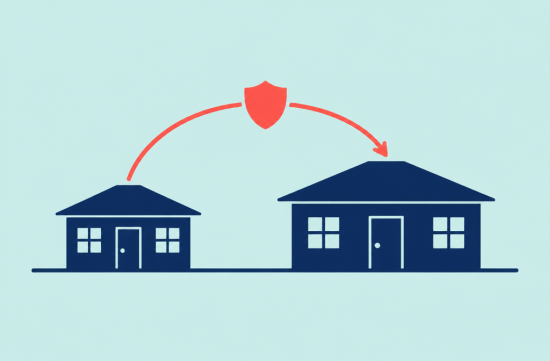
There's a common question among those looking to sell their home in Miami and move to another: Will property taxes skyrocket when moving to a new home?
To put it simply, if you are relocating your homestead within Florida, you can carry over a significant portion of the benefits you've accumulated. This system is known as portability.
First, let's discuss why this system is necessary. Florida limits the increase in assessed value for homes registered as homesteads to the lower of 3% per year or the previous year's CPI increase.
This mechanism is commonly referred to as the Save Our Homes cap. In areas where home values are rising quickly, the gap between market value and assessed value widens significantly.
Recent trends in the South Florida market show that older homes tend to have a much larger gap. The problem is that when you sell your home, that gap disappears.
New homes are reassessed based on their market value at the time of purchase. This is why even moving to a similar home in the same neighborhood can result in a drastically different tax bill.
Portability allows you to transfer that gap, or the difference between market value and assessed value, to your new homestead. The basis for this is Florida Statute 193.155(8), and the amount you can transfer is up to $500,000.
The calculation depends on whether your new home is more expensive or less expensive. It's easier to understand when you look at both scenarios side by side.
For example, let's say your current home has a market value of $600,000 and an assessed value of $350,000. In this case, the transferable difference is $250,000.
If your new home costs $800,000, you would subtract that $250,000 difference, starting your assessed value at $600,000. Upsizing to a larger home is that straightforward.
Conversely, if you're downsizing to a $400,000 home, the calculation is based on a ratio. You would multiply the old assessed value by the ratio of the new market value to the old market value, resulting in an assessed value of approximately $233,333 for the new home.
It's important to remember that when downsizing, only the proportionate benefit transfers, not the full amount. This is often overlooked by those moving to a smaller condo as they approach retirement.
There's also a time limit. You must have had your previous homestead on January 1 of one of the three years prior to applying for a new homestead on your new home.
In simple terms, you need to establish your new homestead within three years of selling your old home. This period used to be two years but has now been extended to three.
The most common mistake is assuming that portability is automatically applied. You must submit the DR-501T form separately along with your new homestead application.
The deadline is the same as for homestead applications, which is March 1. You can apply online through the Miami-Dade County Property Appraiser's website.
There's another variable to consider in the current situation. On the 3rd of this month, an amendment to significantly increase homestead exemptions passed with 62% approval in unofficial counts.
Since the requirement for passage was 60%, it comfortably exceeded that threshold. However, keep in mind that this is a preliminary figure before final certification.
According to the details, the homestead exemption excluding school taxes will increase to $150,000 in 2027 and $250,000 in 2028. Starting in 2029, it will be indexed to inflation.
However, individuals who settle in Florida after December 31, 2026, will initially only receive the existing exemption and will receive the increased exemption starting in their fifth year. This provision has also raised constitutional concerns.
If you meet the homestead requirements as a Florida resident by December 31 of this year, you will be eligible for the increased exemption immediately. In contrast, newcomers from other states will experience a delay in receiving the exemption and will not qualify for portability since they lack a history of Florida homestead.
Ultimately, existing residents who are moving within the state can benefit from both the increased exemption and portability. These two benefits are separate mechanisms and do not replace one another.
Reports indicate that the portability and Save Our Homes cap itself have not changed with this amendment. We will need to wait for next year's legislative session for detailed implementation regulations.
In summary, the longer you have held your existing homestead, the more valuable portability becomes. Conversely, if your holding period is short and the gap is small, the perceived benefit may be less significant.
If I were to move, I would first check the current market value and assessed value difference on the Property Appraiser's website before selling. That number represents the maximum benefit I can carry over.
Next, when determining the price range for my new home, I would calculate how taxes would change based on whether I'm upsizing or downsizing. If the numbers are unclear, contacting the Property Appraiser directly is the most accurate approach.
There are also situations where calculations become complicated, such as joint ownership or combining two homes. Since outcomes can vary based on individual circumstances, it's advisable to confirm with the Property Appraiser or a tax professional.
This is a market where tax burdens have increased alongside rising home prices. Just keeping track of the March 1 deadline can change the property taxes you pay each year, so if you have plans to move, it's good to keep this in mind.
 UdirTemper








 Dolly |

 B.I.G. Victor |

 Amber H |

 uplifted |

 Dr. Kelso |

 My Miami Stories |


 Komet Park |


 Valley Hong |
 Georgia Springcamp |
 myheart |
 Missouri Kings News Information |
 Going Once |
 monica hong |
 Tainami American Travel Story |
 tarve7 |
 Something is popping in the situation |
 chiobase |
 homan |
 The Yellow |
 love ya |
 virex |
 U.S. Weather Bureau News |
 korvex93 |
 nougatpop |
 milkyotter |
 sun walker |