

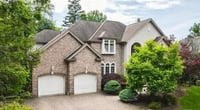
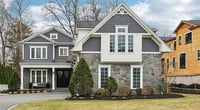
Let's say there is a family looking for a three-bedroom single-family home. They chose Closter due to their child's school, and their budget is tight. This month's question is simple: should they rent or buy?
To put it bluntly, based on the numbers alone, renting is more convenient right now. However, there are many caveats attached to the home price figures. Let's take a look at those caveats.
First, regarding rentals. According to data updated by Zumper on November 6, the average rent in Closter is $3,900.
This represents a 29% decrease compared to last year. At first glance, this is a surprising number. However, in the last 30 days, it has actually increased by 6%.
When broken down by bedroom count, the picture changes. A one-bedroom is $2,422, which is a 10% increase, while a two-bedroom is $3,645, reflecting a 17% increase.
Conversely, a three-bedroom is $4,495, which is a 7% decrease. A four-bedroom is $5,500, down 30%.
By housing type, apartments have risen to $3,100, a 20% increase, while single-family homes have decreased to $4,900, an 11% drop. Smaller homes are increasing while larger homes are decreasing.
Therefore, one should not take the overall average decrease of 29% at face value. Closter is a neighborhood with limited inventory, so the average can fluctuate significantly depending on what homes are on the market that month.
Within the Zumper page, there is also a listing for a two-bedroom apartment at $3,000, which differs from the $3,645 average. This level of discrepancy should be noted when reading the data.
Foreclosure.com reports that as of October 14, the median rent is $3,290, with no change from the previous year. The methodology for gathering this data differs, so it cannot be directly compared to Zumper's figures.
Looking at neighboring areas using the same Zumper October data, Emerson is at $3,900, Dumont at $3,648, New Milford at $3,000, and River Edge at $2,675.
Now, let's discuss home sales. Honestly, I have not yet found reliable public data for the median sales price in October. RealtyTrac's October figure shows $0, indicating that the data may still be incomplete.
Thus, I will use estimated market values. Foreclosure.com estimates the median home value as of October 14 to be $1,266,450, which is a 7.22% increase from the previous year.
Zillow's typical home value as of June 30 is $1,208,549, also a 7.2% increase from the previous year. Since the reference points are over three months apart, one should not simply combine these two figures to calculate the increase.
ATTOM reports that in the 07624 zip code, there were 102 transactions in the last 12 months, with a median of $1,244,500. However, the page does not specify the date range for those 12 months.
None of these figures represent actual October sales prices. Still, all three numbers cluster around the $1.2 million mark. The two sources that reported increases both indicate around 7%.
Now, regarding interest rates. As of November 5, Freddie Mac reports the average for a 30-year fixed mortgage at 7.18%. This is down from 7.40% on October 8 and 15, marking three consecutive weeks of decline.
However, this is still 0.96 percentage points higher than the same week last year, which was at 6.22%. The impact of this difference varies.
Returning to that family, let's assume they are looking at a $1.25 million home, putting down 20% and borrowing $1 million. I calculated that their principal and interest payment at 7.18% would be $6,774 per month.
If the rate were 6.22%, it would be $6,138. The difference in monthly payments due to the interest rate alone is $636. This is how much it has widened in just one year.
Compared to the average rent of $4,900 for a single-family home from Zumper, the principal and interest payment is $1,874 higher. This does not yet include property taxes and homeowners insurance. The opportunity cost of a $250,000 down payment is also not factored in.
Of course, if home prices rise, this calculation will change. The principal will also gradually accumulate. Therefore, I first ask how many years they plan to live there.
Regarding neighborhood issues, one must consider the zoning changes that occurred this year. The court has set the affordable housing obligation for Closter's fourth round at 16 units for current demand and 241 units for future demand, effective May 5, 2025.
Due to a shortage of vacant land, adjustments were made, and according to city ordinances, zoning must be changed to allow for 61 affordable units. This led to the adoption of Ordinance 2026:1383 on March 11, 2026.
The details are specific. It conditionally allows multi-family units in the Business Overlay Zone. A maximum of 14 units per acre is permitted, with townhouses requiring a minimum of 1 acre and apartments a minimum of 3 acres.
The height limit is 28 feet, up to 2.5 stories. In the 3A zone, commercial-residential mixed developments must allocate at least 20% of the total units as affordable.
This is not a building permit. I have not found any 2026 data indicating which projects have been approved. It is still too early to consider this as a factor that will affect rents or home prices.
However, if you are looking at homes near commercial zones, it is worth checking the planning board meeting minutes on the city website. Property taxes vary by home, so please obtain the actual assessed amounts for each listing to calculate accurately.
If I were in a position where I might move within five years, I would consider renting first to experience the neighborhood. Given that rental prices for larger homes have decreased, it is worth negotiating. If a long-term home becomes available, it would not be too late to reassess the interest rates then.
 builder90






 uplifted |
 Dr. Kelso |

 silents |
 Choco Choco Star |
 gentle |

 Glow Yo |

 secretmo |

 Anytime Journey |

 Amber H |
 eatontown blog |
 The Good Life |
 garlic bread |
 Western US Medical Student Association |
 American Food Information & Calories |
 Big North |
 babybay |
 Ford Kim |
 honda civic |
 whimsical |
 nova nova |
 figtop |
 Yahoo LALA |
 Korea News Economic News |
 calvor |
 timistic |
 Lee Sang Don |
 victoria jung |
 The Long Shot |
 Univ Student |